




Greenlane Announces Los Angeles to Las Vegas Truck Charging Corridor
Greelane has announced its first commercial EV charging corridor running 280 miles from Los Angeles to Las Vegas.

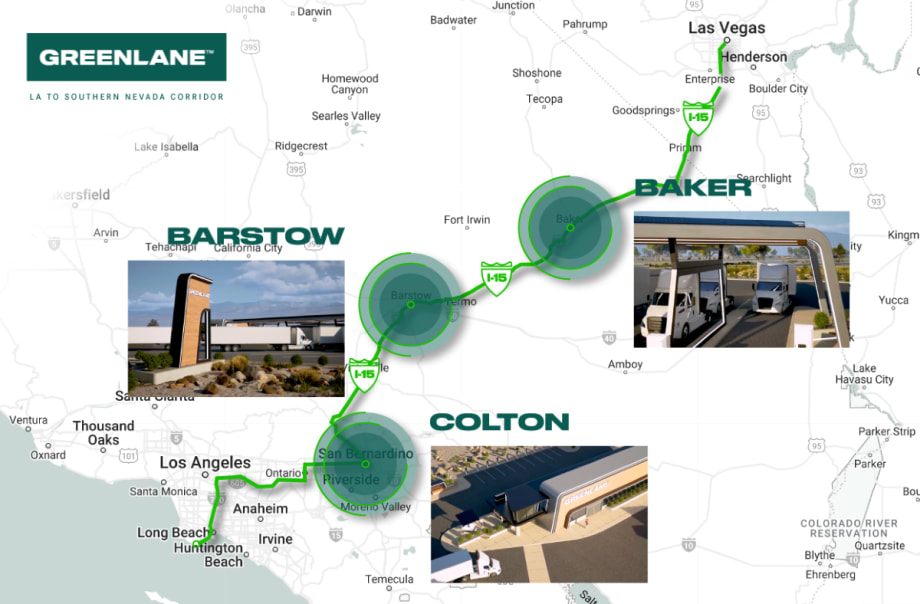
Greenlane's new charging corridor features more than 100 chargers and modern amenities designed to increase the comfort of drivers.
Photo: Greenlane
Greenlane has announced its first commercial EV charging corridor. The new charging corridor covers 280 miles from Los Angeles to Las Vegas.
Greenlane is a joint venture between Daimler Truck North America, NextEra Energy Resources, and BlackRock (through a fund managed by its Climate Infrastructure business).
100-Plus Chargers and Modern Amenities
The new charging corridor features more than 100 chargers, modern amenities designed to increase the comfort of drivers, resilience for high uptime and ultimately moving freight more efficiently.
Running along Interstate 15, the new Greenlane aims to accelerate the rollout of carbon-neutral freight transportation with the charging corridor. Key to that effort are initial charging locations in Colton, Barstow and Baker, California.
Over the next year, further locations will be added along the corridor, extending beyond Southern Nevada and to San Pedro in California, the company said.
“After considering various factors, such as truck telematics data, frequent freight routes and customer deployment strategy, the Greenlane team selected these three optimal locations for our first commercial charging corridor to accelerate the transition to zero emissions,” said Patrick Macdonald-King, CEO of Greenlane. “The launch of this corridor not only marks a critical step in addressing the urgent need for publicly available, nationwide electric charging for commercial vehicles but will also serve as a model for the EV charging hubs of the future.”
Overnight Charging on the Horizon
At full build, Greenlane said, the Colton site is planned to have over 60 chargers, including 400 kW Direct Current Fast Chargers (DCFC) to speed charging of medium- and heavy-duty zero-emission vehicles (ZEVs).
More 200 kW DCFC charging options onsite will enable long-duration and overnight charging for heavy-duty tractors, medium-duty ZEVs and school buses. Greenlane will also deploy multiple passenger car charging stalls to support light-duty and passenger vehicles.
Later project phases will support both long-duration and overnight charging lanes for tractor-trailer combinations. The Greenlane site in Colton will also be future proofed to accommodate the Megawatt Charging System (MCS) when commercially available.
"By using a predictive modeling tool to simulate truck traffic and energy flow at the site, we can determine how many chargers are necessary to meet the regional demand based on vehicle characteristics and departure and arrival times for vehicles hauling freight along this corridor," said Macdonald-King. "Our findings indicated that placing the three stations approximately 60 to 90 miles apart would maximize uptime for day-cab drivers by enabling shorter charging sessions at each stop and ultimately allowing customers to move freight confidently without any limitations."
Designed to upgrade and enhance the current rest stop experience, each Greenlane site will have wide pull-through lanes, allowing drivers to enter and exit the property quickly and easily. While waiting for vehicles to charge, drivers can access modern facilities, with restrooms and other amenities, including food and beverage options.
Greenlane said its goal is to develop a nationwide network of commercial charging infrastructure locations across the U.S. The charging sites will also serve battery-electric passenger car and light-duty fleet customers and are designed to provide hydrogen refueling for commercial vehicles in the coming years.
Located at the intersection of Interstates 10 and 215, the Colton hub will offer multiple ways for heavy, medium, and light-duty ZEV drivers to charge their vehicles.
Greenlane is targeting a spring groundbreaking on the Colton flagship site, aiming to open in late 2024.
More Fuel Smarts

How Volvo Updated Its D13 for EPA 2027 [Watch]
Volvo’s updated D13 promises lower emissions without sacrificing performance or fuel economy. Take a closer look at what changed inside the engine in this HDT Spotlight video.
Read More →
Diesel Price Spike Shortens Payback for Natural Gas Trucks, Report Says
Energy Vision estimates fleets could recover the higher purchase price of an RNG-fueled Class 8 tractor in 1.3 to 2.8 years under current fuel-price scenarios.
Read More →
Calstart Becomes Catalyst Mobility, Reflecting Broader Focus
Calstart is now Catalyst Mobility, reflecting the nonprofit’s growing national role in clean transportation, including zero-emission trucks, infrastructure and incentive programs.
Read More →

Record Diesel Prices Squeeze Trucking Fleets
Average U.S. diesel prices have climbed to nearly $6 a gallon, surpassing the 2022 record as tight refinery capacity and Middle East disruptions keep fuel costs elevated.
Read More →
How Fuel Delivery Shapes Engine Performance
Fuel delivery depends on more than what happens at the injector. For fleet, maintenance and technical professionals, looking at the full path from pump to injector can provide useful context for understanding engine performance.
Read More →
East Coast Port Launches $45M Electric Truck Push
The Port Authority of New York and New Jersey announced millions in incentives for zero-emission drayage trucks, yard tractors, and new charging hubs near the port.
Read More →
California Bill Could Shed Light on Electric Truck Prices
Why do battery-electric Class 8 trucks remain so expensive? A California bill headed to Gov. Gavin Newsom would give fleets and state agencies more visibility into what manufacturers charge.
Read More →
Detroit Opens Orders for EPA 2027 Engines
Detroit isn’t starting from scratch to meet EPA 2027 diesel emissions standards. Its Gen 6 DD13 and DD15 engines keep much of today’s platform while updating the fuel and aftertreatment systems.
Read More →
Zero-Emission Truck Corridor Planned for West Coast
California, Oregon, Washington, British Columbia and Baja California are coordinating plans for truck charging and hydrogen fueling from Canada to Mexico.
Read More →
A Closer Look at Kenworth’s Electric T880E Vocational Truck [Video]
Learn more about Kenworth's T880E battery-electric vocational truck at the Paccar Technical Center, including its range, applications, upfitting considerations, and PTO options, in this HDT Spotlight video.
Read More →