




FTR: Don't Look for Positive Trucking Conditions Again Until 2021
According to FTR’s projections for its Trucking Conditions Index, a combination of drastic declines in freight volumes, utilization, and rates due to the COVID-19 pandemic could lead to the worst overall trucking conditions on record during the second quarter of this year.

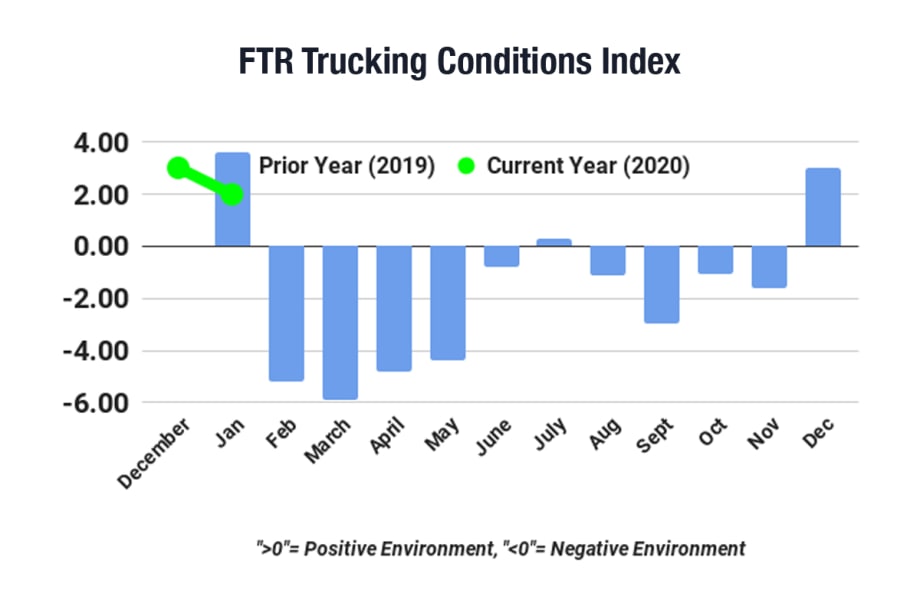
February’s TCI of 0.96 was down from January but still slightly positive, a continuation of three straight months.
Source: FTR
According to FTR’s projections for the Trucking Conditions Index, a combination of drastic declines in freight volumes, utilization, and rates due to the COVID-19 pandemic could lead to the worst overall trucking conditions on record during the second quarter of this year. While the forecast predicts the biggest drops in April and May, the current outlook is for the index to remain negative well into next year.
Although February’s TCI of 0.96 was down from January, it was still slightly positive, a continuation of three straight months. But that's the last month that will stay positive for a while, FTR says.
“Although trucking conditions might prove to be comparable to the worst of the Great Recession, the trucking industry – like the rest of the economy – has never seen such an abrupt deterioration,” said Avery Vise, vice president of trucking at FTR. “The need to restock grocery shelves provided a brief boost for some segments, but the economic shutdown now has taken a toll on the whole industry. While an economic restart likely will begin in May, the damage wrought during this period will weaken trucking conditions for months to come.”
FTR said in its April 17 report that it expects Gross Domestic Product (GDP) to plunge nearly 24% on quarter-over-quarter on a seasonally adjusted annual rate. The Labor Department on Thursday reported millions more first-time claims for unemployment benefits for the week ended April 11. Over the past four weeks, first-time unemployment claims have exceeded 22 million. The Federal Reserve released March figures on industrial production and manufacturing, which fell by 5.4% and 6.3% from February, respectively. These are the largest declines for both since early 1946, just after the end of World War II, FTR said.
The hit to retail and food service sales was even more severe, according to FTR – not surprising given that this was the sector of the economy that was first affected by social distancing. Total retail and food service sales plunged 8.7% from February and were down 6.2% year over year. Clothing and restaurants were down sharply, while food and beverage stores were up sharply. March residential construction data showed housing starts were down a "staggering" 22.3% from February, FTR said.
Due to the fluid and uncertain impact of the COVID-19 outbreak, FTR has been publishing an analysis that is available to the public, featuring:
April 16 update to the FTR Freight Outlook
An interactive heatmap reflecting how the COVID-19 crisis is affecting spot market rates and load volumes in trucking.
April 17 Weekly Transportation Update with information for all modes of transportation and economic outlook information.
April 16 webinar replay for The Outlook After Coronavirus.
Economic Outlook webinar replay and report with the forecast for the rest of the year and into 2021.
More Fleet Management

Color Match Smarter: Tools That Restore & Perform
For fleet managers and collision repair professionals keeping heavy-duty trucks on the road, getting the color right the first time isn't just about appearance — it's about efficiency, turnaround time, and bottom-line results. Discover how today's digital color tools are transforming the repair process from guesswork to precision.
Read More →
FMCSA Pauses Biennial-Update Enforcement Amid Motus Transition
Carriers whose updates were due on or after June 1 have more time, while FMCSA works to stabilize its new registration system and warns of phishing sites impersonating its new carrier registration system, Motus.
Read More →
2026 Blueprint for Countering Smarter Supply Chain Theft
Cargo theft is no longer just the cost of doing business. It's a multi-billion-dollar criminal enterprise exploiting vulnerabilities across your fleet, drivers, and supply chain.
Read More →


How Telematics Improves Visibility, Control, and Performance in Refrigerated Fleets
Explore how telematics help refrigerated fleets improve visibility, uptime, efficiency, compliance, and cargo protection across connected cold chain operations.
Read More →
What the U.S.-Canada Trade War Means for Trucking
Escalating U.S.-Canada tariffs could disrupt cross-border freight, reduce truck volumes, raise costs, and create new uncertainty for carriers on both sides of the border.
Read More →
What Are Trucking’s Top Concerns for 2026?
The American Transportation Research Institute wants to know what's worrying trucking fleet managers, drivers, and other stakeholders in its annual Industry Issues survey.
Read More →
American Trucking Associations Looks for a New Leader
ATA President and CEO Chris Spear abruptly left his job at the association on August 21, at a pivotal time for the trucking industry.
Read More →
Public Wi-Fi Cybersecurity Risks: How Truck Drivers and Fleets Can Protect Their Data
Public Wi-Fi can expose truck drivers and fleets to credential theft, malware, and other cyber threats. Here’s how to reduce the risk on the road.
Read More →
For Nicky Cupp, Fleet Innovation Starts With Frustration
HDT Truck Fleet Innovator Nicky Cupp turns everyday pain points at Fraley & Schilling into opportunities for better technology and smarter processes.
Read More →
Adam Buttgenbach’s Approach to Electric Trucks: Start With Where They Fit
HDT Truck Fleet Innovator Adam Buttgenbach helped PepsiCo build one of North America’s largest EV fleets by focusing on where electric trucks make operational sense.
Read More →