




FTR Conference: Expect 'Sauntering' Economy to Continue
"Sometimes growing stronger is also the next thing that leads to the next recession." Dr. Larry Davidson, professor emeritus of business economics and public policy at Indiana University’s Kelley School of Business, talked about "secular stagnation" at the FTR Transportation Conference.

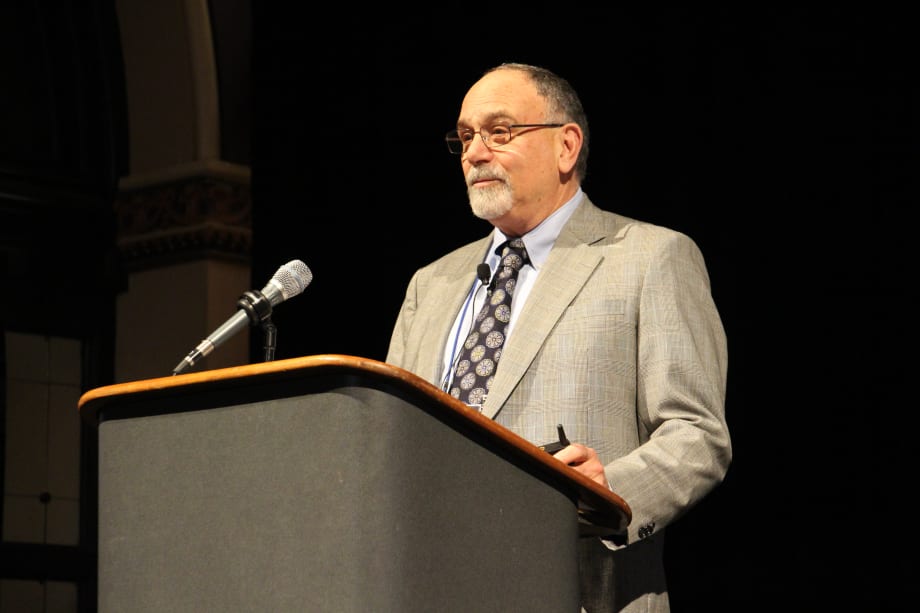
"Sometimes growing stronger is also the next thing that leads to the next recession," said Dr. Larry Davidson, professor emeritus of business economics and public policy at Indiana University’s Kelley School of Business. Photo: Evan Lockridge
"Sometimes growing stronger is also the next thing that leads to the next recession," said Dr. Larry Davidson, professor emeritus of business economics and public policy at Indiana University’s Kelley School of Business.Photo: Evan Lockridge
Both an optimistic and a slightly pessimistic view of the economy kicked off the annual FTR Transportation Conference in Indianapolis Wednesday morning.
“We seem to have taken on – lock, stock and barrel – a new story called secular stagnation,” said Dr. Larry Davidson, professor emeritus of business economics and public policy at Indiana University’s Kelley School of Business. “The story is this is the new economy, that we are going to have to put up with growth that’s like we’ve had recently.”
In other words, don’t expect the U.S. economy to pick up much steam over the annual growth that has been around 1.8% the past few years. Conversely, you shouldn’t have to worry much about it slamming on the brakes hard anytime soon, according to Davidson.
He presented a number of economic yardsticks, both positive and negative, including showing how gross domestic product growth in the U.S. has slowed compared to historically higher levels, for a pace Davidson described as “sauntering.”
While this may seem bad, it’s not, Davidson said. He pointed out that this slower pace of economic growth causes many to believe that a recession may be on the horizon. Yet the opposite is more likely true, he emphasized.
“One reason an economic recession happens is they come from shocks that no one anticipated,” he said. “It’s the economic environment conditions that are going to determine when the next recession comes.”
Such shocks can come from anywhere, he said, pointing as an example to the 1970s when the price of oil quadrupled in a very short time. For something more recent, think of the U.S. financial crisis, which hardly anyone expected, that resulted in the Great Recession.
While some economic indicators may be troublesome – such as reduced business investment, lower labor force participation, stagnant business productivity and an ever ballooning federal budget deficit – the U.S. and even the world are on the verge of many technological revolutions that are going to have long-lasting effects, much the same way the first cars and trucks have shaped the economy of today.
“We do want to get out of this secular stagnation. We do want things to grow stronger. But sometimes growing stronger is also the next thing that leads to the next recession,” Davidson said. “We should be confident this is a great country, with a great system with the flexibility to overcome any problems."
More Fleet Management

Color Match Smarter: Tools That Restore & Perform
For fleet managers and collision repair professionals keeping heavy-duty trucks on the road, getting the color right the first time isn't just about appearance — it's about efficiency, turnaround time, and bottom-line results. Discover how today's digital color tools are transforming the repair process from guesswork to precision.
Read More →
FMCSA Pauses Biennial-Update Enforcement Amid Motus Transition
Carriers whose updates were due on or after June 1 have more time, while FMCSA works to stabilize its new registration system and warns of phishing sites impersonating its new carrier registration system, Motus.
Read More →
2026 Blueprint for Countering Smarter Supply Chain Theft
Cargo theft is no longer just the cost of doing business. It's a multi-billion-dollar criminal enterprise exploiting vulnerabilities across your fleet, drivers, and supply chain.
Read More →


How Telematics Improves Visibility, Control, and Performance in Refrigerated Fleets
Explore how telematics help refrigerated fleets improve visibility, uptime, efficiency, compliance, and cargo protection across connected cold chain operations.
Read More →
What the U.S.-Canada Trade War Means for Trucking
Escalating U.S.-Canada tariffs could disrupt cross-border freight, reduce truck volumes, raise costs, and create new uncertainty for carriers on both sides of the border.
Read More →
What Are Trucking’s Top Concerns for 2026?
The American Transportation Research Institute wants to know what's worrying trucking fleet managers, drivers, and other stakeholders in its annual Industry Issues survey.
Read More →
American Trucking Associations Looks for a New Leader
ATA President and CEO Chris Spear abruptly left his job at the association on August 21, at a pivotal time for the trucking industry.
Read More →
Public Wi-Fi Cybersecurity Risks: How Truck Drivers and Fleets Can Protect Their Data
Public Wi-Fi can expose truck drivers and fleets to credential theft, malware, and other cyber threats. Here’s how to reduce the risk on the road.
Read More →
For Nicky Cupp, Fleet Innovation Starts With Frustration
HDT Truck Fleet Innovator Nicky Cupp turns everyday pain points at Fraley & Schilling into opportunities for better technology and smarter processes.
Read More →
Adam Buttgenbach’s Approach to Electric Trucks: Start With Where They Fit
HDT Truck Fleet Innovator Adam Buttgenbach helped PepsiCo build one of North America’s largest EV fleets by focusing on where electric trucks make operational sense.
Read More →