




Ford Unveils Walking Delivery Robot Concept Vehicle
Digit is an experimental, walking delivery robot, designed by Ford and Agility Robotics to work in conjunction with automated delivery vehicles.

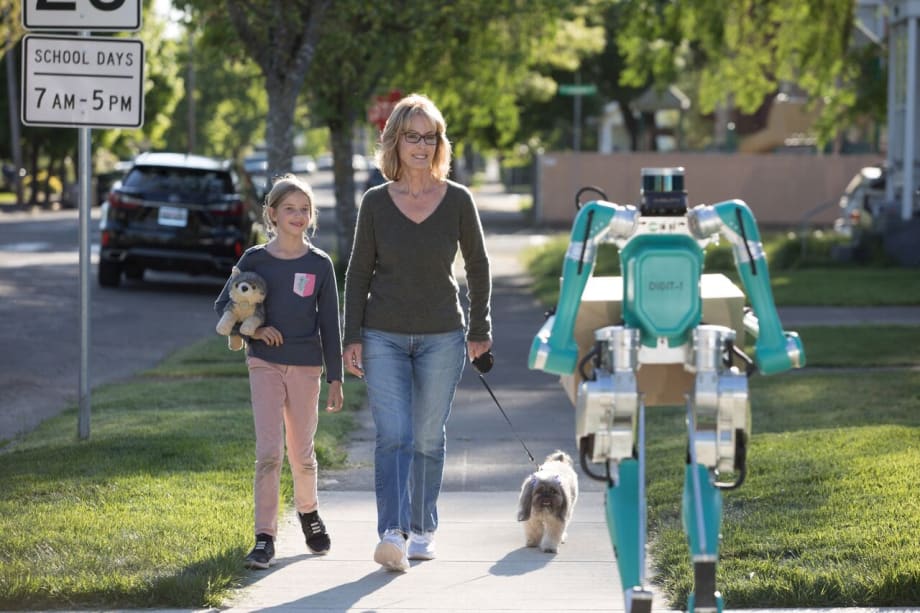
Ford and Ability Robotics designed the Digit delivery robot to be fully integrated with autonomous vehicle technology. When a self-driving vehicle brings Digit to its final destination, the vehicle can wirelessly deliver all the information it needs, including the best pathway to the front door.
Photo: Ford Motor Company
Ford Motor Company's latest innovation is a a two-legged robot designed and built by Agility Robotics called Digit that is designed to deliver packages of up to 40 pounds and is capable of navigating uneven terrain and stairs.
Ford was founded as a cutting-edge, technology leader and revolutionized the world, first with the introduction of the Model T — the first “everyman” car. Three decades later, derided as outdated and obsolete, the company reinvented itself and set the stage for the next generation of V8-powered cars that set the standard for American performance and styling for decades to come.
Many other “firsts” followed – from legendary trucks to Mustang pony cars to mid-sized SUVs, Ford has always seemed to have a knack for spotting a trend in its formative stages and designing vehicles that delivered it to the masses in ways no one could anticipate.
And it looks like Ford is up to its old tricks yet again, this time with the introduction of Digit, which is designed to not only approximate the look of a human, but to walk like one, too. Built out of lightweight material and capable of lifting packages that weigh up to 40 pounds, Digit can go up and down stairs, walk naturally through uneven terrain, and even react to things like being bumped without losing its balance and falling over.
Ford is teaming up with Agility Robotics to explore a brand-new frontier in the world of autonomy — and a new ways of thinking about how deliveries are made to consumers. The project takes on a mission that Ford engineers admit is surprisingly hard to do: Carry out the final step of getting a package from the vehicle that pulls up in front of a house to the front door.
The ability to walk comes so naturally to humans, that we take it granted, Ford engineers note. Then, again, if walking is so easy, why are humans the only species on the planet that can do so? Digit’s designers noted that gaining access to a customer’s door often requires walking through obstacles, including going up stairs and dealing with other challenges, which can be hard for robots with wheels to do since only about one percent of homes in the United States are wheelchair-accessible, according to the Department of Housing and Urban Development. Ford said Digit has been designed to walk upright without wasting energy, so it has no issue traversing the same types of environments most people do every day.
According to Ford, Digit’s unique design also allows it to tightly fold itself up for easy storage in the back of a self-driving vehicle until it’s called into action. Once a self-driving car arrives at its destination, Digit can be deployed to grab a package from the vehicle and carry out the final step in the delivery process.
Ford and Agility Robotics have also designed Digit with a hidden advantage to help it perform better as well. When the robot needs to function on its own, the desire to keep it lightweight and capable of dynamic movement led to an innovative idea: Letting it tap the resources of another robot — one that’s equipped with advanced sensors and heavy computing hardware — for additional support and analytical skills when needed.
A self-driving vehicle is capable of creating a detailed map of the surrounding environment, so Ford and Agility engineers asked themselves, why not share that data with Digit instead of having it recreate the same type of information? As a result of this “mothership-drone” concept, Ford designed Digit to be fully integrated with its autonomous vehicle technology. When a self-driving vehicle brings Digit to its final destination, the vehicle can wirelessly deliver all the information it needs, including the best pathway to the front door. Through this data exchange, Digit can work collaboratively with a vehicle to situate itself and begin making its delivery.
Outfitted with a LiDAR and a few stereo cameras, Digit itself has just enough sensory power to navigate through basic pedestrian scenarios, Ford said. If the robot encounters an unexpected obstacle, it can send an image back to the vehicle and have the vehicle calculate a solution. The car can even send that information into the cloud and request help from other systems to enable Digit to navigate, providing multiple levels of assistance that help keep the robot light and nimble. Digit’s light weight also helps ensure it has a long run time, which is essential for a self-driving delivery business that will be operating most of the day.
Ford’s Digit delivery robot is currently a prototype model in the testing and development phase. There is no word yet from the company as to if, or when, its Digit robot will be ready for commercial production and real-world deployment in delivery applications.
Related: Honeywell Debuts Robotic Unloader for Trucks and Trailers
More Fleet Management

Color Match Smarter: Tools That Restore & Perform
For fleet managers and collision repair professionals keeping heavy-duty trucks on the road, getting the color right the first time isn't just about appearance — it's about efficiency, turnaround time, and bottom-line results. Discover how today's digital color tools are transforming the repair process from guesswork to precision.
Read More →
FMCSA Pauses Biennial-Update Enforcement Amid Motus Transition
Carriers whose updates were due on or after June 1 have more time, while FMCSA works to stabilize its new registration system and warns of phishing sites impersonating its new carrier registration system, Motus.
Read More →
2026 Blueprint for Countering Smarter Supply Chain Theft
Cargo theft is no longer just the cost of doing business. It's a multi-billion-dollar criminal enterprise exploiting vulnerabilities across your fleet, drivers, and supply chain.
Read More →


How Telematics Improves Visibility, Control, and Performance in Refrigerated Fleets
Explore how telematics help refrigerated fleets improve visibility, uptime, efficiency, compliance, and cargo protection across connected cold chain operations.
Read More →
What the U.S.-Canada Trade War Means for Trucking
Escalating U.S.-Canada tariffs could disrupt cross-border freight, reduce truck volumes, raise costs, and create new uncertainty for carriers on both sides of the border.
Read More →
What Are Trucking’s Top Concerns for 2026?
The American Transportation Research Institute wants to know what's worrying trucking fleet managers, drivers, and other stakeholders in its annual Industry Issues survey.
Read More →
American Trucking Associations Looks for a New Leader
ATA President and CEO Chris Spear abruptly left his job at the association on August 21, at a pivotal time for the trucking industry.
Read More →
Public Wi-Fi Cybersecurity Risks: How Truck Drivers and Fleets Can Protect Their Data
Public Wi-Fi can expose truck drivers and fleets to credential theft, malware, and other cyber threats. Here’s how to reduce the risk on the road.
Read More →
For Nicky Cupp, Fleet Innovation Starts With Frustration
HDT Truck Fleet Innovator Nicky Cupp turns everyday pain points at Fraley & Schilling into opportunities for better technology and smarter processes.
Read More →
Adam Buttgenbach’s Approach to Electric Trucks: Start With Where They Fit
HDT Truck Fleet Innovator Adam Buttgenbach helped PepsiCo build one of North America’s largest EV fleets by focusing on where electric trucks make operational sense.
Read More →