





Related: The Dark Side of Autonomous Tech
Honeywell Debuts Robotic Unloader for Trucks and Trailers
Tech giant Honeywell announced a new automated robotic solution for unloading truck trailers and shipping containers at distribution centers.
April 8, 2019
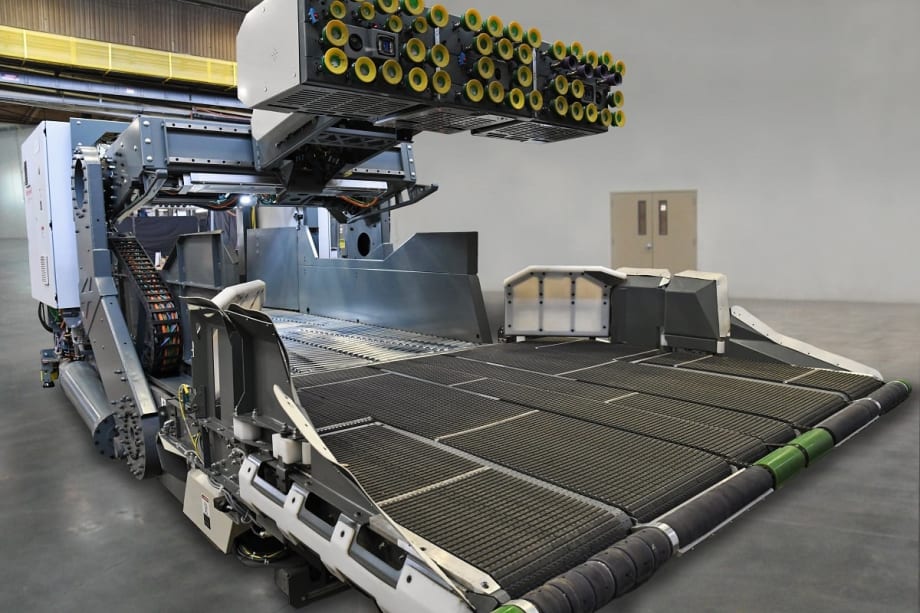
Tech giant Honeywell announced a new automated robotic solution for unloading truck trailers and shipping containers at distribution centers.
Photo courtesy Honeywell
2 min to read
Will robots unload your trucks one day? That’s the future according to tech giant Honeywell, which announced a new automated robotic solution for unloading a wide range of packages from truck trailers and shipping containers at distribution centers.
According to the company, the robotic unloader uses artificial intelligence to operate fully autonomously inside of a trailer, which significantly reduces the manual effort required to operate receiving docks for retail merchandise and parcel distribution centers. This new Honeywell Intelligrated smart robotics offering will help customers improve workplace safety, reduce staffing challenges and minimize damage to packages.
<>
"For distribution center workers, unloading packages is labor-intensive, physically demanding and injury-prone work that is often subject to extreme temperatures. These factors lead to low employee satisfaction and high turnover – as much as 36%, according to the U.S. Bureau of Labor Statistics," said Matt Wicks, vice president of product development at Honeywell Intelligrated, in a release. "With our robotic unloader, we are using advanced machine learning to allow workers to remove themselves from the extreme environment and to oversee multiple unloading machines, increasing productivity and improving safety."
Honeywell's new robotic unloader drives into a trailer or container and uses machine vision to identify various package shapes and sizes so it can determine the optimal approach to unloading. A robotic arm with a series of small suction cups conforms to the package shape to gently extract it from the stack. A conveyor below the arm can serve as a sweeper for packages to move them out of the trailer.
"In real-world applications, we are unloading a rate of up to 1,500 cases per hour and helping companies maximize throughput safely and efficiently," said Wicks. "We're working with Carnegie Mellon University to deploy advanced machine learning to expand the robotic capabilities with improved 3D vision, perception, processing power and gripping."
Unlike other unloading solutions, Honeywell said, its Intelligrated unloader is fully autonomous and is designed to work within existing fleets to eliminate the need for costly configurations or modifications to trailers or standard shipping containers. The unloader features patented gentle mechanisms to minimize package damage without impacting performance.
For nearly three decades, Honeywell Intelligrated has developed robotics solutions for warehousing operations and is a certified robot integrator by the Robotic Industries Association. In addition to its collaboration with Carnegie Mellon University's National Robotics Engineering Center, Honeywell Intelligrated is also combining efforts with Fetch Robotics to deploy autonomous mobile robots to distribution centers.
More Fleet Management

Sponsored•September 16, 2026
Color Match Smarter: Tools That Restore & Perform
For fleet managers and collision repair professionals keeping heavy-duty trucks on the road, getting the color right the first time isn't just about appearance — it's about efficiency, turnaround time, and bottom-line results. Discover how today's digital color tools are transforming the repair process from guesswork to precision.
Read More →
FMCSA Pauses Biennial-Update Enforcement Amid Motus Transition
Carriers whose updates were due on or after June 1 have more time, while FMCSA works to stabilize its new registration system and warns of phishing sites impersonating its new carrier registration system, Motus.
Read More →
Sponsored•September 14, 2026
2026 Blueprint for Countering Smarter Supply Chain Theft
Cargo theft is no longer just the cost of doing business. It's a multi-billion-dollar criminal enterprise exploiting vulnerabilities across your fleet, drivers, and supply chain.
Read More →


Sponsored•September 1, 2026
How Telematics Improves Visibility, Control, and Performance in Refrigerated Fleets
Explore how telematics help refrigerated fleets improve visibility, uptime, efficiency, compliance, and cargo protection across connected cold chain operations.
Read More →
What the U.S.-Canada Trade War Means for Trucking
Escalating U.S.-Canada tariffs could disrupt cross-border freight, reduce truck volumes, raise costs, and create new uncertainty for carriers on both sides of the border.
Read More →
What Are Trucking’s Top Concerns for 2026?
The American Transportation Research Institute wants to know what's worrying trucking fleet managers, drivers, and other stakeholders in its annual Industry Issues survey.
Read More →
American Trucking Associations Looks for a New Leader
ATA President and CEO Chris Spear abruptly left his job at the association on August 21, at a pivotal time for the trucking industry.
Read More →
Public Wi-Fi Cybersecurity Risks: How Truck Drivers and Fleets Can Protect Their Data
Public Wi-Fi can expose truck drivers and fleets to credential theft, malware, and other cyber threats. Here’s how to reduce the risk on the road.
Read More →
For Nicky Cupp, Fleet Innovation Starts With Frustration
HDT Truck Fleet Innovator Nicky Cupp turns everyday pain points at Fraley & Schilling into opportunities for better technology and smarter processes.
Read More →
Adam Buttgenbach’s Approach to Electric Trucks: Start With Where They Fit
HDT Truck Fleet Innovator Adam Buttgenbach helped PepsiCo build one of North America’s largest EV fleets by focusing on where electric trucks make operational sense.
Read More →