




Related: FMCSA May Reward Carriers for Going Beyond Safety Regs
FMCSA Proposes Changes to CSA
The Federal Motor Carrier Safety Administration Monday unveiled proposed changes to its Compliance, Safety, Accountability (CSA) program, including changing some intervention thresholds to better reflect crash risk.
by Staff
June 29, 2015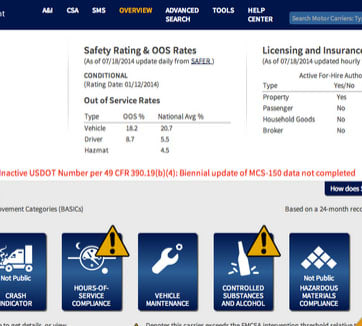
3 min to read
The Federal Motor Carrier Safety Administration Monday unveiled proposed changes to its Compliance, Safety, Accountability (CSA) program, including changing some intervention thresholds to better reflect crash risk.
The agency says its proposed enhancements to the Safety Measurement System (SMS) will improve its ability to prioritize and intervene with motor carriers that pose the greatest safety risk.
Changing Intervention Thresholds
The proposal would change some of the SMS Intervention Thresholds to better reflect the Behavior Analysis and Safety Improvement Categories’ (BASICs) correlation to crash risk.
As part of its SMS Effectiveness Test analysis, FMCSA analyzed the correlation of each BASIC with crash risk and introduced three levels of crash risk correlation:
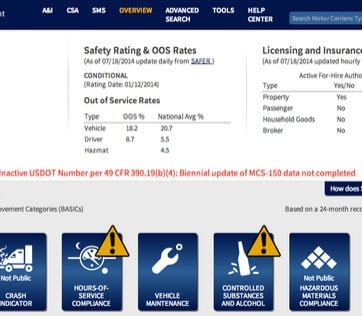
High: Unsafe Driving, Crash Indicator, Hours-of-Service (HOS) Compliance
Medium: Vehicle Maintenance
Low: Controlled Substances/Alcohol, HM Compliance, and Driver Fitness
The proposal would maintain the current intervention thresholds of 65% for the BASICs with the strongest relationship to crash risk -- Unsafe Driving, Crash Indicator, and HOS Compliance.
However, the Vehicle Maintenance Basic would drop from the current 80% threshhold to 75%, which the agency notes will identify a new set of motor carriers to receive warning letters so the agency can address non-compliance issues before crashes occur.
The Controlled Substances/Alcohol BASIC, the Hazmat Compliance BASIC and the Driver Fitness BASIC would rise from the current 80% to 90%, reflecting their lower correlation to crash risk.
Segmenting Hazmat Compliance
The proposal would segment the HM Compliance BASIC by cargo tank (CT) and non-CT carriers.
Industry and enforcement stakeholders raised concerns that large non-cargo-tank hazmat carriers have difficulty improving in the HM Compliance BASIC because they are being unfairly compared to cargo tank HM carriers.
FMCSA studied the feasibility of segmenting the HM Compliance BASIC by business type and found that for most motor carriers that operate cargo tanks, the cargo tanks make up a majority of the carrier's inspections. A carrier was categorized as a CT carrier if more than 50% of its inspections indicated the vehicles were CTs, and for most that percentage was actually much higher.
Non-CT HM and CT HM carriers have different operations and as a result they often receive different violations. After analyzing the issue carefully, FMCSA determined that segmenting the HM Compliance BASIC by CT and non-CT carriers will address this bias and improve the SMS's ability to identify HM carriers with serious safety problems.
Other changes
Other proposed changes to the SMS would:
Reclassify violations for operating while out-of-service (OOS) as under the Unsafe Driving BASIC, rather than the BASIC of the underlying OOS violation.
Increase the maximum Vehicle Miles Travelled used in the Utilization Factor to more accurately reflect operations of high-utilization carriers.
"These enhancements to SMS allow us to sharpen our focus on carriers with high crash rates, more effectively identify driver safety problems and hazardous materials carriers with serious safety problems, and more accurately account for carriers that are driving on our roads the most," said the agency on its website.
FMCSA encourages everyone to review and comment on the proposed SMS enhancements in the Federal Register Notice. The 30-day comment period will end on July 29, 2015. You can submit written comments on the proposed changes to the Federal Docket Management System, Docket ID Number FMCSA-2015-0149-0001.
After reviewing comments received, FMCSA will announce the preview of the proposed enhancements to SMS in a second Federal Register Notice. Submit your comments on the Federal Register Notice here.
More Safety & Compliance

FMCSA Pauses Biennial-Update Enforcement Amid Motus Transition
Carriers whose updates were due on or after June 1 have more time, while FMCSA works to stabilize its new registration system and warns of phishing sites impersonating its new carrier registration system, Motus.
Read More →
ZF Expands Commercial Vehicle Push in North America
ZF is expanding its North American commercial-vehicle presence with new transmission applications, electrification, trailer technology and autonomous-driving systems.
Read More →
Truck Drivers Need More Than Another Alert
Fleets have more visibility into truck health, safety events, and driver activity than ever. The next challenge is turning all that information into useful guidance for the person who has to decide what to do next.
Read More →
Tesla Wants a Self-Driving Semi. Are Cameras Enough?
Could Tesla’s camera-only autonomous driving technology work on an 80,000-pound Semi? In this commentary, HDT's Deborah Lockridge takes a look at Tesla, Cybercab, and how autonomous trucks see the road.
Read More →
What DOT’s Automated Vehicle Strategy Means for Trucking
The U.S. Department of Transportation issued a new automated-vehicle strategy that outlines plans for driverless-truck regulations, cross-state freight corridors, and federal safety standards.
Read More →
NYC Expands Speed, Pedestrian Safety Tech Across Fleet
New York City is expanding intelligent speed assistance and pedestrian-alert systems across its municipal fleet, moving the technologies from pilot programs into vehicle procurement and retrofit requirements.
Read More →
FMCSA Removes 110 Truck Driver Training Schools from Certified ELDT List
Federal regulators also are targeting more than 160 additional training providers and launching a nationwide audit of third-party CDL skills testers as part of a broader crackdown on trucking fraud.
Read More →
Beyond DOT Compliance: What Makes a Trucking Fleet Truly Safe?
A trucking fleet can follow every rule and still make unsafe decisions. The real test comes when safety conflicts with freight, productivity, or cost.
Read More →
Hours of Service Pilot Programs: FMCSA Readies for 2027 Rollout
Two pilot programs could eventually reshape hours-of-service rules, giving truck drivers options to pause their 14-hour clock or use longer split sleeper rest periods.
Read More →
New Guide Offers Pet Safety Tips for Truck Drivers
Hundreds of thousands of pets travel in truck cabs. A new safety guide from Volvo Trucks and the Center for Pet Safety offers practical advice for truck drivers who bring dogs and cats along for the ride.
Read More →