





HDT Talks Trucking Special Report:Are Autonomous Truck Ready for the Road?
FMCSA Denies Request for Longer Workdays for Autonomous-Truck Drivers
The Federal Motor Carrier Safety Administration denied an application from Pronto.ai requesting that drivers of its autonomous-tech trucks be allowed to operate longer hours than current hours-of-service regulations allow.
September 28, 2020
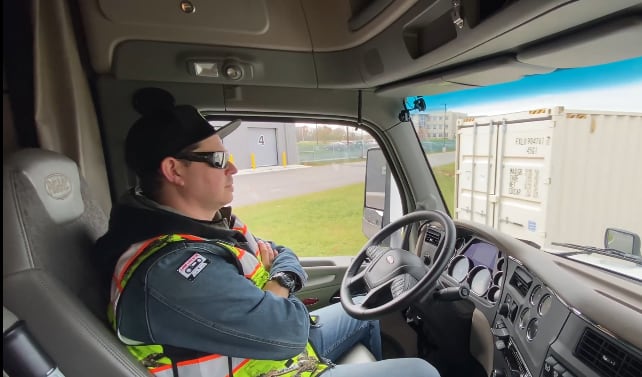
Pronto said its combination of advanced safety technologies would help reduce physical and mental driver stress, thereby allowing a modest increase in certain hours of service parameters.
Photo: Screen capture from VTTI video
4 min to read
The Federal Motor Carrier Safety Administration denied an application from Pronto.ai requesting that its drivers be allowed to operate longer hours than current hours-of-service regulations allow, saying there wasn’t enough data to prove there wouldn’t be an adverse impact on safety.
Pronto.ai asked for an exemption from the 11-hour driving limit and the prohibition against driving after the 14th hour after coming on duty. It asked that drivers of commercial motor vehicles equipped with the Copilot by Pronto advanced driver assistance systems, the SmartDrive Video Safety Program, and operating under certain other safeguards, be allowed to drive up to 13 hours during a work shift within 15 consecutive hours after coming on duty following 10 consecutive hours off duty.
FMCSA said that after analyzing the exemption application and the public comments, it “determined that the applicant has not demonstrated that the requested exemption would likely achieve a level of safety that is equivalent to, or greater than, the level that would be achieved absent the exemption.”
Pronto.ai is the autonomous tech company founded by Anthony Levandowski, who recently was sentenced to 18 months in prison for stealing trade secrets related to autonomous vehicles. Levandowski co-founded a self-driving truck enterprise called Otto after leaving his job in Google's Waymo autonomous vehicle program, using confidential information he took with him from Google. Levandowski stepped down from Pronto in the wake of his arrest last year and Robbie Miller took over as CEO.
Earlier this year, Virginia Tech Transportation Institute announced it will be working with Pronto.ai in a four-year study to provide the trucking industry, regulators, and the general public with practical guidelines for safely integrating automated driving systems into current fleets.
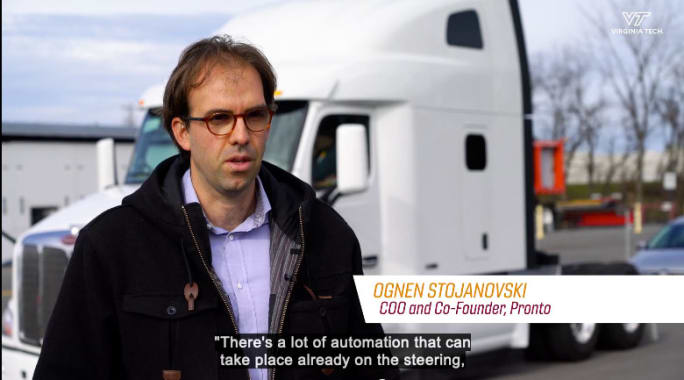
Pronto.ai is working with the Virginia Tech Transportation Institute to develop a roadmap for integrating highly automated vehicles into fleets.
Photo: Screen capture from VTTI video
Why an Hours-of-Service Exemption?
Pronto’s application contended that its combination of advanced safety technologies would help reduce physical and mental driver stress, thereby allowing a modest increase in certain HOS parameters.
In addition to the sophisticated ADAS system, Pronto cited its unique “Safe Landing” feature that identifies highly inattentive or non-responsive drivers, and attempts to safely and gradually bring the truck to a complete stop.
It also pointed to SmartDrive's fatigue-monitoring and alerting system, SmartSense, which provides real-time in-cab alerts to the driver and triggers a video for immediate verification and intervention by the carrier.
And the application cited Pronto's compulsory, full-day driver training program and the ability of SmartDrive's video safety platform to enable rapid identification of drivers needing additional training.
Nearly 300 commenters opposed the exemption request, including the Advocates for Highway and Auto Safety; the California Highway Patrol; the Commercial Vehicle Safety Alliance; the Insurance Institute for Highway Safety; the Teamsters union; the Owner-Operator Independent Driver's Association; the Truckload Carriers Association and others.
Commenters that opposed the exemption said the lack of safety metrics for ADAS poses a risk to the public. The commenters also noted the lack of a federal framework to ensure that any transition to automated driving system technologies is done in a measured, secure, and responsible manner. And some said that granting the exemption would give Pronto an unfair competitive advantage to carriers that use its product.
Six commenters supported the exemption request, including Scopelitis Transportation Consulting. Supporters believe the exemption would be in line with the recent HOS changes. Another point emphasized by a supporting commenter was that the agency could impose a list of conditions, if the exemption were granted, in addition to the conditions listed in Pronto's own application.
In its denial, FMCSA said, “Based on the numerous research studies concerning fatigue and hours of service that the agency has reviewed in recent years, we do not believe there is a basis for allowing individuals to drive up to 13 hours during a work shift, or operate after the 14th hour after coming on duty (except during adverse driving conditions). The premise that the use of advanced technology should reduce the workload on drivers appears reasonable on the surface, but the absence of data or information to quantify the impact on driver fatigue and alertness leaves the agency with no choice but to deny the application.”
More Safety & Compliance

From One Generation to the Next: How Mentorship Builds Safer Truck Drivers
After three decades in trucking, Harold Perry shares what he's learned about driver safety, mentorship, and helping the next generation build confidence behind the wheel.
Read More →
FMCSA Pauses Biennial-Update Enforcement Amid Motus Transition
Carriers whose updates were due on or after June 1 have more time, while FMCSA works to stabilize its new registration system and warns of phishing sites impersonating its new carrier registration system, Motus.
Read More →
ZF Expands Commercial Vehicle Push in North America
ZF is expanding its North American commercial-vehicle presence with new transmission applications, electrification, trailer technology and autonomous-driving systems.
Read More →
Truck Drivers Need More Than Another Alert
Fleets have more visibility into truck health, safety events, and driver activity than ever. The next challenge is turning all that information into useful guidance for the person who has to decide what to do next.
Read More →
Tesla Wants a Self-Driving Semi. Are Cameras Enough?
Could Tesla’s camera-only autonomous driving technology work on an 80,000-pound Semi? In this commentary, HDT's Deborah Lockridge takes a look at Tesla, Cybercab, and how autonomous trucks see the road.
Read More →
What DOT’s Automated Vehicle Strategy Means for Trucking
The U.S. Department of Transportation issued a new automated-vehicle strategy that outlines plans for driverless-truck regulations, cross-state freight corridors, and federal safety standards.
Read More →
NYC Expands Speed, Pedestrian Safety Tech Across Fleet
New York City is expanding intelligent speed assistance and pedestrian-alert systems across its municipal fleet, moving the technologies from pilot programs into vehicle procurement and retrofit requirements.
Read More →
FMCSA Removes 110 Truck Driver Training Schools from Certified ELDT List
Federal regulators also are targeting more than 160 additional training providers and launching a nationwide audit of third-party CDL skills testers as part of a broader crackdown on trucking fraud.
Read More →
Beyond DOT Compliance: What Makes a Trucking Fleet Truly Safe?
A trucking fleet can follow every rule and still make unsafe decisions. The real test comes when safety conflicts with freight, productivity, or cost.
Read More →
Hours of Service Pilot Programs: FMCSA Readies for 2027 Rollout
Two pilot programs could eventually reshape hours-of-service rules, giving truck drivers options to pause their 14-hour clock or use longer split sleeper rest periods.
Read More →