




FMCSA Chooses Strictest Electronic Recorder Option
The Federal Motor Carrier Safety Administration opted for the strictest approach it could take in its new requirement for electronic onboard recorders to track driver hours of service. The final rule announced today will affect nearly 5,700 trucking companies
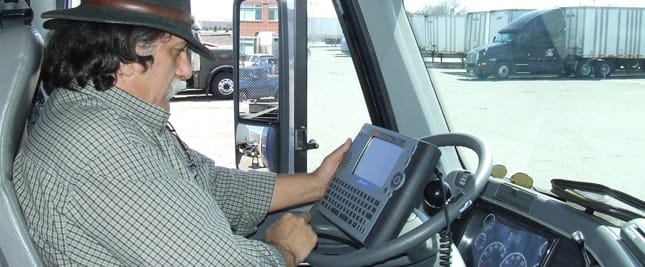
The new EOBR rule, which will go into effect June 1, 2012, says carriers that violate hours of service rules 10 percent of the time, based on single compliance review, must use electronic onboard recorders to track driver hours. (Photo by Kristin Ries)
The Federal Motor Carrier Safety Administration opted for the strictest approach it could take in its new requirement for electronic onboard recorders to track driver hours of service. The final rule announced today will affect nearly 5,700 trucking companies.
The rule, which will go into effect June 1, 2012, says carriers that violate hours of service rules 10 percent of the time, based on single compliance review, must use electronic onboard recorders to track driver hours. The lesser option would have been to target carriers based on two compliance reviews conducted within a 2-year period.
The stricter rule will affect close to 5,700 interstate carriers after its first year of implementation, compared to the approximately 1,000 carriers that would have been targeted under the lesser option.
Both groups of carriers have a crash rate that is significantly higher than the industry average, the agency said. Carriers that violate hours rules 10 percent of the time in two compliance reviews have a crash rate 90 percent higher than the general population. Those that break the 10 percent barrier in just one review have a rate that is 40 percent higher than the general population.
Carriers that violate the standard will have to install recorders on all of their trucks, regardless of when the truck was built, and use the recorders to track driver hours for at least two years. There will be an exception for carriers that install automatic onboard recorders before the compliance review finds them in violation.
Carriers that violate the standard but do not install recorders will not be allowed to operate in interstate commerce. For-hire carriers also risk losing their operating authority.
Going Further
The agency acknowledged that it is under pressure from Congress, the National Transportation Safety Board and numerous other interests to move to an even stricter mandate. It could not go farther in this rule due to procedural limitations, but it is going to start a new rulemaking proceeding to consider a significantly broader mandate, the agency said. As part of that proceeding the agency will look at how the growth in voluntary adoption of recorders is affecting the cost of the devices.
Meanwhile, the greatest safety benefit comes from mandating recorders for high-risk carriers, the agency said.
"We are committed to cracking down on carriers and drivers who put people on our roads and highways at risk," said Transportation Secretary Ray LaHood in a statement. "This gives us another tool to enforce hours of service restrictions on drivers who attempt to get around the rules."
Rule Requires Ties to Engine
The rule clarifies a key technical question: EOBRS will have to be integrally synchronized to the truck's engine. In the proposal leading up to this final rule the agency had considered allowing non-synchronized devices, such as wireless GPS systems, but ultimately decided that synchronization is necessary in order to ensure accuracy.
The rule also sets new performance standards for recorders. Recorders will have to automatically track the truck's location at each change of duty status and while the truck is in motion. They must comply with security requirements. Drivers will be able to add information to the record but the device must keep the original information as well as the annotations. And, the device must provide a digital file for safety enforcement officials to read.
The information recorded must include the driver's name, duty status including on-duty/not driving, driving time, sleeper berth and off-duty, as well as the date, time, truck location and distance traveled. Recorders will have to use global positioning technology or another tracking system.
The carriers that already use recorders may keep using them through the life of the truck. Recorders installed in trucks built starting in April 2012, will have to meet the new standards.
And as an incentive to promote voluntary use, the agency will no longer require supporting documents related to driving time, such as toll receipts, for carriers that install recorders. Also, carriers that use recorders will get more liberal compliance review procedures.
More Drivers

Platform Science Adds Dispatch and Safety Tools
Four additions to PS Fleet help fleets monitor loads, manage driver coaching, share truck locations and adjust video system settings.
Read More →
When Language Stops the Truck: The Return of ELP Out-of-Service Orders
English language proficiency rules for commercial drivers aren’t new, but renewed out-of-service enforcement has raised the stakes. Here’s what carriers need to know before a driver reaches a roadside inspection.
Read More →
Samsara Launches Custom AI Agent Builder
Agent Studio lets fleets create AI tools for hours-of-service monitoring, reporting and driver support, including agents that communicate by phone.
Read More →
Trucker Path Expands Reserved Parking Network
Trucker Path has added close to 6,000 more truck parking spaces to its Trucker Path Reserved Parking Network with the addition of Safe Truck Parking.
Read More →
EEOC Sues Texas Trucking Company Over Driver Age Limits
The agency says Trancasa USA rejected applicants over 65 and applied tougher driving-record standards to those over 60.
Read More →
Nussbaum, Roehl Announce Second Driver Pay Increase This Year
This year has seen a swath of major truck driver pay increases as freight capacity has tightened.
Read More →
From One Generation to the Next: How Mentorship Builds Safer Truck Drivers
After three decades in trucking, Harold Perry shares what he's learned about driver safety, mentorship, and helping the next generation build confidence behind the wheel.
Read More →
Truck Drivers Need More Than Another Alert
Fleets have more visibility into truck health, safety events, and driver activity than ever. The next challenge is turning all that information into useful guidance for the person who has to decide what to do next.
Read More →
FMCSA Removes 110 Truck Driver Training Schools from Certified ELDT List
Federal regulators also are targeting more than 160 additional training providers and launching a nationwide audit of third-party CDL skills testers as part of a broader crackdown on trucking fraud.
Read More →
Hours of Service Pilot Programs: FMCSA Readies for 2027 Rollout
Two pilot programs could eventually reshape hours-of-service rules, giving truck drivers options to pause their 14-hour clock or use longer split sleeper rest periods.
Read More →