




FMCSA Chief Martinez at ATA: Safety Better Served by Working With Industry
It’s rare that a government regulator gets a spontaneous ovation from a room packed full of trucking executives, but that’s exactly what happened Oct. 27 when Federal Motor Carrier Administrator Ray Martinez spoke during the American Trucking Associations’ Management Conference & Exhibition in Austin, Texas.

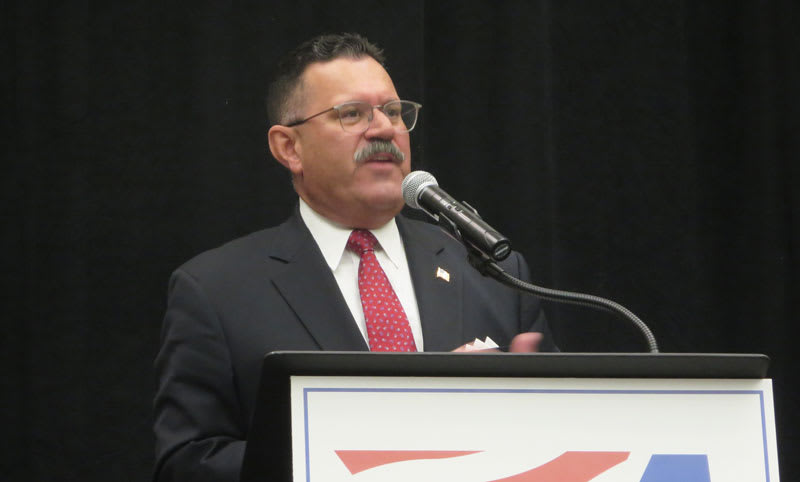
Federal Motor Carrier Safety Administrator Ray Martinez is a crowd-pleaser at the American Trucking Associations' Management Conference & Exhibition in Austin, Texas.
Photo: Deborah Lockridge
It’s rare that a government regulator gets a spontaneous ovation from a room packed full of trucking executives, but that’s exactly what happened Oct. 27 when Federal Motor Carrier Administrator Ray Martinez spoke during the American Trucking Associations’ Management Conference & Exhibition in Austin, Texas.
ATA President and CEO Chris Spear, in his introduction of Martinez, praised how the FMCSA chief has worked with the industry to improve trucking safety. “We have not witnessed this level of engagement since the inception of the agency,” he said – going on 20 years.
In turn, Martinez emphasized that he and his staff come to meetings like this to have “real communication, where we don’t dodge around the issues. If I don't come home from this conference with a list of things we’ve got to check on, then I haven’t done my job – and I'll say this, then you haven’t done your job either.”
Martinez emphasized that President Trump has made it clear to all in his administration that the agencies need to work more closely with their stakeholders.
In government, he said, “there is a school of thought in some quarters … that more laws and more regulations necessarily equals better safety. That is a logical fallacy. It’s essentially regulation by the pound.”
It’s also a fallacy, he said, to believe that that approach to regulation has little to no consequence as to how things work in the real world, whether that’s in commerce or on the enforcement side.
“And if there’s confusion on the commerce side, I can guarantee you there will be confusion on the enforcement side,” he said. “We need to do a better job of working with our regulated community to achieve the safety results we all want.”
A pretty good example of that confusion can be seen in the rollout of the electronic logging device mandate. Martinez took over the helm of the FMCSA March 1, only a month before full enforcement of the ELD mandate kicked in. “That was an interesting buzz saw to walk into nine months ago,” he said to laughter.
“But we do believe ELDs will reduce the number of drivers exceeding hours of service, and reduce fatigue and save lives.”
“The early results are very promising,” he said, noting that of 1.4 million driver inspections since April 1, fewer than 1% were cited for failing to have required ELDs. Hours of service violations, he said, have fallen by 48% over the past year.
But he acknowledged that there’s still people on both the driver and carrier side and the enforcement side that are not fully up to speed, noting that the agency is still in a transitional phase on this ELD mandate, but the agency is “committed to continued collaboration on this,” communicating to all the stakeholders through conference calls, webinars, industry meetings, etc.
Mandatory ELDs, he said, have given the agency an opportunity to reexamine the underlying issue, which is the hours of service regulations, and where adjustment may be needed.
“They have remained largely unchanged for 15 years,” Martinez said. “Has commerce remained unchanged in 15 years? So we’re searching for ways to make the regulations more responsive to current industry realities and prevailing safety needs,” he said, referring to the Advanced Notice of Proposed Rulemaking on the issue, the comment period for which closed Oct. 10.
Martinez drew spontaneous applause for his comments regarding California’s meal and rest break rules. Earlier this month, FMCSA requested public comment on a petition filed by ATA requesting a determination be made by the Department of Transportation that California’s meal and rest break rules are preempted by federal law, with the comment period just lasting a few weeks, ending Oct. 29. Martinez said he was limited in what he could say, but he did say the agency had denied a request to extend the comment period. “I am very, very concerned about patchwork systems where every state gets to decide these issues,” he said to applause. “That is not just an issue of commerce – that is an issue of safety. Everything we look at is through the lens of safety.”
Martinez also said the agency is pushing to make things happen faster. The short comment period on the meal and rest break petition is just one example. And although the agency received more than 5,000 comments on hours of service reform, he said, under this administration's pledge to reduce regulatory burdens, you may be able to expect action faster than in the past.
"When we talked about regulatory reform and I told the Transportation Secretary what I was told by my staff, that it might take three or four years, I was told that was unacceptable. So we are on the fast track."
More Safety & Compliance

From One Generation to the Next: How Mentorship Builds Safer Truck Drivers
After three decades in trucking, Harold Perry shares what he's learned about driver safety, mentorship, and helping the next generation build confidence behind the wheel.
Read More →
FMCSA Pauses Biennial-Update Enforcement Amid Motus Transition
Carriers whose updates were due on or after June 1 have more time, while FMCSA works to stabilize its new registration system and warns of phishing sites impersonating its new carrier registration system, Motus.
Read More →
ZF Expands Commercial Vehicle Push in North America
ZF is expanding its North American commercial-vehicle presence with new transmission applications, electrification, trailer technology and autonomous-driving systems.
Read More →
Truck Drivers Need More Than Another Alert
Fleets have more visibility into truck health, safety events, and driver activity than ever. The next challenge is turning all that information into useful guidance for the person who has to decide what to do next.
Read More →
Tesla Wants a Self-Driving Semi. Are Cameras Enough?
Could Tesla’s camera-only autonomous driving technology work on an 80,000-pound Semi? In this commentary, HDT's Deborah Lockridge takes a look at Tesla, Cybercab, and how autonomous trucks see the road.
Read More →
What DOT’s Automated Vehicle Strategy Means for Trucking
The U.S. Department of Transportation issued a new automated-vehicle strategy that outlines plans for driverless-truck regulations, cross-state freight corridors, and federal safety standards.
Read More →
NYC Expands Speed, Pedestrian Safety Tech Across Fleet
New York City is expanding intelligent speed assistance and pedestrian-alert systems across its municipal fleet, moving the technologies from pilot programs into vehicle procurement and retrofit requirements.
Read More →
FMCSA Removes 110 Truck Driver Training Schools from Certified ELDT List
Federal regulators also are targeting more than 160 additional training providers and launching a nationwide audit of third-party CDL skills testers as part of a broader crackdown on trucking fraud.
Read More →
Beyond DOT Compliance: What Makes a Trucking Fleet Truly Safe?
A trucking fleet can follow every rule and still make unsafe decisions. The real test comes when safety conflicts with freight, productivity, or cost.
Read More →
Hours of Service Pilot Programs: FMCSA Readies for 2027 Rollout
Two pilot programs could eventually reshape hours-of-service rules, giving truck drivers options to pause their 14-hour clock or use longer split sleeper rest periods.
Read More →