




Fleet Safety Conference Begins With Discussion on Safety Technologies
This year’s Fleet Safety Conference started off with a lively discussion during the Future of Vehicle Safety Forum, which included representatives from federal agencies such as the National Transportation Safety Board and the Federal Motor Carrier Safety Administration.

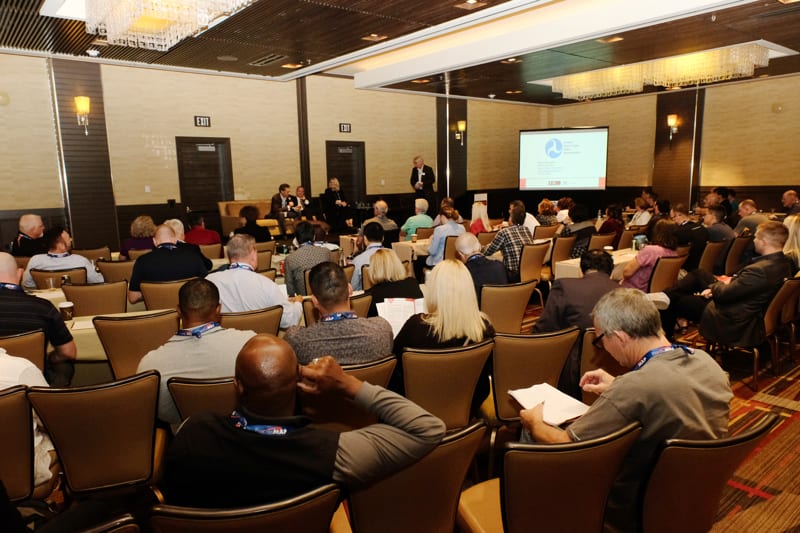
Photo: Stephane Babcock
This year’s Fleet Safety Conference started off with a lively discussion during the Future of Vehicle Safety Forum, which included representatives from federal agencies such as the National Transportation Safety Board and the Federal Motor Carrier Safety Administration, as well as AMCI Testing, a vehicle testing company based in Southern California.
The panel discussed the current and upcoming safety-related vehicle technologies and how they will play a part in reducing fatal and non-fatal crashes. From lane-departure warning systems to automatic emergency braking (AEB), panelists discussed several in-vehicle safety systems as well as the need to train drivers to apply these technologies effectively. The discussion was open to everyone in the room, which helped create an open dialogue on the way technology is shaping the world of light-, medium- and heavy-duty vehicle safety.
“Everyone has the same interests in heart here, and that’s keeping the motoring public safe, keeping commercial drivers safe, and keeping anyone who shares our roads safe,” said Jim Park, HDT equipment editor and the panel’s moderator.
After a brief introduction, Park introduced Jennifer Morrison, supervisory highway crash investigator/investigator-in-charge, with the NTSB's Office of Highway Safety. What started as a quick introduction of both the NTSB and its role in investigating crashes in all modes, soon became an open, dynamic discussion with attendees.
“We’ve been looking at automation in other modes for many years,” said Morrison, which included an accident from June 10, 1995, where the Panamanian passenger ship Royal Majesty grounded on Rose and Crown Shoal about 10 miles east of Nantucket Island, Massachusetts.
The NTSB concluded that the accident was caused by the watch officers’ overreliance on a new and unfamiliar feature of the integrated navigation system. “If you want to control what and how people are going to use these automated features, it has to be part of the design. You can’t tell people, ‘hey, here’s a cupcake, but you can’t eat it until tomorrow.’ We’re humans, we’re going to always push technology and the rules to that extent that we’re allowed to do so.”
William Bensmiller, Nevada division administrator of the FMCSA, was next to take the stage, presenting, among other things, the Department of Transportation's "Preparing for the Future of Transportation: Automated Vehicles 3.0" report, which was released at the beginning of October.
“We’re making a commitment to the American people, and to the industry that is creating this technology, that we are going to take a look at these new technologies and get in front of them,” said Bensmiller. “Most of our rules are written for human drivers, so we’re going to have to look at that and figure out what a safety regulation is going to look like for these autonomous technologies.”
Next up was Guy Mangiamele, Director of Vehicle Testing at AMCI Testing, an unbiased vehicle-testing entity serving OEMs internationally for 35 years.
“We’re all working in this industry that is on the cutting edge of all these new technologies, and so many fascinating things are happening so quickly,” said Mangiamele. “It is a really interesting industry to work in and help save lives.”
After a short break, the panel dove into topics that fell under the heading of advanced driver assistance systems (ADS), including the current state of the technology, maintenance concerns, privacy issues and training drivers to correctly utilize the systems.
“A lot of the large carriers have adopted some type of camera system that allows them to get feedback in an automated manner to the driver with mixed results from what we’ve seen, especially in different weather systems,” said Bensmiller.
According to Morrison, the current safety systems available, including AEB, should be deployed on all highway vehicles, yesterday.
“We’ve been advocating for the use of AEB and collision avoidance technology since 1999,” said Morrison. “Our very first recommendation was given to NHTSA and expressed our thought that it should research and require AEB and collision avoidance systems on all highway vehicles. We believe it is a proven, life-saving technology.”
More Safety & Compliance

FMCSA Pauses Biennial-Update Enforcement Amid Motus Transition
Carriers whose updates were due on or after June 1 have more time, while FMCSA works to stabilize its new registration system and warns of phishing sites impersonating its new carrier registration system, Motus.
Read More →
ZF Expands Commercial Vehicle Push in North America
ZF is expanding its North American commercial-vehicle presence with new transmission applications, electrification, trailer technology and autonomous-driving systems.
Read More →
Truck Drivers Need More Than Another Alert
Fleets have more visibility into truck health, safety events, and driver activity than ever. The next challenge is turning all that information into useful guidance for the person who has to decide what to do next.
Read More →
Tesla Wants a Self-Driving Semi. Are Cameras Enough?
Could Tesla’s camera-only autonomous driving technology work on an 80,000-pound Semi? In this commentary, HDT's Deborah Lockridge takes a look at Tesla, Cybercab, and how autonomous trucks see the road.
Read More →
What DOT’s Automated Vehicle Strategy Means for Trucking
The U.S. Department of Transportation issued a new automated-vehicle strategy that outlines plans for driverless-truck regulations, cross-state freight corridors, and federal safety standards.
Read More →
NYC Expands Speed, Pedestrian Safety Tech Across Fleet
New York City is expanding intelligent speed assistance and pedestrian-alert systems across its municipal fleet, moving the technologies from pilot programs into vehicle procurement and retrofit requirements.
Read More →
FMCSA Removes 110 Truck Driver Training Schools from Certified ELDT List
Federal regulators also are targeting more than 160 additional training providers and launching a nationwide audit of third-party CDL skills testers as part of a broader crackdown on trucking fraud.
Read More →
Beyond DOT Compliance: What Makes a Trucking Fleet Truly Safe?
A trucking fleet can follow every rule and still make unsafe decisions. The real test comes when safety conflicts with freight, productivity, or cost.
Read More →
Hours of Service Pilot Programs: FMCSA Readies for 2027 Rollout
Two pilot programs could eventually reshape hours-of-service rules, giving truck drivers options to pause their 14-hour clock or use longer split sleeper rest periods.
Read More →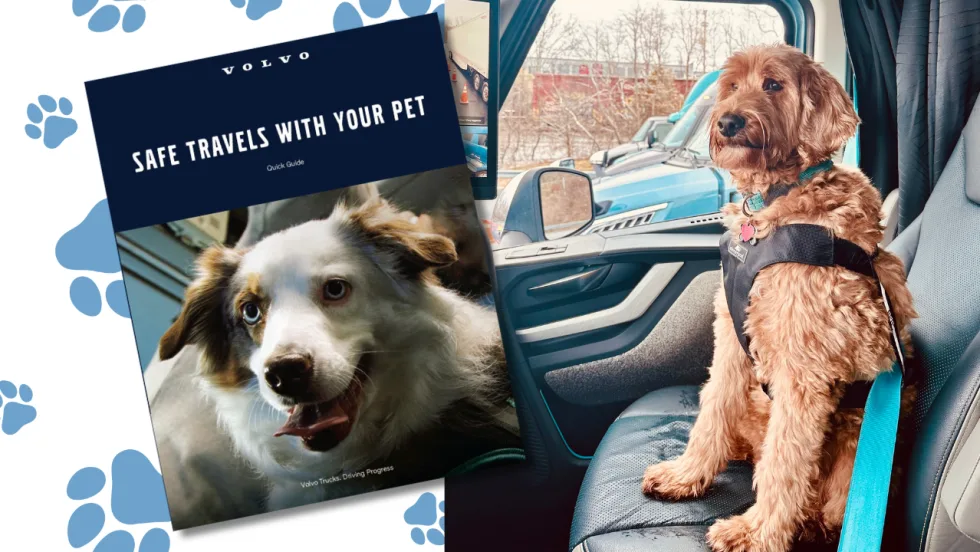
New Guide Offers Pet Safety Tips for Truck Drivers
Hundreds of thousands of pets travel in truck cabs. A new safety guide from Volvo Trucks and the Center for Pet Safety offers practical advice for truck drivers who bring dogs and cats along for the ride.
Read More →