





The Safety Spectrum: Human Lives Must Come Before Faster WiFi
FCC Votes to Shift Part of 5.9 GHz Safety Spectrum to Wi-Fi
The Federal Communications Commission voted unanimously to split up the 5.9 GHz “safety spectrum” frequency previously set aside for use in transportation for vehicle-to-everything technologies, a plan that has prompted dire warnings from departments of transportation and various transportation and safety groups.
November 18, 2020
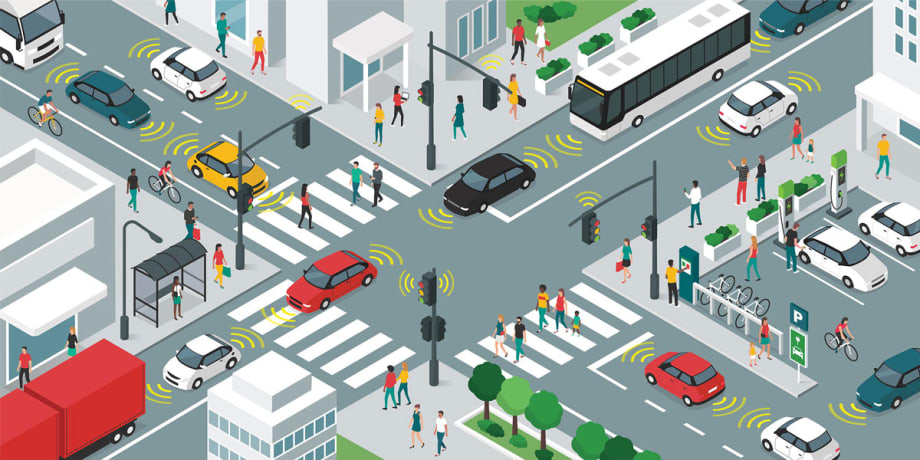
Proponents of vehicle-to-everything technology say the FCC's latest move is a mistake.
Image: Gettyimages.com/elenabs
3 min to read
The Federal Communications Commission voted unanimously to split up the 5.9 GHz “safety spectrum” frequency previously set aside for use in transportation for vehicle-to-everything technologies, a plan that has prompted dire warnings from departments of transportation and various transportation and safety groups.
The block of the 5.9 GHz spectrum band was reserved in 1999 for the development of “connected vehicles” allowing vehicles to communicate with each other and with infrastructure.
Several years ago, however, cable, telecom and content companies asked the FCC to open most of the spectrum band for Wi-Fi use.
Automakers, the National Safety Council, and groups such as ITS America, the NAFA Fleet Management Association, the American Association of State Highway Officials, and the American Trucking Associations, fought against the idea.
Transportation Secretary Elaine Chao has been an outspoken critic of reallocating the spectrum. A year ago, she submitted a letter to FCC Chairman Aji Pai asking him to keep the 5.9 GHz safety spectrum reserved for possible lifesaving transportation benefits.
“Due to the significant potential vehicle-to-everything (V2X ) technologies have to reduce these societal crises, it is imperative to the Department that the full 75 MHz of the 5.9 GHz Band is preserved for its existing purposes, including transportation safety and other intelligent transportation purposes.”
She has warned the FCC decision could result in “thousands more deaths annually on road and millions more injuries than would be the case otherwise.”
Earlier this year, leaders and members of the House Committee on Transportation and Infrastructure criticized the FCC’s plan, saying, “there remain serious outstanding questions about the potential implications of this approach that could significantly undermine safety benefits to the driving public.” And earlier this month, the committee called on the U.S. Government Accountability Office to review the safety implications of sharing the 5.9 GHz spectrum band.
The move also will affect Positive Train Control for commuter rail systems. PTC systems use communication-based and processor-based train control technology to prevent train-to-train collisions, overspeed derailments, incursions into established work zone limits, and movements of trains through switches in the wrong position. Without enough spectrum, the systems could run into issues.
In defending the decision, FCC Chairman Ajit Pai said there is “a pressing need for us to allocate additional spectrum” for Wi-Fi, noting the coronavirus pandemic underscored the fact that “consumers need access and more bandwidth to be able to engage in telework, remote learning, telehealth, and other broadband-related services.”
Reactions to the FCC Vote
The American Association of State Highway Transportation Officials reacted to the FCC’s vote in a statement issued by Jim Tymon, AASHTO executive director.
“AASHTO is disappointed that the FCC has abandoned the 5.9 GHz safety band, despite the unified voice of state DOTs and the broader transportation industry. The leaders of all 50 state departments of transportation, the District of Columbia and Puerto Rico are unanimous in their support for preserving the 5.9 GHz wireless spectrum for transportation-only usage. Without the full 5.9 GHz spectrum available to use for connected vehicle technologies it will be significantly more difficult to eliminate the kinds of fatal vehicle crashes that contribute to more than 37,000 fatalities on America’s roadways each year, as well as the safe deployment of connected and automated vehicles.”
ITS America President and CEO Shailen Bhatt issued a statement saying the move “will, in effect, likely render the entire band useless for safety,” saying that ITS America is just one of dozens of transportation safety organizations that have been sounding the alarm about the implications of this action, including the U.S. DOT, state departments of transportation, and public safety organizations.
“In a time in which we are rightly focused on following science and data, it is inexplicable that the FCC is willfully disregarding the advice of experts,” Bhatt said.
More Safety & Compliance

FMCSA Pauses Biennial-Update Enforcement Amid Motus Transition
Carriers whose updates were due on or after June 1 have more time, while FMCSA works to stabilize its new registration system and warns of phishing sites impersonating its new carrier registration system, Motus.
Read More →
ZF Expands Commercial Vehicle Push in North America
ZF is expanding its North American commercial-vehicle presence with new transmission applications, electrification, trailer technology and autonomous-driving systems.
Read More →
Truck Drivers Need More Than Another Alert
Fleets have more visibility into truck health, safety events, and driver activity than ever. The next challenge is turning all that information into useful guidance for the person who has to decide what to do next.
Read More →
Tesla Wants a Self-Driving Semi. Are Cameras Enough?
Could Tesla’s camera-only autonomous driving technology work on an 80,000-pound Semi? In this commentary, HDT's Deborah Lockridge takes a look at Tesla, Cybercab, and how autonomous trucks see the road.
Read More →
What DOT’s Automated Vehicle Strategy Means for Trucking
The U.S. Department of Transportation issued a new automated-vehicle strategy that outlines plans for driverless-truck regulations, cross-state freight corridors, and federal safety standards.
Read More →
NYC Expands Speed, Pedestrian Safety Tech Across Fleet
New York City is expanding intelligent speed assistance and pedestrian-alert systems across its municipal fleet, moving the technologies from pilot programs into vehicle procurement and retrofit requirements.
Read More →
FMCSA Removes 110 Truck Driver Training Schools from Certified ELDT List
Federal regulators also are targeting more than 160 additional training providers and launching a nationwide audit of third-party CDL skills testers as part of a broader crackdown on trucking fraud.
Read More →
Beyond DOT Compliance: What Makes a Trucking Fleet Truly Safe?
A trucking fleet can follow every rule and still make unsafe decisions. The real test comes when safety conflicts with freight, productivity, or cost.
Read More →
Hours of Service Pilot Programs: FMCSA Readies for 2027 Rollout
Two pilot programs could eventually reshape hours-of-service rules, giving truck drivers options to pause their 14-hour clock or use longer split sleeper rest periods.
Read More →
New Guide Offers Pet Safety Tips for Truck Drivers
Hundreds of thousands of pets travel in truck cabs. A new safety guide from Volvo Trucks and the Center for Pet Safety offers practical advice for truck drivers who bring dogs and cats along for the ride.
Read More →