





Are Your Technicians Ready for Lower- and Zero-Emissions Trucks?
EPA Action Would Allow Congress to Kill California's Clean Truck Rules
The Trump administration is seeking to revoke California’s EPA waivers approved under the Biden administration, with the aim of killing the state's Advanced Clean Trucks and Omnibus NOx rules.
February 18, 2025
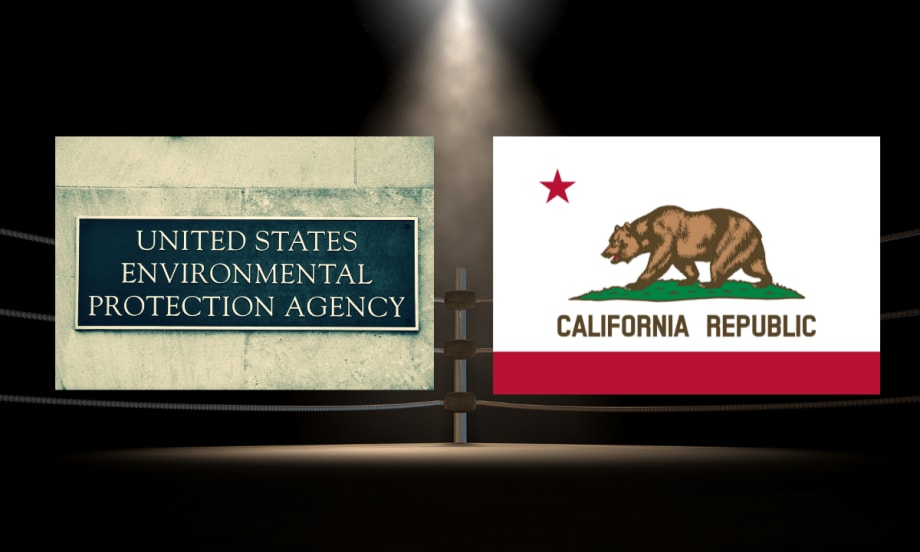
The EPA is ready to rumble in the Trump administration's fight against California's truck emissions rules.
Image: HDT Graphic
5 min to read
The Trump administration is seeking to revoke California’s EPA waivers approved under the Biden administration, with the aim of killing the state's Advanced Clean Trucks and Omnibus NOx rules.
U.S. Environmental Protection Agency Administrator Lee Zeldin announced Friday that the EPA is transmitting to Congress the Biden administration’s rules granting waivers that allowed California to preempt federal car and truck standards set by EPA and the National Highway Traffic Safety Administration.
This would allow Congress to kill the waivers under the Congressional Review Act — although in the past, these EPA waivers for California were not considered to be “rules” subject to the CRA.
“The Biden administration failed to send rules on California’s waivers to Congress, preventing members of Congress from deciding on extremely consequential actions that have massive impacts and costs across the entire United States,” Zeldin said in a statement.
The American Trucking Associations and The Owner-Operator Independent Drivers Association praised the move.
“This is not the United States of California,” ATA President & CEO Chris Spear said in a statement. “California should never be given the keys to set national policy and regulate America’s supply chain.
“Thanks to the leadership of the Trump administration, Congress now has one more avenue available to reclaim the keys from Sacramento and restore common sense to our nation’s environmental policies.”
OOIDA President Todd Spencer said, "Setting national policy is the responsibility of Congress, not California....OOIDA and our 150,000 members appreciate the EPA’s efforts to protect small-business truckers nationwide from California’s regulatory encroachments.”
Earlier this month, California Gov. Gavin Newsom approved $25 million for anticipated legal challenges against the Trump administration. The state sued more than 120 times during his first term, winning about two-thirds of the cases.
California’s EPA Exemptions and the Congressional Review Act
Under the Clean Air Act, since 1967, California has been allowed to adopt emissions requirements independent from EPA’s regulations to meet its significant air quality challenges. But the state must get a waiver from the agency in order to do so.
Other states have the option to adopt California’s more stringent emissions rules.
The Congressional Review Act is a tool Congress can use to overturn certain federal agency actions. It requires agencies to report the issuance of “rules” to Congress. Within 60 days of getting that report, Congress can issue a joint resolution of disapproval.
If a CRA joint resolution of disapproval is approved by both houses of Congress and signed by the President, or if Congress successfully overrides a presidential veto, the rule at issue cannot go into effect or continue in effect.
In 2023, such a resolution on EPA’s truck emissions rules passed the Senate but not by enough to override a presidential veto.
Is a Waiver a Rule?
Exactly what constitutes a “rule” under the Congressional Review Act is subject to interpretation.
The CRA applies to final rules, including major rules, nonmajor rules, and interim final rules. The definition may include agency actions that are not subject to traditional notice-and-comment rulemaking, such as guidance documents and policy memoranda.
The CRA does not apply to presidential actions or to non-rule agency actions such as orders.
The issuance of a waiver has in the past been viewed as an order rather than a rule, and thus not subject to the requirement to submit it to Congress.
Advanced Clean Trucks Rule
The EPA granted a waiver for California's Advanced Clean Trucks rule in 2023, which is pushing truck makers to sell zero-emission trucks in the state.
Normally, that means we would be well past the 60-day period when the Congressional Review Act allows for Congress to act.
However, that 60-day period starts from when the rule was submitted to Congress. Since the EPA did not submit its waiver approval as a “rule,” that 60-day clock is reset with the Trump EPA’s transmission of the waiver approvals to Congress.
California’s ACT rule has been the target of a number of lawsuits ever since it was adopted as well as much industry criticism and pushback for its unrealistic goals.
OOIDA's Spencer noted that for its small-business trucker members, "vehicle reliability and affordability are critical. So far, there is no convincing evidence that electric commercial motor vehicles are a viable option for small-business truckers given the high costs and inadequate charging infrastructure."
Even before the ACT waiver was granted, many states passed laws to adopt California’s stricter rules as well.
However, reading the writing on the wall with the incoming Trump administration, California last month withdrew its application to the EPA for the waiver needed to go ahead with its Advanced Clean Fleets rule, which would have allowed the state to dictate what vehicles fleets were allowed to purchase.
CARB’s NOx Omnibus rules were not granted an EPA waiver until late last year. Those rules have also raised concerns in the trucking industry, especially because they are expected to increase engine prices significantly.
The Power of Congress
Also late last year, the U.S. Supreme Court declined to weigh in on the constitutionality of California’s ability to set more stringent emissions standards.
The Environmental Defense Fund said killing the waivers using the Congressional Review Act would “reverse decades of consistent practice, contradict the decisions of independent Congressional offices, and violate the law by asserting that the agency’s waiver of preemption that allows California to protect people from air pollution is a ‘rule’ that falls under the Congressional Review Act.
“In fact, previous EPA administrators of both parties, the office specially charged with determining which agency actions are subject to Congressional review, the independent Congressional Research Service, and Republican members of Congress have all consistently recognized that the Congressional Review Act has never applied to EPA’s waiver decisions.”
Even without the Congressional Review Act, however, Congress could pass a regular piece of legislation to kill off California’s latest emissions rules, or even the state's ability to write separate emissions rules altogether.
Bills have been introduced over the past several years to revoke California’s Clean Air Act authority, but none have passed. With a Republican-controlled House and Senate, however, it’s far more likely that this will actually happen.
All this poses a dilemma for truck and engine manufacturers, which have already poured significant investments into meeting federal and California emissions requirements. And they must consider the possibility that when Democrats retake control of the White House and/or Congress that the pendulum will swing the other direction.
Updated 8:40 am EST 2/19/2025 to add comments from OOIDA
More Fuel Smarts

How Volvo Updated Its D13 for EPA 2027 [Watch]
Volvo’s updated D13 promises lower emissions without sacrificing performance or fuel economy. Take a closer look at what changed inside the engine in this HDT Spotlight video.
Read More →
Diesel Price Spike Shortens Payback for Natural Gas Trucks, Report Says
Energy Vision estimates fleets could recover the higher purchase price of an RNG-fueled Class 8 tractor in 1.3 to 2.8 years under current fuel-price scenarios.
Read More →
Calstart Becomes Catalyst Mobility, Reflecting Broader Focus
Calstart is now Catalyst Mobility, reflecting the nonprofit’s growing national role in clean transportation, including zero-emission trucks, infrastructure and incentive programs.
Read More →

Record Diesel Prices Squeeze Trucking Fleets
Average U.S. diesel prices have climbed to nearly $6 a gallon, surpassing the 2022 record as tight refinery capacity and Middle East disruptions keep fuel costs elevated.
Read More →
Sponsored•September 9, 2026
How Fuel Delivery Shapes Engine Performance
Fuel delivery depends on more than what happens at the injector. For fleet, maintenance and technical professionals, looking at the full path from pump to injector can provide useful context for understanding engine performance.
Read More →
East Coast Port Launches $45M Electric Truck Push
The Port Authority of New York and New Jersey announced millions in incentives for zero-emission drayage trucks, yard tractors, and new charging hubs near the port.
Read More →
California Bill Could Shed Light on Electric Truck Prices
Why do battery-electric Class 8 trucks remain so expensive? A California bill headed to Gov. Gavin Newsom would give fleets and state agencies more visibility into what manufacturers charge.
Read More →
Detroit Opens Orders for EPA 2027 Engines
Detroit isn’t starting from scratch to meet EPA 2027 diesel emissions standards. Its Gen 6 DD13 and DD15 engines keep much of today’s platform while updating the fuel and aftertreatment systems.
Read More →
Zero-Emission Truck Corridor Planned for West Coast
California, Oregon, Washington, British Columbia and Baja California are coordinating plans for truck charging and hydrogen fueling from Canada to Mexico.
Read More →
A Closer Look at Kenworth’s Electric T880E Vocational Truck [Video]
Learn more about Kenworth's T880E battery-electric vocational truck at the Paccar Technical Center, including its range, applications, upfitting considerations, and PTO options, in this HDT Spotlight video.
Read More →