




Engine Technology Forum Calls on Legislators to Recognize Renewable Diesel
Low-carbon fuels are in the spotlight as California’s Air Board and Energy Commission prepare to review policies and update guidance.

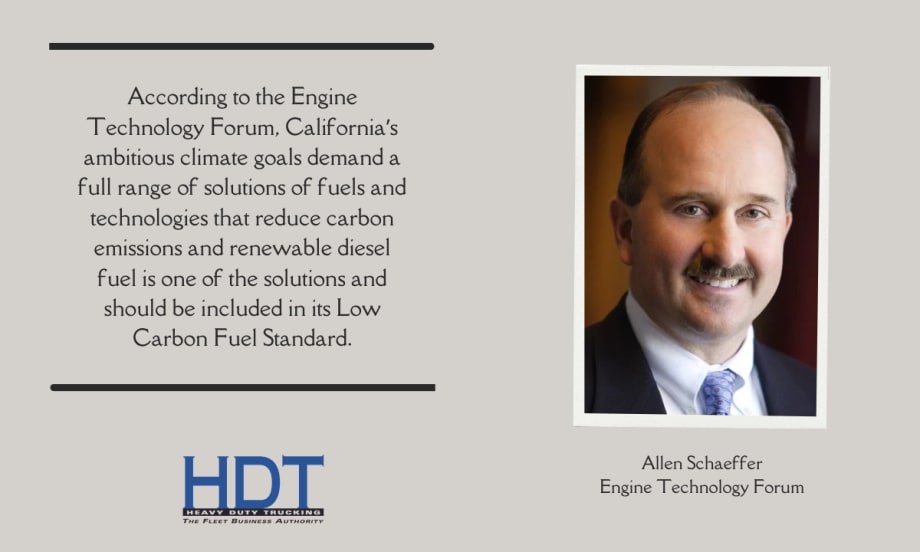
The Engine Technology Forum is called on California policymakers to recognize the continued importance of advanced renewable biodiesel fuels and maximize their roles and inclusion as essential decarbonization options for fleets.
Graphic: HDT/Canva
In proceedings before California energy and environmental agencies, the Engine Technology Forum (ETF) will call on policymakers to recognize the continued importance of advanced renewable biodiesel fuels and maximize their roles and inclusion as essential decarbonization options.
On November 8, the California Air Resources Board (CARB) will consider major revisions to its Low Carbon Fuel Standard (LCFS).
Separately, the California Energy Commission (CEC) is revising its Renewable Portfolio Standard Guidebook. This playbook establishes important guidance and credits toward achieving renewable energy goals in the electric power sector.
A Call for Effective and Inclusive Policies
Both proceedings have significant implications for the future use of advanced renewable biofuels like biodiesel and renewable diesel fuels.
“Both CARB and the CEC have important obligations in these proceedings this fall to promulgate effective and inclusive policies and guidance that will signal to the marketplace and to consumers that vehicle owners and businesses alike will have a full array of proven, available and affordable tools to reduce greenhouse gas emissions without harming the economy,” said Allen Schaeffer, executive director of the Engine Technology Forum.
Schafer said California’s goals for reducing greenhouse gas emissions are ambitious and challenging for all sectors.
California environmental agencies envision near complete shifts from traditional internal combustion engines (ICE) and liquid and gaseous fossil fuels to zero emissions technology.
Through gradually reducing carbon intensity of the fuel pool, low carbon fuels such as biodiesel and renewable diesel have been a reliable success story in delivering near term progress toward decarbonization, ETF said.
However, the proposed feedstock caps and “sustainability guardrails” on biofuel production proposed by CARB impart a greater burden than benefit to Californians.
Renewable fuel producers, petroleum suppliers and fleets that must rely on ICEs using low carbon fuels to comply with the spirit of California’s ZEV/near-ZEV transition will be most impacted, according to Schafer.
CARB’s Data Makes the Case
The use of low carbon renewable fuels across this vast population of vehicles has contributed substantially to California’s progress and current success in reducing greenhouse gas emissions, Schafer noted.
According to CARB’s own data, the program in its present form is exceeding expectations in reducing carbon intensity from transportation fuels.
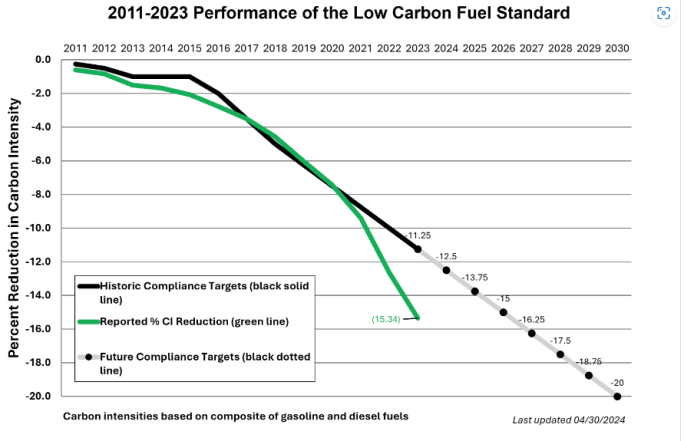
CARB's own data, shown in this agency chart, makes the case for the expanded use of renewable diesel fuel, according to the ETF.
Graph: CARB
However, ETF said, the proposed amendments seem certain to deter further progress from renewable fuel producers and their suppliers while undermining the viability of transportation fuel providers. And they will drive up the cost of producing and supplying California’s unique transportation fuels.
According to Schafer, the proposed amendments disrupt the predictable and orderly transition of the fuels industry in a way that unnecessarily increases costs to the economy and discourages investment in renewable low carbon fuels.
In its present form, the Low Carbon Fuel Standard discourages improvements that could help California accelerate achievement of the continued progress toward the state’s climate goals, Schafer said. And, he added, through its leadership, the contribution of other states in helping to achieve national climate goals are diminished as well.
The proposed amendments’ increased stringency and diminished compliance tools will likely compromise technology neutrality by the elimination of pure market signals that incentivize the production of lower-carbon intensity fuels.
ICE Technology Remains Dominant
Schafer noted that internal combustion engines (ICEs) running on gasoline, diesel or natural gas remain the dominant power behind California’s economy today.
ICEs are expected to continue to serve trucking and other sectors as the majority fuel type for decades to come. Even, Schafer noted, as the state implements its policies that seek to transition only to zero emission vehicles (ZEVs).
As is evidenced by consumer response, Schafer noted that the pace of electrification of the transportation sector (light, medium and heavy-duty vehicles) is proving to be uneven and uncertain.
Many fleets are delaying or downgrading electric vehicle investments and deferring introduction of new models announced by several vehicle manufacturers.
This elevates the importance and significance of having an effective and affordable low carbon fuels policy available for all sectors, in Schafer’s view.
A Drop-In Alternative to Diesel
As the California Energy Commission updates its Renewable Energy Portfolio Standard Guidebook, ETF noted in its comments that a significant deficiency in the current guidebook is the appropriate recognition of Hydrotreated Vegetable Oil (“HVO”) -- also known as Renewable Diesel (RD) -- as a distinct qualifying renewable fuel in Chapter 2.
HVO can be produced using the same feedstocks as biodiesel. However, the chemical process to it is different and results in a far different fuel than biodiesel, Schafer said. As such, ETF argues that it warrants its own specific and separate energy resource listing in the Guidebook.
As a “drop in” alternative to diesel fuel, HVO provides significant carbon reductions when compared to diesel fuel or lesser blends of biodiesel, Schafer said. And as such, has a potentially significant role to play in the decarbonization of California’s Electrical grid, he added.
According to the ETF, California’s ambitious climate goals demand a full range of solutions of fuels and technologies that reduce carbon emissions.
ETF said HVO/RD is one of those solutions and should be included in the Guidebook.
Considering the sheer size of the diesel power generation fleet in California, including HVO/RD ensures that those utilizing diesel technologies will strive to maximize the use of renewable fuels, which has the potential for a significant reduction in greenhouse gas emissions from the energy sector.
More Fuel Smarts

How Volvo Updated Its D13 for EPA 2027 [Watch]
Volvo’s updated D13 promises lower emissions without sacrificing performance or fuel economy. Take a closer look at what changed inside the engine in this HDT Spotlight video.
Read More →
Diesel Price Spike Shortens Payback for Natural Gas Trucks, Report Says
Energy Vision estimates fleets could recover the higher purchase price of an RNG-fueled Class 8 tractor in 1.3 to 2.8 years under current fuel-price scenarios.
Read More →
Calstart Becomes Catalyst Mobility, Reflecting Broader Focus
Calstart is now Catalyst Mobility, reflecting the nonprofit’s growing national role in clean transportation, including zero-emission trucks, infrastructure and incentive programs.
Read More →

Record Diesel Prices Squeeze Trucking Fleets
Average U.S. diesel prices have climbed to nearly $6 a gallon, surpassing the 2022 record as tight refinery capacity and Middle East disruptions keep fuel costs elevated.
Read More →
How Fuel Delivery Shapes Engine Performance
Fuel delivery depends on more than what happens at the injector. For fleet, maintenance and technical professionals, looking at the full path from pump to injector can provide useful context for understanding engine performance.
Read More →
East Coast Port Launches $45M Electric Truck Push
The Port Authority of New York and New Jersey announced millions in incentives for zero-emission drayage trucks, yard tractors, and new charging hubs near the port.
Read More →
California Bill Could Shed Light on Electric Truck Prices
Why do battery-electric Class 8 trucks remain so expensive? A California bill headed to Gov. Gavin Newsom would give fleets and state agencies more visibility into what manufacturers charge.
Read More →
Detroit Opens Orders for EPA 2027 Engines
Detroit isn’t starting from scratch to meet EPA 2027 diesel emissions standards. Its Gen 6 DD13 and DD15 engines keep much of today’s platform while updating the fuel and aftertreatment systems.
Read More →
Zero-Emission Truck Corridor Planned for West Coast
California, Oregon, Washington, British Columbia and Baja California are coordinating plans for truck charging and hydrogen fueling from Canada to Mexico.
Read More →
A Closer Look at Kenworth’s Electric T880E Vocational Truck [Video]
Learn more about Kenworth's T880E battery-electric vocational truck at the Paccar Technical Center, including its range, applications, upfitting considerations, and PTO options, in this HDT Spotlight video.
Read More →