





From the HDT Archives (2017):
Driving Orange EV's All-Electric Terminal Tractor
Electric Yard Tractors go to Work in Port Newark
Ten battery-electric yard tractors are now in operation in Port Newark, New Jersey, which Red Hook Container Terminals said it is the single largest deployment of battery-electric trucks in the eastern U.S.
August 13, 2021
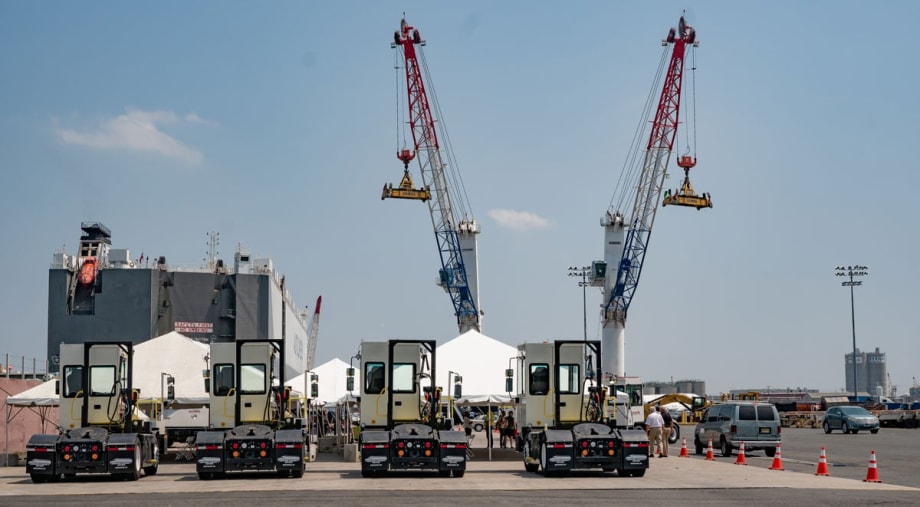
Ten battery-electric yard tractors are being used to move cargo containers at the Red Hook Marine Terminal in Port Newark.
Photo: Red Hook
4 min to read
Ten battery-electric yard tractors are now in operation at a container terminal in Port Newark, New Jersey. Red Hook Container Terminals on Aug. 11 held a ribbon-cutting to announce the official deployment of the BYD Motors yard tractors. The announcement said it is the single largest deployment of battery-electric trucks in the eastern United States and the first such deployment at a Port Authority of New York and New Jersey marine terminal.
The heavy-duty zero emission battery electric yard tractors are being used to move cargo containers at the Red Hook Marine Terminal in Port Newark.
In addition, Red Hook operates a cross-harbor barging operation between its facilities in Port Newark and Red Hook Brooklyn, which removes an estimated 30,000 truck trips from New Jersey and New York City streets every year, reducing local diesel truck air pollution and C02 emissions.
Five of the yard tractors are being used for sea container movement from the cross-harbor barging operation. The other five go to the other terminals and to the Millennium Rail yard to pick up and drop off containers.
“Red Hook has always taken the health of the communities it operates in, its workers, and the planet seriously,” said Mike Stamatis, president and CEO of Red Hook Container Terminal, in a news release. “This project was a long-time in the making and a large investment, but it is an investment we believe will return dividends in terms of public health, operational costs, and efforts to save the planet.”
More About the Electrification Project
The Red Hook zero-emission battery electric truck fleet project was developed and managed by Climate Change Mitigation Technologies, a New Jersey-based developer and manager of zero-emission truck and bus projects for public and private fleets. The New Jersey Department of Environmental Protection funded a portion of the project using Volkswagen Mitigation Trust funds, and Red Hook funded the balance of vehicle and project costs.
CCMT partnered with Hudson County Motors in Secaucus, New Jersey, the first BYD Motors truck dealer in the nation. BYD has more than 14,000 battery-electric trucks and 65,000 electric buses deployed worldwide.
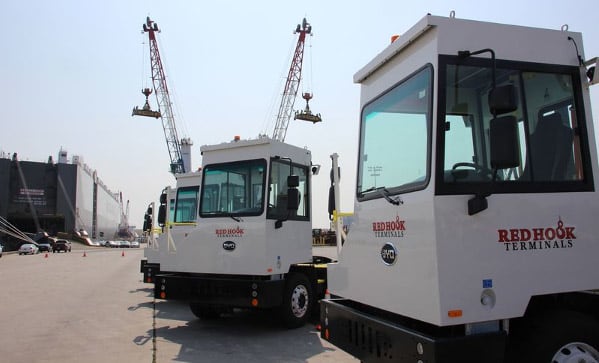
The BYD model 8Y yard tractors being deployed by Red Hook Container Terminals can operate continuously for 12 hours before recharging.
Photo: Red Hook
The BYD model 8Y yard tractors being deployed by Red Hook Container Terminals LLC are third-generation equipment that come with 217 kWh lithium iron phosphate battery packs that have 241 horsepower and can pull loads of up to 102,000 pounds gross vehicle weight rating. They can operate continuously for up to 12 hours or more before recharging, or can operate 24/7 with opportunity charging during shifts.
AC and DC charging is available. DC fast charging takes approximately two hours from a 20% state of charge. Early operational results indicate that the yard tractor can operate two whole shifts before needing re-charging.
Yard Tractors are a Great Fit for Electrification
In a recent report on truck electrification, ACT Research identified yard tractors as one of the highest potential applications for rapid adoption of the technology.
“There’s a set [of vehicle applications] that might not be high-volume, but we see the transition to electrification could be close to 100% over the next 20 years,” ACT analyst Jim Meil told HDT in an interview. “Class 8 yard spotters are a small-volume niche market, but the mission requirements are so conducive to electrification that we see almost a full migration,” he added.
In fact, the upcoming Advanced Clean Transportation Expo in Long Beach, California, Aug. 30-Sept. 2, will feature electric terminal tractors on display and/or in the ride-and-drive from Autocar, BYD, Dana, and Orange EV, plus a hydrogen-electric model from Capacity Trucks.
And the North American Council for Freight Efficiency's Run on Less: Electric demonstration project will also feature several fleets using terminal tractors:
NFI using an Ottawa Kalmar Electric Terminal Tractor in Chino, California
Ryder Systems using a Lonestar Specialty Vehicles terminal tractor in Georgetown, Kentucky
Ruan using an Orange EV terminal tractor in Otsego, Minnesota
While East Coast ports may not be as far along in deploying zero-emissions vehicles as California, port officials said this was only the beginning of their efforts.
“These zero-emission electric yard tractors do not represent the finish line as far as meeting the seaport’s goal to reduce emissions. But it’s a major step forward,” said Sam Ruda, director of the Port Department of the Port Authority of New York and New Jersey. “It affirms both that the technology is developing rapidly and is applicable to container terminals, and it underscores the role the public and private sectors are playing in making it a reality.”
More Fuel Smarts

How Volvo Updated Its D13 for EPA 2027 [Watch]
Volvo’s updated D13 promises lower emissions without sacrificing performance or fuel economy. Take a closer look at what changed inside the engine in this HDT Spotlight video.
Read More →
Diesel Price Spike Shortens Payback for Natural Gas Trucks, Report Says
Energy Vision estimates fleets could recover the higher purchase price of an RNG-fueled Class 8 tractor in 1.3 to 2.8 years under current fuel-price scenarios.
Read More →
Calstart Becomes Catalyst Mobility, Reflecting Broader Focus
Calstart is now Catalyst Mobility, reflecting the nonprofit’s growing national role in clean transportation, including zero-emission trucks, infrastructure and incentive programs.
Read More →

Record Diesel Prices Squeeze Trucking Fleets
Average U.S. diesel prices have climbed to nearly $6 a gallon, surpassing the 2022 record as tight refinery capacity and Middle East disruptions keep fuel costs elevated.
Read More →
Sponsored•September 9, 2026
How Fuel Delivery Shapes Engine Performance
Fuel delivery depends on more than what happens at the injector. For fleet, maintenance and technical professionals, looking at the full path from pump to injector can provide useful context for understanding engine performance.
Read More →
East Coast Port Launches $45M Electric Truck Push
The Port Authority of New York and New Jersey announced millions in incentives for zero-emission drayage trucks, yard tractors, and new charging hubs near the port.
Read More →
California Bill Could Shed Light on Electric Truck Prices
Why do battery-electric Class 8 trucks remain so expensive? A California bill headed to Gov. Gavin Newsom would give fleets and state agencies more visibility into what manufacturers charge.
Read More →
Detroit Opens Orders for EPA 2027 Engines
Detroit isn’t starting from scratch to meet EPA 2027 diesel emissions standards. Its Gen 6 DD13 and DD15 engines keep much of today’s platform while updating the fuel and aftertreatment systems.
Read More →
Zero-Emission Truck Corridor Planned for West Coast
California, Oregon, Washington, British Columbia and Baja California are coordinating plans for truck charging and hydrogen fueling from Canada to Mexico.
Read More →
A Closer Look at Kenworth’s Electric T880E Vocational Truck [Video]
Learn more about Kenworth's T880E battery-electric vocational truck at the Paccar Technical Center, including its range, applications, upfitting considerations, and PTO options, in this HDT Spotlight video.
Read More →