




Electric Truck Project Deploys 100 Trucks in California
Daimler Trucks North America and Volvo Trucks North America will produce and deliver 100 Class 8 battery-electric trucks for deployment in Schneider and NFI’s Southern California fleet operations as part of the Joint Electric Truck Scaling Initiative.

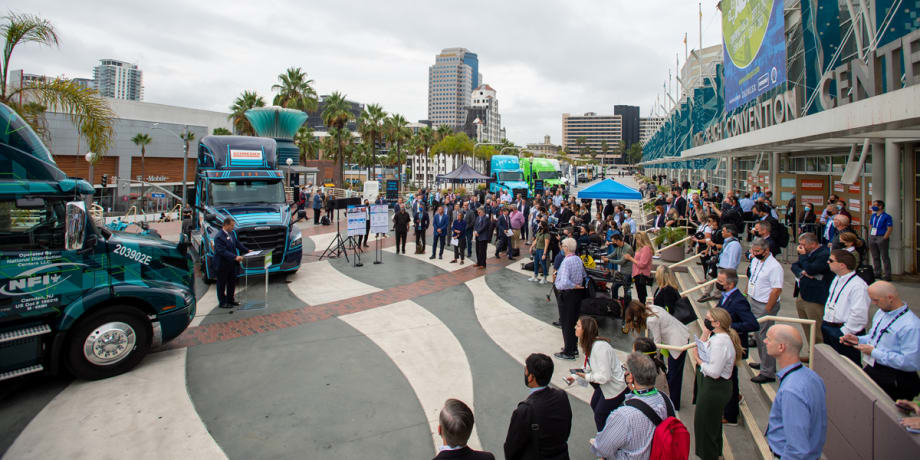
Daimler Trucks North America and Volvo Trucks North America will produce and deliver 100 Class 8 battery-electric trucks for deployment in Schneider and NFI’s Southern California fleet operations as part of the Joint Electric Truck Scaling Initiative.
Photo: ACT Expo
The South Coast Air Quality Management District, California Air Resources Board and the California Energy Commission are leading an effort to deploy 100 battery-electric regional haul and drayage trucks across California.
The battery-electric trucks will be deployed through a partnership with NFI Industries and Schneider as part of a project known as the Joint Electric Truck Scaling Initiative. The Initiative, jointly financed by CARB and the CEC ($26.98 million), is the largest investment of its kind, South Coast AQMD officials said in a press release. South Coast AQMD contributed $5.43 million, and another 20 project partners funded $41.37 million.
Daimler Trucks North America and Volvo Trucks North America will produce and deliver Class 8 battery-electric trucks for deployment in Schneider and NFI’s Southern California fleet operations.
Beginning in 2022, Schneider will add 50 Freightliner eCascadias — the truck manufacturer’s first commercial Class 8 battery-electric truck— to its Southern California intermodal operations. DTNA will deliver another 30 eCascadias to NFI.
In addition, Volvo Trucks will deliver 30 VNR Electric trucks, an all-electric Class 8 model that the company commercialized in late 2020, to NFI. With the deployment of a combined 50 battery-electric trucks at its Ontario facility, NFI will operate the first fully zero-emission freight logistics fleet in California.
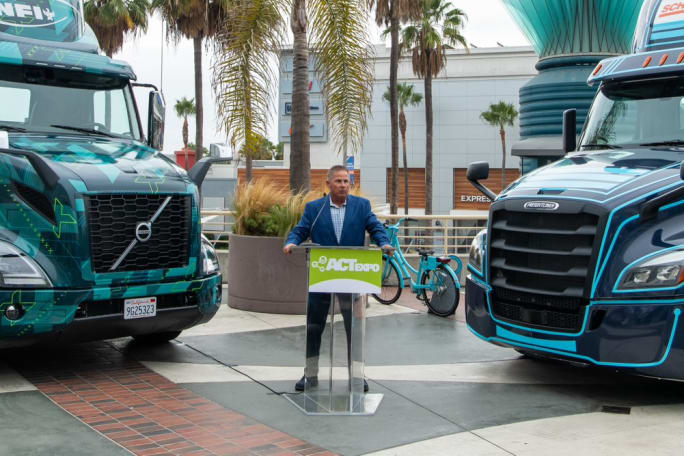
Volvo Trucks will deliver 30 VNR Electric trucks, an all-electric Class 8 model that the company commercialized in late 2020, to NFI.
Photo: ACT Expo
Through the JETSI project, NFI and Schneider will collectively install 50 electric vehicle chargers, warehouse upgrades, on-site energy storage and rooftop solar, resulting in more than $16.8 million of regional economic activity from associated construction costs, South Coast AQMD officials said in a press release.
Over 20 project partners representing charging equipment manufacturers, infrastructure providers, nonprofit organizations, technology suppliers and more will collaborate on the eight-year project to ensure all aspects of fleet electrification are considered.
Partners include Green Paradigm Consulting, Power Electronics, Electrify Commercial, Gladstein, Neandross & Associates, Coalition for Clean Air, Calstart, Electric Power Research Institute, Ri-cardo Strategic Consulting, Los Angeles Cleantech Incubator, Black & Veatch, and University of California, Riverside. The Port of Long Beach, Port of Los Angeles, and Southern California Edison.
The project is poised to reduce five tons of pollutants such as nitrogen oxides and particulate matter annually along Southern California’s I-710 corridor, as well as eliminate 8,247 metric tons of greenhouse gas emissions. Connecting the San Pedro Bay Port complex to inland distribution centers and warehouses, the I-710 accounts for 20% of all PM emissions in Southern California, South Coast AQMD officials said.
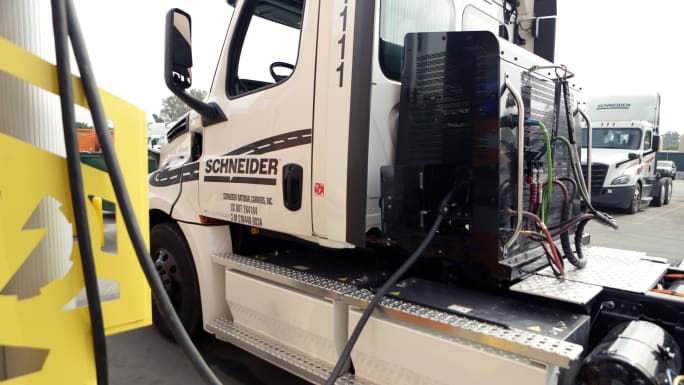
Beginning in 2022, Schneider will add 50 Freightliner eCascadias to its Southern California intermodal operations.
Photo: ACT Expo
At Schneider, the zero-emission trucks will replace the equivalent of more than 690,000 diesel-gallons annually while helping to accelerate commercialization of heavy-duty battery-electric vehicles across the market. Schneider officials say they has plans for more BEVs and route options.
The scaling of zero-emission vehicles is a key component of the company’s goal to reduce carbon emissions by 7.5% per mile by 2025 and by 60% per mile by 2035, said Schneider President and CEO Mark Rourke in a press release.
“We recognize the impact we can make through more significant innovation in fleet efficiency,” said Schneider Executive Vice President and Chief Administrative Officer Rob Reich. “Our primary sustainability focus is to minimize the environmental impact directly from our fleet.”
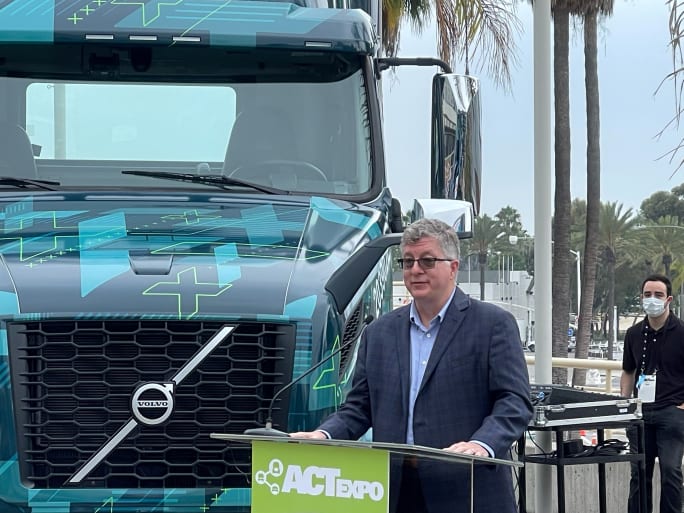
Schneider Executive Vice President and Chief Administrative Officer Rob Reich at ACT Expo.
Photo: Jack Roberts
Schneider has piloted an eCascadia for six months through Freightliner’s Customer Experience fleet.
More Fuel Smarts
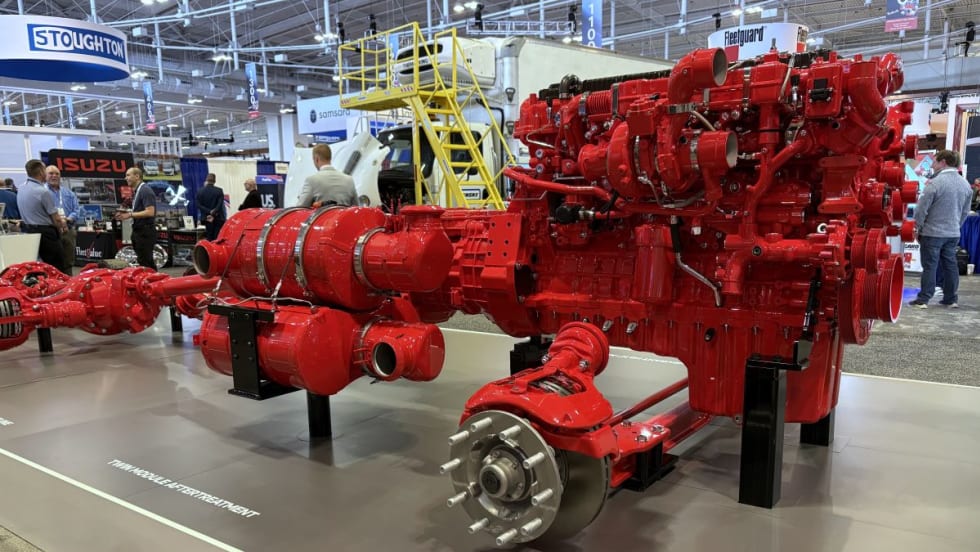
Cummins Adjusts 2027 Engine Rollout After EPA Proposal
The engine maker will gradually introduce its new Model Year 2027 diesel engines while continuing to offer current models during the transition, citing the EPA's proposed emissions rule changes.
Read More →
EPA Proposal Could Ease 2027 Truck Costs and Buying Uncertainty
The proposal doesn't change the tougher NOx standard, but it would revise key implementation requirements that manufacturers say have driven up costs and complicated fleet purchasing decisions.
Read More →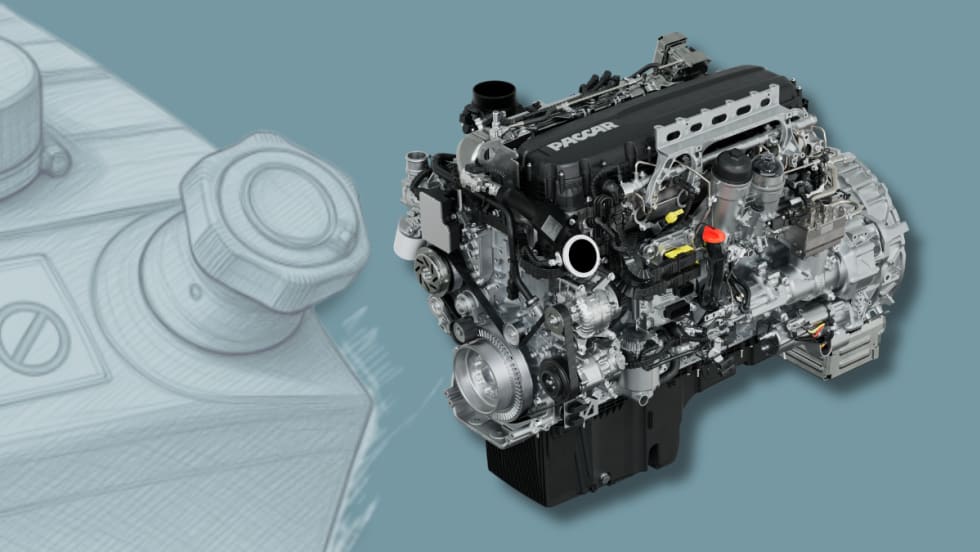
Cummins, Paccar Ease DEF Derates After EPA Guidance
Updated diesel engine software gives truck operators more time to address emissions-system issues while staying compliant with EPA emissions standards.
Read More →
Maintenance in the Messy Middle Part 3: Biodiesel
Biodiesel can reduce emissions, improve fuel-system lubricity and use existing diesel infrastructure. But NACFE’s Messy Middle maintenance report says fleets must actively manage storage, cold-weather operation, filters and oil drain intervals to avoid problems.
Read More →
Enhance Fleet Performance with High-Efficiency Auxiliary Power Units
Drive sustainable cost savings while increasing driver comfort during short- and long-haul logistics operations.
Read More →
Maintenance in the ‘Messy Middle’ Part 2: Renewable Diesel Fuel
NACFE's latest Messy Middle Powertrain Service & Maintenance report says renewable diesel gives fleets an opportunity to reduce carbon emissions without changing trucks, fueling infrastructure or maintenance practices. But technicians still need to understand several important operational differences.
Read More →
The Diesel Engine Enters NACFE’s ‘Messy Middle’
NACFE’s new Messy Middle Powertrain Service & Maintenance report says keeping modern diesel engines running now depends as much on software, diagnostics and data as traditional mechanical service.
Read More →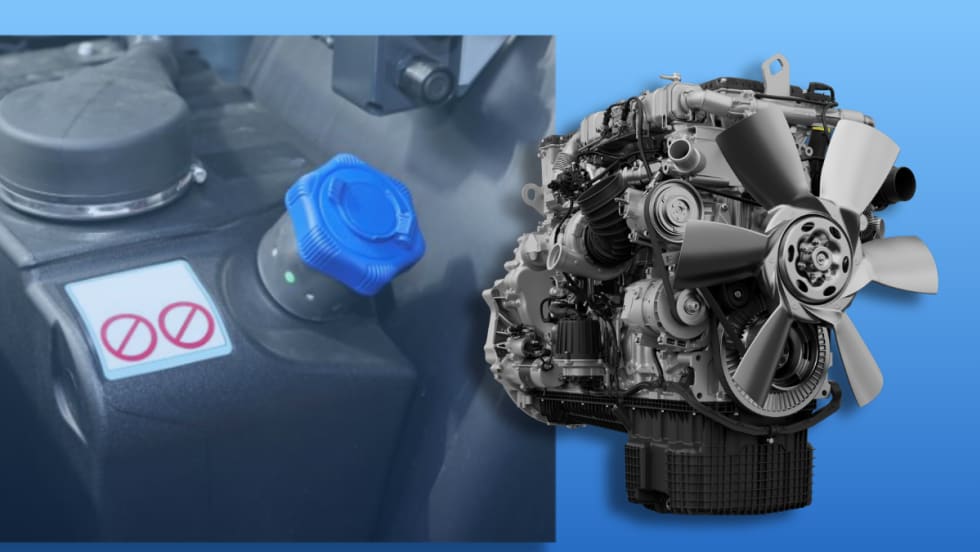
DTNA Software Update Gives Truckers More Time Before DEF Derates Take Effect
The changes reflect EPA guidance aimed at reducing downtime caused by emissions-system faults while maintaining compliance requirements.
Read More →
New Agentic Predictive Maintenance Report Demonstrates How Degraded Aftertreatment Systems Waste Fuel
Questar analyzed a large mixed-class fleet and discovered it was wasting as much as $30 in fuel per vehicle, per day, because of mechanically degraded aftertreatment systems.
Read More →
New York City's Microhub Project is Delivering Results
Trucking, last-mile delivery companies, and environmental advocates like what they are seeing so far with New York's microhub program.
Read More →