




Einride Achieves World-First Autonomous Border Crossing
Einride has successfully completed an electronic border crossing without any human intervention, the OEM announced.

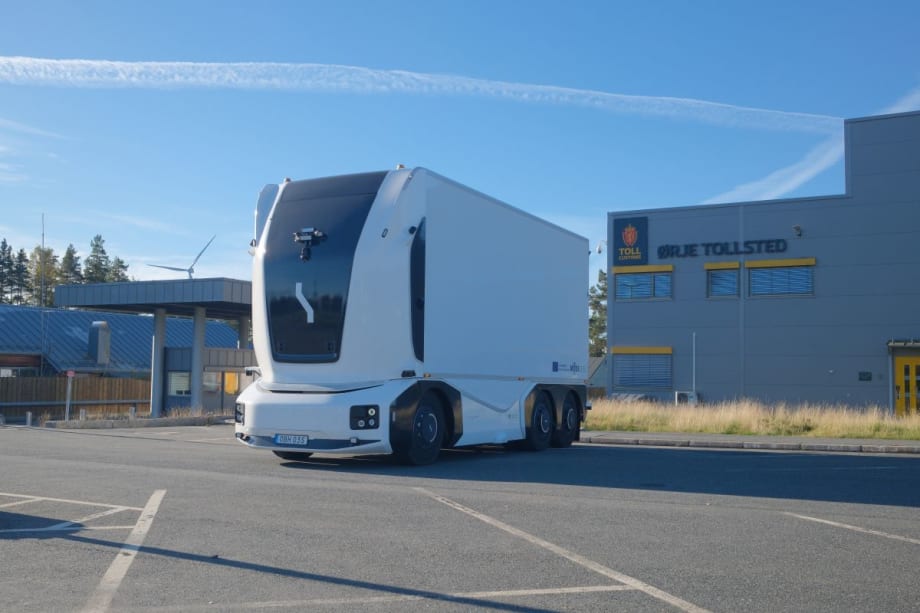
Einride has made the fully electronic, fully autonomous border crossing on behalf of PostNord – the Norwegian postal service.
Photo: Einride
In what it is calling a “world first, Einride announced it has successfully delivered goods from Sweden to Norway without any human intervention.
Einride made the fully electronic, fully autonomous border crossing on behalf of PostNord – the Norwegian postal service. The OE said the event marks the first cables, electric, autonomous border-crossing in history.
A Challenging Situation
The demonstration was part of the EU co-founded MODI project, aimed at enabling the safe rollout of autonomous transportation solutions in Europe.
Einride successfully passed through the Norwegian customs without a driver onboard, facilitated by C-ITS technology from its partner Q-Free.
The autonomous border-crossing took place at the Ørje border crossing and marks the world-first cabless electric autonomous crossing of a country's border.
Autonomous cross-border vehicle operations are challenging due to differing national regulations as well as technical barriers such as inconsistent road signage and customs procedures.
According to Einride, this significant achievement represents a major leap forward for autonomous cross-border operations, building on Einride's extensive background in industrial freight.
Tolletaten, The Norwegian Customs, is supporting the initiative due to the high relevance of automating this use case for their future operations.
To address the complexities of international border crossings and handle tasks typically managed by a human driver, Einride integrated its systems with Norway’s digital customs solution (Digitoll) through its partner Q-Free. This allows the OE to digitally declare goods in advance to create a seamless border customs clearance process.
Einride showcased the broader capabilities of its electric autonomous technology through the seamless integration of its advanced hardware and software, the company said.
This included the Einride Driver (the company’s proprietary Autonomous Drive Stack), its purpose-built cabless autonomous vehicle, and a Control Tower (an intelligent platform for fleet management and oversight), highlighting how the technology can improve safety, efficiency, and sustainability in road freight.
A Safe Rollout of Autonomous Driving Technology
This world-first cabless electric autonomous border-crossing demonstration is a key component of the EU co-founded MODI project.
The MODI project aims to enable the safe rollout of heavy-duty autonomous transportation across a wide variety of market applications, thereby improving the transport and logistics industry by accelerating the introduction of Connected, Cooperative, and Automated Mobility (CCAM) solutions.
"We are immensely proud to have completed the world's first cabless, electric, fully autonomous cross-border delivery," said Henrik Green, CTO and general manager for Einride Autonomous Technologies. "We are dedicated to continuously extending our capabilities into new applications, showcasing how autonomous technology can enhance transportation safety, efficiency, and sustainability. The MODI project perfectly embodies this commitment, assisting in the realization of EU value-based objectives by thoughtfully balancing safety with innovation."

The autonomous border-crossing took place at the Ørje border crossing, and marks the world-first cabless electric autonomous crossing of a country's border.
Photo: Einride
The autonomous border crossing is a joint effort between Swedish and Norwegian project partners including Statens Vegvesen, Sintef, Q-Free, Trafikverket and Østfold kommune, conducted on behalf of PostNord, annually shipping nearly 200 million parcels across the Nordic region.
“At PostNord, we are committed to exploring innovative solutions that make logistics more sustainable and efficient,” said May-Kristin Willoch, Head of Environment & DPO, PostNord Norway. “Taking part in this historic milestone with Einride demonstrates how autonomous and digital technologies can reshape the future of transport, reduce emissions, and improve safety. This achievement is not just about crossing a border – it’s about entering a new era for the logistics industry.”
More Equipment

How Volvo Updated Its D13 for EPA 2027 [Watch]
Volvo’s updated D13 promises lower emissions without sacrificing performance or fuel economy. Take a closer look at what changed inside the engine in this HDT Spotlight video.
Read More →
Michelin Tire Improves Efficiency and Durability for Regional Fleets
The Michelin X Multi Energy D2 is a regional haul drive tire engineered to help fleets improve fuel efficiency, durability and traction in demanding stop-and-go operations.
Read More →
ZF Expands Commercial Vehicle Push in North America
ZF is expanding its North American commercial-vehicle presence with new transmission applications, electrification, trailer technology and autonomous-driving systems.
Read More →
Tesla Wants a Self-Driving Semi. Are Cameras Enough?
Could Tesla’s camera-only autonomous driving technology work on an 80,000-pound Semi? In this commentary, HDT's Deborah Lockridge takes a look at Tesla, Cybercab, and how autonomous trucks see the road.
Read More →
Kodiak: Driverless Long-Haul Truck Launch on Track for 2026
Kodiak AI says its driverless long-haul safety case is 93% complete and it remains on track to begin commercial operations by year-end 2026.
Read More →
What DOT’s Automated Vehicle Strategy Means for Trucking
The U.S. Department of Transportation issued a new automated-vehicle strategy that outlines plans for driverless-truck regulations, cross-state freight corridors, and federal safety standards.
Read More →
East Coast Port Launches $45M Electric Truck Push
The Port Authority of New York and New Jersey announced millions in incentives for zero-emission drayage trucks, yard tractors, and new charging hubs near the port.
Read More →
PlusAI Going Public to Fund Autonomous Truck Launch
A SPAC deal could provide PlusAI with up to $300 million as it works toward a 2027 commercial launch of factory-built autonomous trucks.
Read More →
NHTSA Moves to Rewrite Truck Fuel-Economy Rules
The National Highway Traffic Safety Administration says it lacks authority to regulate medium- and heavy-duty truck engines separately from complete vehicles, but the existing standards have not yet been eliminated.
Read More →
Detroit Opens Orders for EPA 2027 Engines
Detroit isn’t starting from scratch to meet EPA 2027 diesel emissions standards. Its Gen 6 DD13 and DD15 engines keep much of today’s platform while updating the fuel and aftertreatment systems.
Read More →