




Economic Watch: Retail Sales, Industrial Production Improve
A jump in retail sales and industrial output are just two of several economic indicators released Friday showing the economy is performing at least somewhat better, but there are still some lingering concerns.

A jump in retail sales and industrial output are just two of several economic indicators released Friday showing the economy is performing at least somewhat better, but there are still some lingering concerns.
The U.S. Commerce department reports a 0.6% jump in retail sales in June from the previous month, but that follows a downwardly revised 0.2% improvement in May that was first reported as 0.5% gain.
This most recent performance exceeded many analysts' expectations. Retail sales increased at a 2.7% annual pace in June, better than May’s 2.2% rate. In the first six months of the year, sales are 3.1% higher than during the same period in 2015.
Pushing June sales higher was a 3.9% surge at building supply stores, the biggest hike since 2010. Sales of motor vehicles and parts improved 0.1% compared to a 0.5% drop in May. Overall, 11 of the 13 categories saw an increase in June sales, as non-store retailer sales (including e-commerce) grew at their fastest annual pace in a decade, up 14.2% from a year ago.
So-called “core or control sales,” which exclude the more volatile figures for autos, gasoline, building materials and food, increased 0.5%, the eighth straight month they have improved.
The improvement prompted some economists to revise their forecasts higher for second quarter annual gross domestic product growth beyond 2%. First-quarter GDP growth was an anemic 1.1% annual rate.
“Another solid increase in June leaves control retail sales up an annualized 7.4% in second quarter," said Josh Nye, economist at RBC Economics. "This supports our expectation that consumer spending surged 4% after a disappointing 1.5% increase in first quarter.
“Abstracting from volatility over the first half of the year, which is likely due in part to seasonal adjustment issues, consumer spending continues to trend higher at a solid clip alongside robust, albeit choppy, job gains and a gradual pickup in wages.”
He also said while recent figures show a slight moderation in employment growth, it’s more a reflection of the economy nearing full employment rather than a slowdown in underlying activity. Consumer spending should remain an area of strength for the U.S. economy, he contended.
Inventories continue to rise
While this report could add to hopes that trucking will see more freight due to stronger sales, it could be offset by continuing issues with inventories. The Commerce Department also reported on Friday that U.S. business inventories rose more than anticipated in May.
The 0.2% increase follows an unrevised 0.1% gain in April. Retail inventories excluding autos increased 0.4% in May following a 0.2% drop in May.
Retail inventories have pulled down the nation’s GDP rate for the past year. Businesses stocked up, but those inventories were well ahead of sales demand. Inventories were down just 1.4% in May from a year earlier.
The latest hike was likely due to higher prices, according to Reuters.
A separate Commerce Department report, also released Friday, shows retail prices in June increased 0.2% form the month before, its fourth consecutive monthly gain and slightly more than Wall Street expectations.
This increase in the Consumer Price Index (CPI) puts the nation’s annual inflation rate at 1%. The so-called “core inflation” rate, which strips out volatile food and energy prices, also rose 0.2% in June, the same gain for the past three months.
The “core CPI” is up 2.3% over the past year, beating the average annual rate of 1.9% for the past decade, according to Reuters. This is beyond the Federal Reserve’s target of a 2% annual increase, a standard it set previously as a precondition for increasing interest rates. This latest performance is likely to add to speculation the Fed will increase interest rates as soon as September, following its first hike in many years last December.
The report on retail sales follows one from a day earlier showing prices at the wholesale level increased 0.5% in June, the biggest increase in a year. The jump in the Producer Price Index (PPI) was bigger than expected but is up only 0.3% over the past year, the first time it has been in positive territory since December 2014.
But... Consumer Sentiment Declines
Even with another pickup in retail sales in June, a preliminary reports shows a downturn in consumer sentiment this month, according to the University of Michigan Survey of Consumers. However, the results were skewed by one group.
Its Index of Consumer Sentiment fell 4.3% from the month before, with declines also recorded in measures of consumer feelings about current economic conditions and consumer expectations. However, the results, according to Surveys of Consumers chief economist Richard Curtin, are due to increased concerns about prospects for the national economy that were mainly voiced by high-income households.
“Prior to the Brexit vote, virtually no consumer thought the issue would have the slightest impact on the U.S. economy,’" he said. “Following the Brexit vote, it was mentioned by record numbers of consumers, especially high-income consumers.”
According to the survey, nearly one in four households with incomes in the top third mentioned Brexit when asked to identify any recent economic news that they had heard.
“For these households, the initial impact on domestic stock prices translated Brexit into personal wealth losses," Curtin said. “While stock prices quickly rebounded, an underlying sense of uncertainty about global prospects, as well as the outlook for the domestic economy, have not faded.”
He said the overall decline in the Sentiment Index was “rather minor,” and could be anticipated to recover some of those losses in late July or early August. Curtin is forecasting consumer spending to rise by 2.7% in both 2016 and 2017.
Industrial Production Does About-Face But Remains Soft
Meantime, the Federal Reserve released a report Friday showing industrial production increased 0.6% in June after declining 0.3% in May.
For the second quarter as a whole, this measure of activity at the nation’s factories, mines and utilities fell at an annual rate of 1%, its third consecutive quarterly decline.
Manufacturing output moved up 0.4% in June, a gain largely due to an increase in motor vehicle assemblies, as the output of manufactured goods other than motor vehicles and parts was unchanged. This follows a 0.3% May decline and an increase of 0.1% in April.
The measure for utilities rose 2.4% as a result of warmer weather than is typical for June, boosting demand for air conditioning. The output of mining moved up 0.2% for its second consecutive small monthly increase following eight straight months of decline.
At 104.1% of its 2012 average, total industrial production in June was 0.7% lower than its year-earlier level.
Capacity utilization for the industrial sector increased 0.5 of a percentage point in June to 75.4%, a rate that is 4.6 percentage points below its long-run 1972–2015 average.
The June performance is adding to hopes manufacturing is starting to see increased signs of better life, following a measure of the sector from the Institute for Supply Management increasing in June to its highest level in 16 months. However, some point out since manufacturing outside of the auto sector failed to gain in the Federal Reserve report, it's unlikely the manufacturing sector will see a big boost when ISM figures for July are released on August 1.
More Fleet Management

How Innovative Trucking Leaders Turn Change Into an Advantage
As the pace of change accelerates in trucking, the fleets that adapt best have more than the latest technology. They have cultures that embrace improvement.
Read More →
Freight Broker Bonds Just Got Harder to Get. Here's What That Means for Your Fleet.
When it gets harder for a freight broker to prove they are financially sound, the ones who cannot clear that bar get pushed out of the market. And those are exactly the brokers who used to leave motor carriers holding the bag.
Read More →
Long-Awaited Canadian Border Bridge to Open in Detroit
For trucking, the bridge opening should offer immediate improvements in efficiency and reliability, with new customs facilities, expanded inspection capacity, and direct freeway-to-freeway connections.
Read More →
Aurora Rolls Out Next Generation of Driverless Trucks for Commercial Freight
Aurora's latest autonomous trucks it's rolling out with International feature lower-cost hardware designed for a million miles as the company expands commercial driverless freight operations across the U.S. Sun Belt.
Read More →
Freight Tonnage Down, Rates up, as Lower Capacity Powers Trucking Recovery
The recovery from the freight recession continues to be driven by reduction in capacity rather than by increased demand.
Read More →
Think Your Trucking Fleet Isn't Using Much AI? Think Again
Shadow AI — the use of unauthorized artificial intelligence tools at work — is becoming increasingly common, putting sensitive company data at risk. Learn how trucking fleets can protect sensitive data while embracing AI.
Read More →
ArcBest Consolidates Brands, Cuts Workforce
The company will bring three business units under the ArcBest brand, eliminate about 2% of positions, and expects the changes to generate $40 million in annual savings.
Read More →
Trucking Fleets Faced Record Operating Costs During Third Year of Freight Recession
ATRI's annual operational cost report shows carriers trimmed fleets, delayed equipment purchases, and ran older trucks as expenses continued to outpace freight rates.
Read More →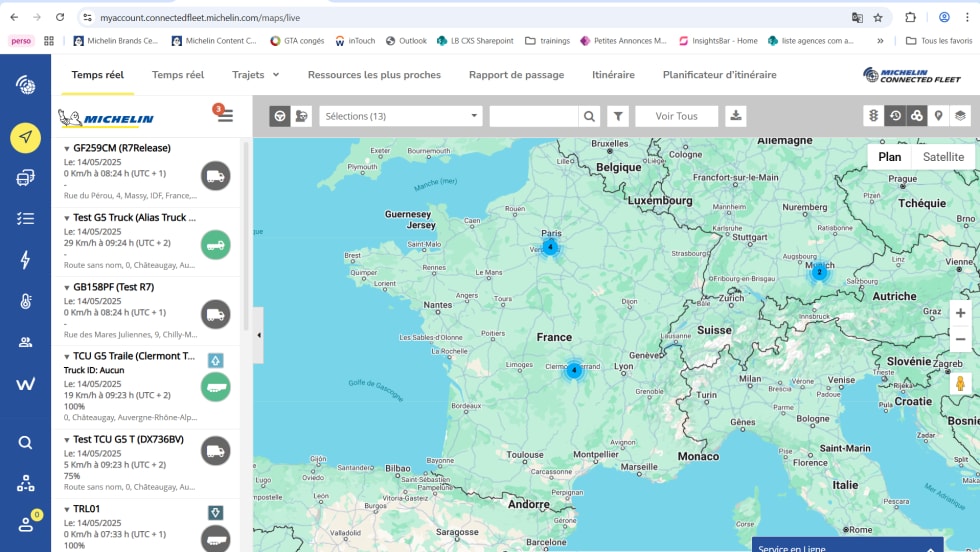
Michelin Adds AI Assistant to MyConnectedFleet Platform
Michelin’s new generative AI tool delivers instant fleet insights, helping managers analyze fuel use, tire maintenance, vehicle status, and operational performance without manually creating reports.
Read More →
LytxOne Platform Now Features AI, Compliance, and Asset Tracking Tools
New enhancements add AI-powered insights, asset tracking, compliance automation, and configurable privacy controls to Lytx's all-in-one fleet management platform.
Read More →