




Economic Watch: Retail Sales, Consumer Confidence and Producer Prices Decline
Retail sales moved 0.1% lower in September from August but were 3.2% higher from the same time in 2012, according to the U.S. Commerce Department.

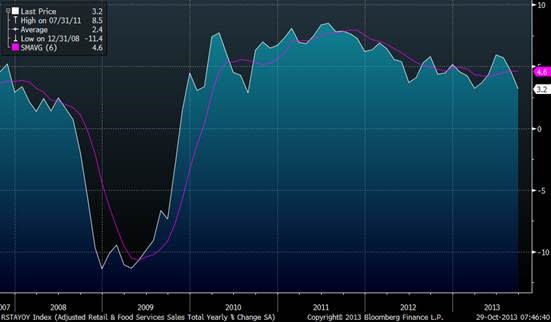
Retail Sales with six-month moving average. Credit: Sterne, Agee & Leach
Three new separate reports show retail sales, consumer confidence and wholesale prices are down.
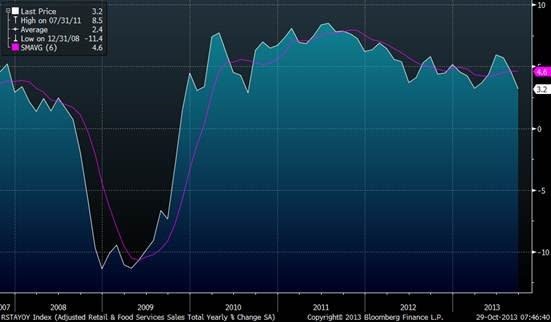
Retail Sales with six-month moving average.
Sterne, Agee & Leach
Retail sales moved 0.1% lower in September from August but were 3.2% higher from the same time in 2012, according to the U.S. Commerce Department.
The weakness was centered around autos, down 2.2%, the biggest decline in auto dealer sales since October 2012. Excluding autos, retail sales rose 0.4% in September. Year-over-year auto sales are up 5.1% in September.
Clothing sales dropped 0.5% in September, department stores sales declined 0.9% and miscellaneous purchases fell 1.2%. On the side of strength, furniture sales rose 0.2% in September, electronics purchases increase 0.7% and food and beverage sales increased 0.9%. Health and personal care sales improved 0.4%, building materials gained a minimal 0.1%, and sporting goods sales gained 0.5%. Finally, general merchandise sales and non-store retailers purchases both increased 0.4% in September. Net retail sales rose in nine of the 13 major categories.
“While it’s easy to point to the government shutdown as the catalyst to weak headline spending in September and further into the fourth quarter, it doesn't tell the whole story,” said Lindsey M. Piegza, managing director and chief economist at the investment firm Sterne Agee. “Of course the ongoing shenanigans in Washington have sown uncertainty exacerbating the consumers’ inclination to remain sidelined, but the weak trend in spending was already well established before talks in Washington began. Amid tepid job creation and minimal income growth, consumers are struggling to keep their heads above water.”
She said retailers are already initiating holiday discounts to lure in customers, but many more see the declining trend in spending and bracing for a weak holiday season, resulting in lowering sales forecasts and reducing seasonal hiring.
The report came as a new survey by The Conference Board shows consumer confidence is down this month.
Its Consumer Confidence Index, which had declined moderately in September, decreased sharply in October. It now stands at 71.2 compared 80.2 in September.
“Consumer confidence deteriorated considerably as the federal government shutdown and debt-ceiling crisis took a particularly large toll on consumers’ expectations,” said Lynn Franco, director of economic indicators at The Conference Board. “Similar declines in confidence were experienced during the payroll tax hike earlier this year, the fiscal cliff discussions in late 2012, and the government shutdown in 1995/1996. However, given the temporary nature of the current resolution, confidence is likely to remain volatile for the next several months.”
Finally a third report from the U.S. Labor Department shows prices at the wholesale level edged slightly slower in September.
The Producer Price Index fell 0.1% from the month before, following a 0.3% increase in August Excluding the volatile categories of food and energy, core wholesale prices rose 0.1%. in September.
“From the Federal Reserve’s standpoint inflation remains a non-issue continuing its slow, downward trend on an annual basis and remaining well below the Fed’s threshold of 2.5%,” said Piegza. “Remember the Fed’s primary fear of inflation stems from tightness in the labor market or a decline in the pool of available labor putting upward pressure on wages. But with a pool of labor topping 18 million and 13 million Americans actively seeking employment, resulting in less than 1% real annual wage growth, it is clear there is still ample slack in the labor market.”
She notes, more recently, Fed officials have pointed to potential bubbles particularly in the financial markets as taking precedence over a fear of inflation.
More Fleet Management

What Will ATA’s New Leader Bring to Trucking's Table?
Incoming President and CEO Mark Colson’s record in Alabama offers clues about his priorities and approach following Chris Spear’s abrupt departure as the head of the American Trucking Associations.
Read More →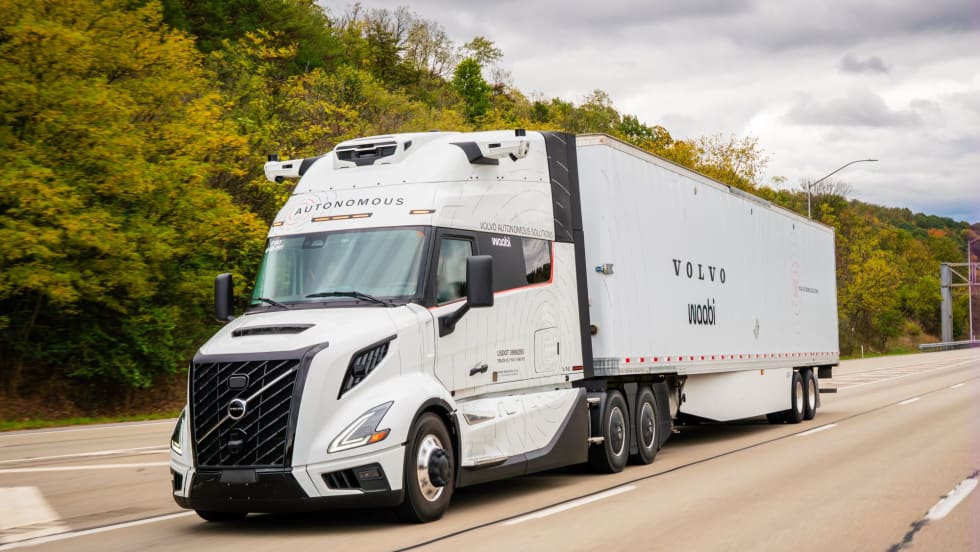
Volvo, Waabi Start Commercial Autonomous Operations in Texas
Volvo VNL Autonomous trucks, powered by the Waabi Driver, are hauling freight directly to third-party facilities for a customer in Texas.
Read More →
Samsara Launches Custom AI Agent Builder
Agent Studio lets fleets create AI tools for hours-of-service monitoring, reporting and driver support, including agents that communicate by phone.
Read More →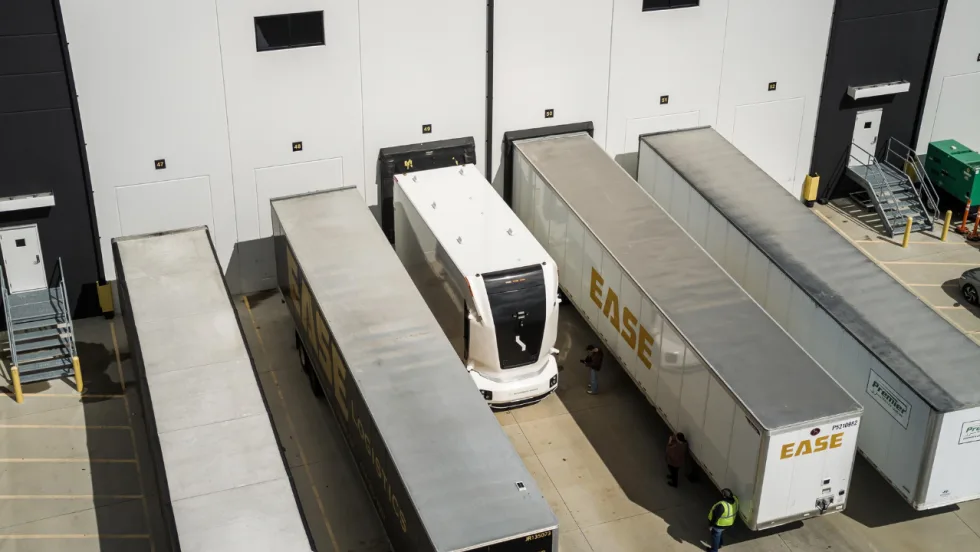
Einride Driverless Electric Trucks Begin Daily Freight Operations in Ohio
Two cabless electric trucks are hauling freight between EASE Logistics facilities in Marysville, Ohio, as part of a multi-state truck automation project.
Read More →
Geotab Links Fleet Card to Vehicle Data
The new card combines fuel discounts with telematics-based purchase controls. Geotab’s analysis also points to potential savings from choosing lower-priced fuel stops.
Read More →
How MFA Helps Protect Trucking Fleets
Multi-factor authentication adds protection when passwords are stolen. Here’s how it works and where fleets should start.
Read More →
How Better Freight Data Helps Trucking Teams Get Ahead of Disruption
Trucking and logistics teams have plenty of data. The problem is getting the right information in front of the right people soon enough to act. Better-connected data can help teams spot trouble earlier and make smarter decisions before small problems become big ones.
Read More →
Trimble: Taking Artificial Intelligence in Trucking Beyond Faster Tasks
At Insight 2026, Trimble executives argued that fleets may need to redesign workflows to get more from AI as it introduced new products and enhancements. AI’s value will depend on how fleets combine automation with their people's knowledge.
Read More →
Build a bulletproof fleet: Uniting ELDs and dash cams for total compliance
An ELD can prove compliance, but it cannot always prove what happened on the road. Discover how uniting accurate ELD data with AI-powered dash cam video can help your fleet strengthen compliance, defend against liability, protect drivers and reduce operational costs.
Read More →
Nominations Open for HDT Emerging Leaders
Heavy Duty Trucking is looking for accomplished trucking fleet professionals under 40 who are making an impact and helping lead the industry forward.
Read More →