




Economic Watch: Job Creation, Non-Manufacturing Employment Lose Steam
UPDATED -- Private sector employment increased by 139,000 jobs from January to February, according to the National Employment Report released Wednesday by the payroll management services provider ADP.

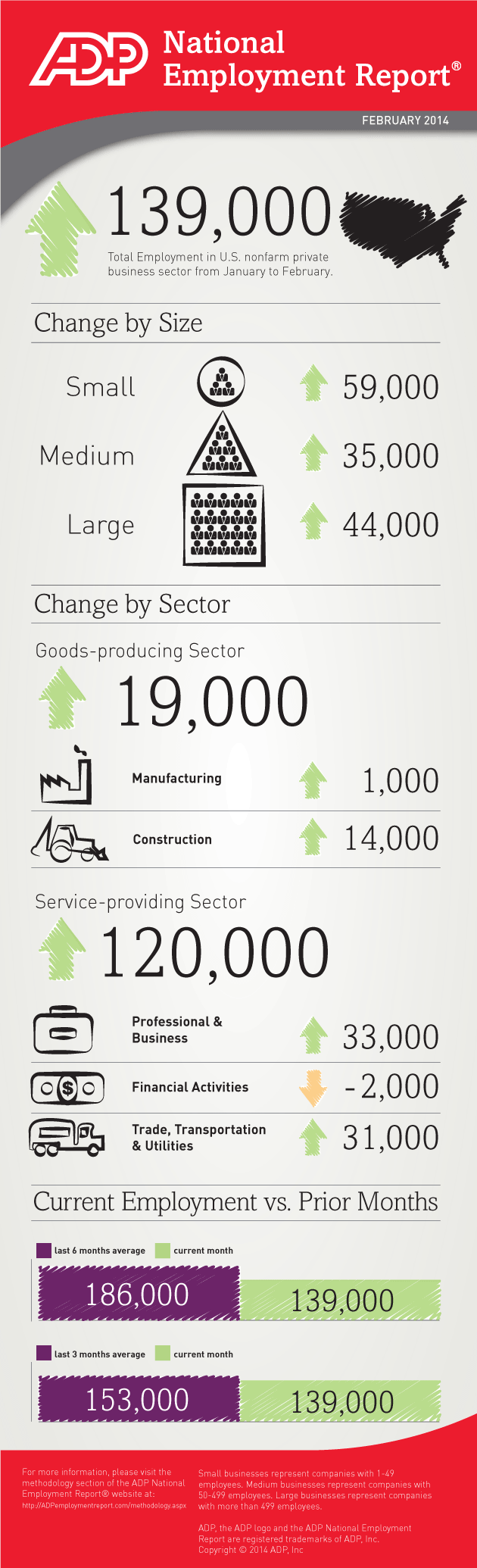
UPDATED -- Private sector employment increased by 139,000 jobs from January to February, according to the National Employment Report released Wednesday by the payroll management services provider ADP.
The increase is well below the average over the last 12 months.
Mark Zandi, chief economist of Moody’s Analytics, said, "February was another soft month for the job market. Employment was weak across a number of industries. Bad winter weather, especially in mid-month, weighed on payrolls. Job growth is expected to improve with warmer temperatures.”
Payroll growth for businesses with 49 or fewer employees accelerated in February, adding 59,000 jobs. Though the month was improved from January, growth remains slower than previous months. The smallest gain for small businesses in 2013 was 71,000.
Employment levels among medium-sized companies, those with 50-499 employees, rose by 35,000 and employment at large companies, those with 500 or more employees, increased by 44,000. While this represented acceleration in job growth for large firms, growth at mid-size firms was slower than it has been since April 2013.
A separate report shows economic activity in the non-manufacturing sector grew in February for the 49th consecutive month, but the level was the slowest in four-years, according to the nation's purchasing and supply executives.
The report from the Institute for Supply Management show its Non-Manufacturing Index registered 51.6% in February, 2.4 percentage points lower than January's reading of 54%. The Non-Manufacturing Business Activity Index decreased to 54.6%, which is 1.7 percentage points lower than the reading of 56.3% reported in January, but reflects growth for the 55th consecutive month.
The New Orders Index registered 51.3%, 0.4 percentage point higher than the reading of 50.9% registered in January. The Employment Index decreased 8.9 percentage points to 47.5% from the January reading of 56.4% and indicates contraction in employment for the first time after 25 consecutive months of growth.
“A disappointing decline in headline service activity in February, suggesting a weakened consumer state,” said Lindsey Piegza, chief economist with the investment firm Sterne Agee. “However, improvement in the key forward-looking indicators, new orders and backlog, suggests improving momentum and activity in the pipeline.”
She notes while consumers have been cutting back on goods consumption, service consumption is on the rebound, particularly in health care. “In other words, unlike many of the retail indicators, we expect steady support, at least in the near term, reflecting consumers appetite for services,” she said.
A third report shows overall economic activity in the U.S. continued to expand from January into February.
The Federal Reserve “beige book” says reports from most of its regions indicate improved levels of activity, but in most cases the increases were characterized as modest to moderate.
New York and Philadelphia experienced a slight decline in activity, which was mostly attributed to the unusually severe weather experienced in those regions. Growth slowed in Chicago, and Kansas City reported that conditions remained stable during the reporting period. The outlook among most Districts remained optimistic.
Retail sales growth weakened since the previous report for most districts, as severe winter weather limited activity. However, Richmond, St. Louis, and Minneapolis reported modest sales growth since the beginning of the year. Weather was also cited as a contributing factor to softer auto sales in many districts, with the exception of Cleveland, which saw strong gains.
Manufacturing sales and production in several districts were negatively impacted by severe winter weather; however, modest improvements were noted in Boston, Atlanta, Minneapolis, and Dallas.
Residential real estate markets continued to improve in several areas, albeit modestly. Boston and New York gave mixed reports on sales, and Philadelphia, Cleveland, Minneapolis, and Kansas City noted a decrease in sales. Many districts cited low inventories of housing and continued home price appreciation.
Update adds Federal Reserve report.
More Fleet Management

Your Trucks Are Busy. That Doesn’t Mean They’re Winning.
High utilization doesn’t always mean strong margins. Looking beyond the current load can help fleets make better dispatch decisions and get more value from each truck’s time.
Read More →
Why This Trucking Recovery Is Different
Freight demand remains sluggish, but rising costs and tougher enforcement have taken enough capacity out of the market to change the outlook for motor carriers.
Read More →
Platform Science Adds Dispatch and Safety Tools
Four additions to PS Fleet help fleets monitor loads, manage driver coaching, share truck locations and adjust video system settings.
Read More →
PrePass Intelligence Mines Fleet Bypass, Toll and Safety Data
PrePass Intelligence helps fleets measure bypass savings, flag potential toll overcharges, and spot suspicious transactions by combining data from separate systems.
Read More →
Motive Adds AI Agents for Fleet Operations
New tools automate follow-up on fleet data, from maintenance work orders to driver alerts, with two-way voice conversations planned for later this year.
Read More →
Can You Beat Our Trucking Trivia Challenge?
Test your truck knowledge with 19 trivia questions from Heavy Duty Trucking Exchange. Can you keep up with the fleet pros?
Read More →
BeyondTrucks Adds Rules Checks to Dispatch
New Compatibility Engine checks driver qualifications, equipment requirements and fleet policies before loads are dispatched.
Read More →
Diesel Prices Hijack Trucking’s Worry List
ATRI’s annual survey finds cautious optimism about freight, but diesel costs, litigation, and insurance continue to squeeze fleets. Drivers have different priorities on several issues.
Read More →
Nomination Deadline Extended for HDT Emerging Leaders
Just a few more days to nominate accomplished trucking fleet professionals under 40 who are making an impact and helping lead the industry forward for the HDT Emerging Leaders award. Deadline extended to October 20!
Read More →
What Will ATA’s New Leader Bring to Trucking's Table?
Incoming President and CEO Mark Colson’s record in Alabama offers clues about his priorities and approach following Chris Spear’s abrupt departure as the head of the American Trucking Associations.
Read More →