





From the HDT archives (2014): Daimler Trucks Shares its Vision of the Future
DTNA's New Engineering Chief on Autonomous Tech, Electric Trucks and More
When Rainer Müller-Finkeldei started working on artificial intelligence at Daimler in 1995, few people knew what AI was or had heard of neural networks. Now he’s in the thick of autonomous truck development and more as the new senior vice president of engineering and technology at Daimler Trucks North America.
August 4, 2020
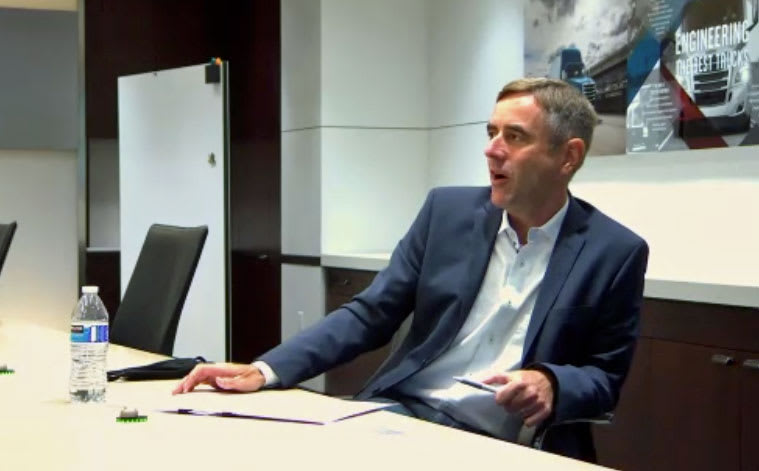
Rainer Müller-Finkeldei speaks to reporters via Zoom call.
Photo: Screen capture of Zoom call
6 min to read
When Rainer Müller-Finkeldei started working on artificial intelligence at Daimler in 1995, few people knew what AI was or had heard of neural networks. Now he’s in the thick of autonomous truck development and more as the new senior vice president of engineering and technology at Daimler Trucks North America.
Müller-Finkeldei, who also has been appointed to DTNA’s operating committee, assumes responsibility for all DTNA product engineering activities. Müller-Finkeldei replaces Wilfried Achenbach, who will retire after a 10–year tenure in the role. He joins the company from Mercedes-Benz Trucks, where he has served as director of Mechatronics since 2010.
In a Zoom call with trucking journalists on Aug. 4, Müller-Finkeldei characterized himself as a “mad physics guy” who “studied computer science [when] nobody knew what that was.”
Müller-Finkeldei’s team pioneered SAE Level 2 autonomous technology that underpins advanced driver assist systems in Daimler brands worldwide. He also noted the advances in HMI (human-machine interface) systems in trucks, as dashboards have been moving from classic needle-based instrument clusters to multi-functional touch-screen displays.
“Taking over the lead for the full vehicle development is a great opportunity,” he said, noting he was especially excited about electric trucks and autonomous technology.
Autonomous Trucks
“I’m really happy to be involved in our great journey to pioneer autonomous driving in trucks,” he said, “something I was fascinated about right from the beginning. Having followed these technologies, we’re now seeing that evolving to a totally new level; for me it’s one of the technologies that has the potential of changing the overall transportation industry globally.”
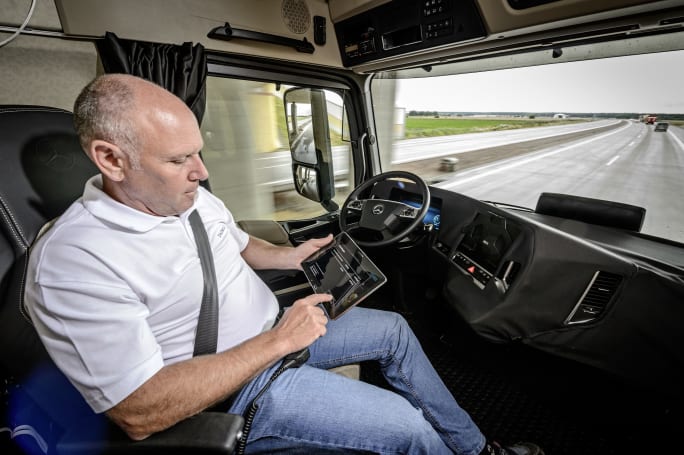
Daimler's Future Truck concept demonstrated autonomous truck technology back in 2014.
Photo: Daimler Trucks
He was on the team at Daimler when it started developing autonomous trucks, he said. But when we’ll actually get to true “driverless trucks” is not something he feels one can predict.
“As always in something as innovative and unexplored as autonomous driving is, it’s hard to say whenever this point will be,” he said. “We are focused on making level 4 autonomous driving possible. Level 5, having a truck that fully autonomously is able to cope with every situation, this a technology that I see pretty way out there.”
Daimler, he said, is focused on one area that has “a good chance of being the first segment where Level 4 autonomous driving is technically possible, and this is the classic hub to hub, on known routes, where we have exact mapping of those roads, where we can make sure the vehicle is in a safe place when it starts, and we can closely monitor those vehicles.”
DTNA is working with Torc Robotics in this effort; last year, Daimler Trucks acquired a majority stake in Torc as part of a strategy that will see the United States become the focus of the company’s autonomous technology development efforts.
“Yes, it’s still a way out, there are still quite some problems to conquer and to solve, but with our partner Torc we are learning every day, and automated trucks are out on the road collecting data every day in autonomous mode with a safety driver on board, and we are learning every day how to make this happen,” Müller-Finkeldei said. “I’m not able to give you a date when this will be, but I’m confident that we picked the right spot to have the first application of autonomous driving, in trucks and in that very specific use case of hub-to-hub delivery.”
He contrasted his reticence to predict a timeline with some of the many companies that are out there working on autonomous vehicle development. “If I look at the startups, they are always saying it will be next year – and every year it’s next year.”
Electric Vehicles
Perhaps on the nearer horizon are batter-electric trucks. Müller-Finkeldei pointed to DTNA’s Innovation Fleet of eCascadias and eM2s, a fleet of 30 electric trucks that so far has accumulated 300,000 miles in real-world use by customers.
Globally, he said, there are already electric commercial buses operating in many cities, and the knowledge gained from those operations has been used to help develop electric trucks.
He also pointed out that when it comes to electric trucks, there’s more to putting them into service than just building a working truck.
“It’s not enough to simply have an electric driven truck with some batteries and electric motors,” he said. “You have to have the full environment and infrastructure in place at your customers. You have to work with your customers from the beginning to figure out if the application is suitable for electric drive in terms of range, in terms of the possibility of bringing back the vehicle to a central hub, is there time to do the recharging of the batteries and so on. And we work with customers to build up the needed [charging] infrastructure.”
Today, he said the cost of electric trucks is still too high to make them competitive with conventional diesel, but with coming advances in areas such as next-generation electric components and batteries, “we can see that also in the next years we will see electric vehicles coming to a point where for certain applications – and this is for sure still limited range, we are talking about a range of 100-200 miles or a little more – that this will come into a position where from an economic standpoint it makes sense to move over from an internal combustion engine.”
Advancing Conventional Powertrains
While autonomous and electric trucks may be exciting future-looking projects, Müller-Finkeldei also emphasized that conventional diesel-powered trucks are still customers’ main focus.
The company will soon be launching a new Western Star, for instance, which he said he is “very convinced will be the next big thing in the vocational market.” DTNA has been working to carry over the technology from its on-highway truck leadership and use it to meet the needs and expectations of vocational customers.
“We are focusing on continuing to develop fuel economy benefits that every year add more savings” for customers, he said. Connectivity is also a big focus, which helps improve uptime and reliability.
Connectivity and the data that comes from that, he said, also can help DTNA give information to customers to help them improve their businesses. “What can I do for example to train my drivers to get even better fuel economy? How can I make best use of the safety systems out there? I am convinced there is still quite a potential of finding efficiencies and savings for our customers.”
When it comes to telematics, he also pointed out that DTNA is working with partners such as Platform Science to integrate third-party applications into its trucks. “You wouldn’t expect a smartphone OEM to make all their own apps.”
More About the Transition

Rainer Müller-Finkeldei is the new senior vice president of engineering and technology for Daimler Trucks North America.
Photo: Daimler Trucks North America
Müller-Finkeldei joined Daimler’s research labs in 1995 while working on his PhD. He obtained his PhD and Masters in Computer Science and Physics from the Julius-Maximilians University of Wurzburg, Germany, and he studied computer science at both the University of Würzburg and the University of Texas at Austin. He and his family will relocate to Portland from their home in Stuttgart.
From 2006 to 2010, Müller-Finkeldei served as the senior manager of Mechatronics’ integration and validation team. Since joining Daimler, he has held increasing roles of responsibility across Daimler business units and engineering functions, including Daimler Trucks product creation group, electronics development at Daimler vans, and Daimler’s research and technology department.
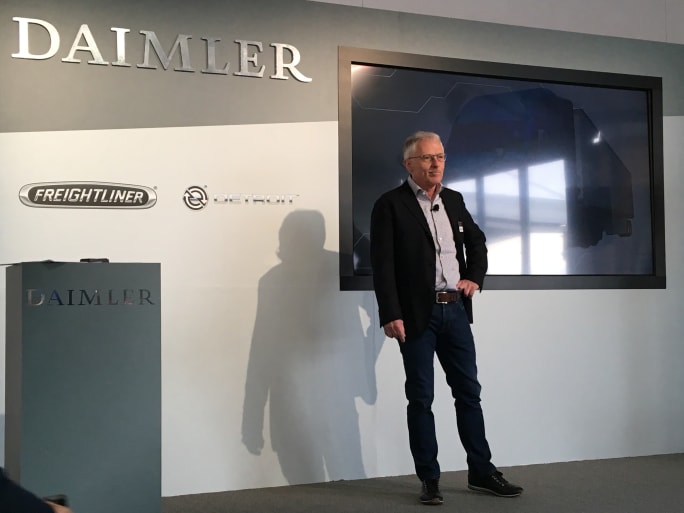
Müller-Finkeldei replaces the retiring Wilfried Achenbach, shown here at the CES electronics show in 2019.
Photo: Jim Park
Achenbach joined DTNA from his former role as director of Mechatronics at Mercedes-Benz Trucks – the role now vacated by Müller-Finkeldei.
“Achenbach leaves an enduring mark on the DTNA team,” according to the announcement, “having solidified an engineering culture defined by its values of teamwork, engineering excellence, fuel economy leadership and, above all, safety. Under Achenbach’s stewardship, DTNA became the first commercial vehicle manufacturer in North America to introduce an SAE Level 2 autonomous advanced driver assistance system, Detroit Assurance.
More Equipment

How Volvo Updated Its D13 for EPA 2027 [Watch]
Volvo’s updated D13 promises lower emissions without sacrificing performance or fuel economy. Take a closer look at what changed inside the engine in this HDT Spotlight video.
Read More →
Michelin Tire Improves Efficiency and Durability for Regional Fleets
The Michelin X Multi Energy D2 is a regional haul drive tire engineered to help fleets improve fuel efficiency, durability and traction in demanding stop-and-go operations.
Read More →
ZF Expands Commercial Vehicle Push in North America
ZF is expanding its North American commercial-vehicle presence with new transmission applications, electrification, trailer technology and autonomous-driving systems.
Read More →
Tesla Wants a Self-Driving Semi. Are Cameras Enough?
Could Tesla’s camera-only autonomous driving technology work on an 80,000-pound Semi? In this commentary, HDT's Deborah Lockridge takes a look at Tesla, Cybercab, and how autonomous trucks see the road.
Read More →
Kodiak: Driverless Long-Haul Truck Launch on Track for 2026
Kodiak AI says its driverless long-haul safety case is 93% complete and it remains on track to begin commercial operations by year-end 2026.
Read More →
What DOT’s Automated Vehicle Strategy Means for Trucking
The U.S. Department of Transportation issued a new automated-vehicle strategy that outlines plans for driverless-truck regulations, cross-state freight corridors, and federal safety standards.
Read More →
East Coast Port Launches $45M Electric Truck Push
The Port Authority of New York and New Jersey announced millions in incentives for zero-emission drayage trucks, yard tractors, and new charging hubs near the port.
Read More →
PlusAI Going Public to Fund Autonomous Truck Launch
A SPAC deal could provide PlusAI with up to $300 million as it works toward a 2027 commercial launch of factory-built autonomous trucks.
Read More →
NHTSA Moves to Rewrite Truck Fuel-Economy Rules
The National Highway Traffic Safety Administration says it lacks authority to regulate medium- and heavy-duty truck engines separately from complete vehicles, but the existing standards have not yet been eliminated.
Read More →
Detroit Opens Orders for EPA 2027 Engines
Detroit isn’t starting from scratch to meet EPA 2027 diesel emissions standards. Its Gen 6 DD13 and DD15 engines keep much of today’s platform while updating the fuel and aftertreatment systems.
Read More →