





Related: Hair Testing Could Take Nearly 300,000 Truck Drivers Off the Road
Drug Testing Refusal Data Added to Clearinghouse Report
New information in the latest Drug and Alcohol Clearinghouse Report could accelerate calls for federal approval of other testing methods, such as hair and oral fluid testing, according to one safety and compliance expert.
July 20, 2020

Image: Rex Medlen from Pixabay
3 min to read
New information in the latest Drug and Alcohol Clearinghouse Report could accelerate calls for federal approval of other testing methods, such as hair and oral fluid testing, according to one safety and compliance expert.
The June 2020 Monthly Summary Report, the second such report issued by the Federal Motor Carrier Safety Administration since the clearinghouse went into effect in January, showed an uptick in queries in June. That’s a change in direction, as those numbers dropped in March, April and May, presumably because of the economic slowdown and freight recession caused by the COVID-19 pandemic.
“The report allows us to pretty clearly see a COVID-related dip in pre-employment queries, indicating driver hiring slowed in March-May 2020 due to the pandemic,” said Dave Osiecki, president and CEO, Scopelitis Transportation Consulting. “June brought good news for the industry, though, with a 28% increase in the number of pre-employment queries. Great to see that hiring snapped back!”
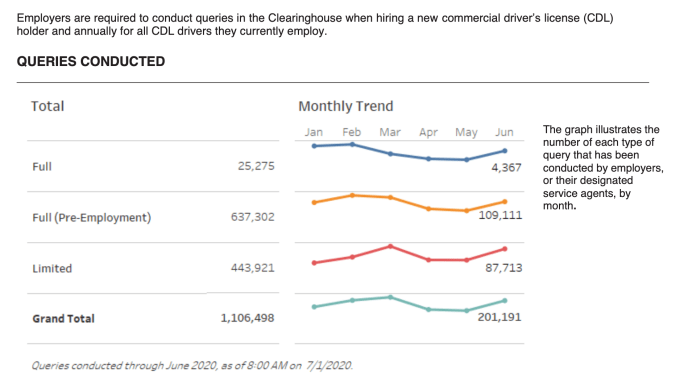
The number of queries to the Drug and Alcohol Clearinghouse has increased as the economy has started to re-open from the COVID-19 pandemic.
Image: FMCSA
The number of violations reported to the clearinghouse also increased in June, with 4,587 drug violations and 107 alcohol violations. As in the previous month, marijuana by far outpaced other substances identified in positive drug tests, with 12,867 positives. The next highest was cocaine at 3,868, with positives for amphetamine and methamphetamine around 2,500 each.
The June report featured a new breakdown of the number of refusals and violations associated with each type of test (e.g., pre-employment, random, post-accident, etc.), Osiecki said.
“What stuck with me was that 13% of pre-employment drug testing violations were refusals,” he told HDT in an email. “Considering that, in the pre-employment context, a refusal can really only occur after the driver has been handed a urine collection cup, this number may be a good proxy for how often drivers attempt to defeat the urinalysis. This number, if it remains high, could accelerate calls for DOT approval of other testing methods like hair and oral fluid testing.”
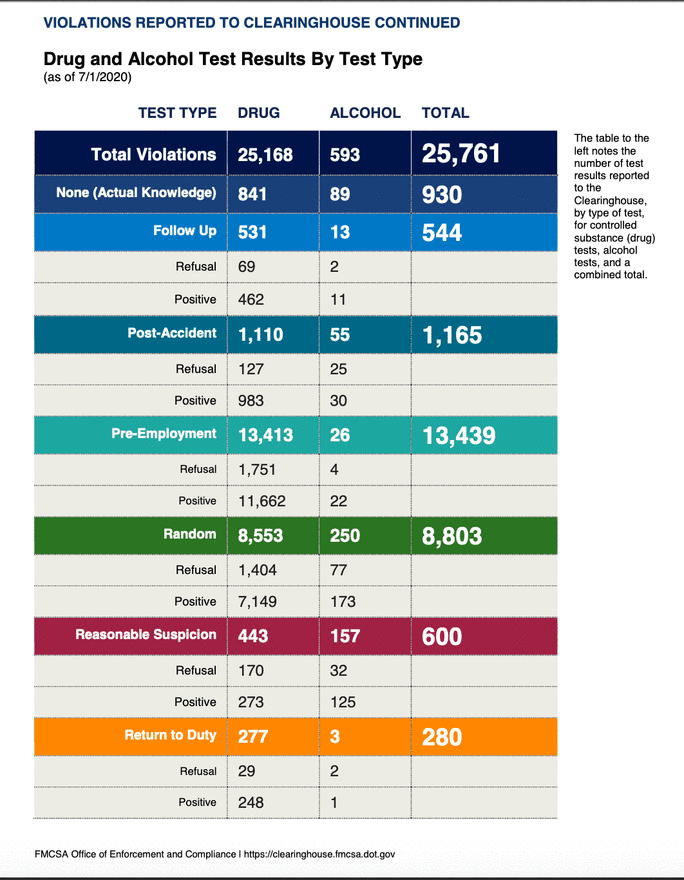
The June Clearinghouse report features a breakdown of violations.
Image: FMCSA
David Heller, vice president of government affairs for the Truckload Carriers Association, noted that the database, queried over 1.1 million times since January, has provided motor carriers with the drug testing history of drivers operating in our industry.
“We look forward to the time when carriers who employ hair testing, either as an alternative to or in conjunction with urine-based tests, can input or access the results of these tests to the clearinghouse in order to provide an even greater account of any particular driver’s violation history.”
According to Osiecki, if the number of reported violations continues at the current rate, approximately 53,000 drivers will be disqualified in 2020, mainly as a result of drug testing violations.
“Using the return-to-duty percentages in the June report, this means that around 8,500 of these drivers will make it through the RTD process in 2020 and drive again. That leaves about 44,500 drivers exiting the industry in 2020. Is the industry safer and better as a result? The answer seems pretty clear to me.”
More Safety & Compliance

FMCSA Pauses Biennial-Update Enforcement Amid Motus Transition
Carriers whose updates were due on or after June 1 have more time, while FMCSA works to stabilize its new registration system and warns of phishing sites impersonating its new carrier registration system, Motus.
Read More →
ZF Expands Commercial Vehicle Push in North America
ZF is expanding its North American commercial-vehicle presence with new transmission applications, electrification, trailer technology and autonomous-driving systems.
Read More →
Truck Drivers Need More Than Another Alert
Fleets have more visibility into truck health, safety events, and driver activity than ever. The next challenge is turning all that information into useful guidance for the person who has to decide what to do next.
Read More →
Tesla Wants a Self-Driving Semi. Are Cameras Enough?
Could Tesla’s camera-only autonomous driving technology work on an 80,000-pound Semi? In this commentary, HDT's Deborah Lockridge takes a look at Tesla, Cybercab, and how autonomous trucks see the road.
Read More →
What DOT’s Automated Vehicle Strategy Means for Trucking
The U.S. Department of Transportation issued a new automated-vehicle strategy that outlines plans for driverless-truck regulations, cross-state freight corridors, and federal safety standards.
Read More →
NYC Expands Speed, Pedestrian Safety Tech Across Fleet
New York City is expanding intelligent speed assistance and pedestrian-alert systems across its municipal fleet, moving the technologies from pilot programs into vehicle procurement and retrofit requirements.
Read More →
FMCSA Removes 110 Truck Driver Training Schools from Certified ELDT List
Federal regulators also are targeting more than 160 additional training providers and launching a nationwide audit of third-party CDL skills testers as part of a broader crackdown on trucking fraud.
Read More →
Beyond DOT Compliance: What Makes a Trucking Fleet Truly Safe?
A trucking fleet can follow every rule and still make unsafe decisions. The real test comes when safety conflicts with freight, productivity, or cost.
Read More →
Hours of Service Pilot Programs: FMCSA Readies for 2027 Rollout
Two pilot programs could eventually reshape hours-of-service rules, giving truck drivers options to pause their 14-hour clock or use longer split sleeper rest periods.
Read More →
New Guide Offers Pet Safety Tips for Truck Drivers
Hundreds of thousands of pets travel in truck cabs. A new safety guide from Volvo Trucks and the Center for Pet Safety offers practical advice for truck drivers who bring dogs and cats along for the ride.
Read More →