




Related: Southern California Mayors Aim for Zero Emissions at Ports
Draytech Summit Offers Glimpse of Port Trucking's Future
The Harbor Trucking Association held its inaugural Draytech Summit, bringing together port servicing companies and technology suppliers to focus on streamlining operations on every level, from dispatch to planning to driver hours of service.

Steven Martinez・Web Editor
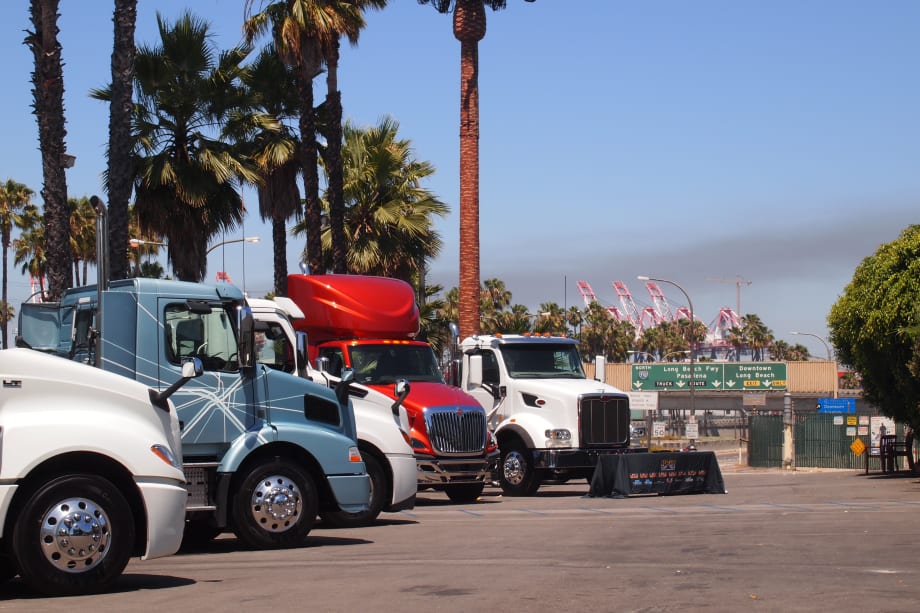
New trucks were available to Draytech attendees to check out during the event. Photos: Steven Martinez
4 min to read
New trucks were available to Draytech attendees to check out during the event.Photos: Steven Martinez
Not far from where the Queen Mary is moored, across the bay from Downtown Long Beach, California, the Harbor Trucking Association held its inaugural Draytech Summit June 28, bringing together port servicing companies and technology suppliers for a day of networking and learning.
At a venue near the Ports of Los Angeles and Long Beach with views of the harbor's blue waters, attendees were given first-hand demonstrations of the latest technologies designed to streamline operations on every level, from dispatch to planning to driver hours of service.
The theme of the event was drayage-focused technology, and a small exhibition hall hosted 25 booths with technology exhibitors like Blackberry, Sprint, Driver iQ and others.
Other more port-focused companies, like ChassisFinder.com, tackled problems such as bringing the process of short-term chassis rentals online. There were also several trucks on hand in the parking lot, showcasing the latest regional tractors, including the recently launched International RH.
Mario Cordero, the executive director of the Port of Long Beach, addressed the group at the start, emphasizing the ports’ goal of remaining competitive with ports in Savannah, Georgia, and others along the East Coast with a recent Panama Canal expansion that could entice traffic away from Southern California. But more than just staying competitive, the goal of the afternoon was to show how technology can be used to increase efficiency and potentially increase market share, said Cordero.
The Queen Mary is now a permanent fixture of the bay, attached to the docks and operating mostly as a kitschy hotel, bar, and tourist attraction in 2017. Once one of the largest vessels on the sea, the famous old ocean liner is now outsized by the ever-larger container ships sailing in and out of the ports, bringing goods from all over the globe.
It is estimated that around 40% of the cargo that comes to the U.S. moves through the Ports of Los Angeles and Long Beach. But with that incredible load of goods comes a logistical nightmare for member companies of the HTA, where a late ship or truck driver delayed in traffic can cause operations to grind to a standstill.
The ports’ efficiency problem is an opportunity for some, however, and General Electric unveiled a new pilot program called The Port Information Portal that promises to swallow all of the data from the ports and spit out useful and accurate supply chain information.
General Electric was one of four technology suppliers that gave 20- to 40-minute talks about their latest products for the ports, speaking to a room of round tables surrounded by sometimes skeptical company owners. Blackberry, Trinium, and Voyage Control also held presentations.
Blackberry was on hand to show its Radar asset tracking solution, giving companies the ability to monitor and track freight on the road, in the yard or on the sea. Trinium showed its comprehensive transportation management solution for harbor drayage, rail drayage and multi-modal trucking companies.
The speaker from Voyage Control spoke about the company building an appointment system for the YTI terminal. Its solution had been used previously in applications as diverse as forklift operations at a warehouse to the elevators on a high-rise construction site. Working with the companies that service YTI’s terminal, the company again touched on the theme of saving time, and therefore money, simply by taking the guessing out of port operations.
The most comprehensive attempt at streamlining port data came from GE, which presented a goal of tying together the most up-to-date information from every port operation, allowing companies to schedule and predict operations, up to 14 days in advance, according to GE. Its pilot program was limited to the APM terminals, the Maersk and MSC liner ships, multiple trucking partners, and multiple BCOs or beneficial cargo owners.
The pilot was partially funded by the city of Los Angeles, and GE’s main partner in implementing the system was the Port of Los Angeles. The program is looking to expand, and representatives from GE kept mentioning a list of companies “an arm’s length long” or even “the length of Shaquille O’Neal’s arm” waiting to join in on the data.
But the company owners in attendance were prudent and perhaps cautious of the sudden confluence of Silicon Valley and transportation. They asked questions about costs, predictive analytics and the prospect of expansion to the Port of Long Beach – an important piece of the puzzle considering the symbiotic relationship between the two ports.
The pilot program is a little more than a month old and for now the answers were optimistic, but still to be determined. The future of fully data-driven trucking and transportation is fast approaching, that much seems clear, but for the time being, it may still be out to sea.
While Long Beach was picturesque that day, the towering cranes and container ships anchored both in the harbor and waiting just outside the bay make it clear that the primary purpose of these waters is work. The aquarium, apartments, hotels, restaurants, and Queen Mary are just window dressing for a vast cargo complex, looking toward the future.

The Queen Mary was not far from the event, now permanently parked in Long Beach, Calif.
More Fleet Management

Why Private Fleets Are Taking More Freight
Private fleets are putting their own trucks on demanding customers and high-cost lanes as companies seek greater control over service, costs, and capacity.
Read More →
Sponsored•September 16, 2026
Color Match Smarter: Tools That Restore & Perform
For fleet managers and collision repair professionals keeping heavy-duty trucks on the road, getting the color right the first time isn't just about appearance — it's about efficiency, turnaround time, and bottom-line results. Discover how today's digital color tools are transforming the repair process from guesswork to precision.
Read More →
FMCSA Pauses Biennial-Update Enforcement Amid Motus Transition
Carriers whose updates were due on or after June 1 have more time, while FMCSA works to stabilize its new registration system and warns of phishing sites impersonating its new carrier registration system, Motus.
Read More →


Sponsored•September 14, 2026
2026 Blueprint for Countering Smarter Supply Chain Theft
Cargo theft is no longer just the cost of doing business. It's a multi-billion-dollar criminal enterprise exploiting vulnerabilities across your fleet, drivers, and supply chain.
Read More →
Sponsored•September 1, 2026
How Telematics Improves Visibility, Control, and Performance in Refrigerated Fleets
Explore how telematics help refrigerated fleets improve visibility, uptime, efficiency, compliance, and cargo protection across connected cold chain operations.
Read More →
What the U.S.-Canada Trade War Means for Trucking
Escalating U.S.-Canada tariffs could disrupt cross-border freight, reduce truck volumes, raise costs, and create new uncertainty for carriers on both sides of the border.
Read More →
What Are Trucking’s Top Concerns for 2026?
The American Transportation Research Institute wants to know what's worrying trucking fleet managers, drivers, and other stakeholders in its annual Industry Issues survey.
Read More →
American Trucking Associations Looks for a New Leader
ATA President and CEO Chris Spear abruptly left his job at the association on August 21, at a pivotal time for the trucking industry.
Read More →
Public Wi-Fi Cybersecurity Risks: How Truck Drivers and Fleets Can Protect Their Data
Public Wi-Fi can expose truck drivers and fleets to credential theft, malware, and other cyber threats. Here’s how to reduce the risk on the road.
Read More →
For Nicky Cupp, Fleet Innovation Starts With Frustration
HDT Truck Fleet Innovator Nicky Cupp turns everyday pain points at Fraley & Schilling into opportunities for better technology and smarter processes.
Read More →