




DOT Announces Record Low Highway Fatality Rate in 2004
The fatality rate on the nation’s highways in 2004 was the lowest since record-keeping began 30 years ago, the U.S. Department of Transportation’s National Highway Traffic Safety Administration (NHTSA) announced Monday
The fatality rate on the nation’s highways in 2004 was the lowest since record-keeping began 30 years ago, the U.S. Department of Transportation’s National Highway Traffic Safety Administration (NHTSA) announced Monday.
However, fatalities from large truck crashes increased slightly from 5,036 to 5,190.
The number of alcohol-related fatalities also dropped for the second straight year.
All told, 42,636 people died on the nation’s highways in 2004, down from 42,884 in 2003. The fatality rate per 100 million vehicle miles traveled (VMT) was 1.46 in 2004, down from 1.48 in 2003. The fatality rate has been steadily improving since 1966 when 50,894 people died and the rate was 5.5.
“Drivers are safer today on our nation’s highways than they have ever been, in part because of the safer cars, higher safety belt use and stronger safety laws that this Department has helped champion,” said Secretary of Transportation Norman Y. Mineta. “But as long as the number of highway deaths remains as high as it is, we will keep advocating for the kind of vehicles, roads and driving habits that make people safer in their cars and trucks.”
Since 2001, the number of states with primary safety belt laws has increased to 22, along with the District of Columbia and Puerto Rico, leading to an 80% safety belt use level, the highest ever. In addition, all states, plus the District of Columbia and Puerto Rico, now have 0.08 blood alcohol laws for drivers. Minnesota’s 0.08 law took effect Monday.
NHTSA's Fatality Analysis Reporting System (FARS) also shows that, between 2003 and 2004:
• Fatalities from large truck crashes increased slightly from 5,036 to 5,190.
• Motorcycle fatalities increased from 3,714 to 4,008, an 8% rise.
• Alcohol-related fatalities dropped from 17,105 to 16,694, a 2.4% decline.
• Rollover deaths among passenger vehicle occupants increased 1.1% from 10,442 to 10,553.
• Total fatalities in sport utility vehicles (SUVs) increased 5.6%, from 4,483 to 4735, while fatalities in passenger -- cars, pickup trucks and vans decreased a total of 834.
• Passenger vehicle occupant fatalities dropped to 31,693 – the lowest since 1992. Declining fatalities in passenger cars are consistent with more crashworthy vehicles in the fleet and increases in safety belt use.
• Pedestrian deaths declined 2.8% from 4,774 in 2003 to 4,641.
• In 2004, 55% (down from 56% in 2003) of those killed in passenger vehicles were not wearing safety belts.
This underscores the value of the need for states to adopt primary safety belt laws.
NHTSA earlier estimated that highway crashes cost society $230.6 billion a year, about $820 per person.
More Safety & Compliance
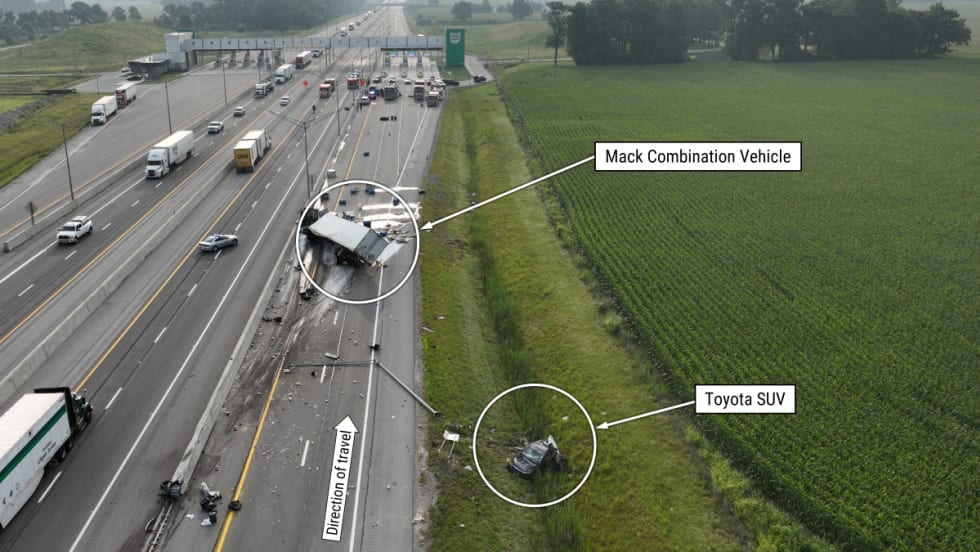
Fatal Crash Exposes Toll Plaza Risks
An NTSB investigation found that last-minute lane changes and large speed differences at an Ohio toll plaza created a hazard the truck driver couldn't avoid in time.
Read More →
When Language Stops the Truck: The Return of ELP Out-of-Service Orders
English language proficiency rules for commercial drivers aren’t new, but renewed out-of-service enforcement has raised the stakes. Here’s what carriers need to know before a driver reaches a roadside inspection.
Read More →
A Camera Isn't a Safety Program. Here's What Brokers Are Screening for Now
Footage alone may not be enough to pass broker vetting processes. Here's what counts as a defensible safety program now.
Read More →

Marijuana and Trucking’s Drug-Testing Dilemma
Marijuana is getting stronger, laws are changing, and drug tests still can’t reliably establish impairment. What does that mean for truck drivers and the fleets that employ them?
Read More →
PrePass, Kodiak Connect Driverless Trucks to Roadside Enforcement
The system will allow enforcement agencies to verify Enhanced Inspection information and decide whether Kodiak’s autonomous trucks can bypass roadside screening sites.
Read More →
From One Generation to the Next: How Mentorship Builds Safer Truck Drivers
After three decades in trucking, Harold Perry shares what he's learned about driver safety, mentorship, and helping the next generation build confidence behind the wheel.
Read More →
FMCSA Pauses Biennial-Update Enforcement Amid Motus Transition
Carriers whose updates were due on or after June 1 have more time, while FMCSA works to stabilize its new registration system and warns of phishing sites impersonating its new carrier registration system, Motus.
Read More →
ZF Expands Commercial Vehicle Push in North America
ZF is expanding its North American commercial-vehicle presence with new transmission applications, electrification, trailer technology and autonomous-driving systems.
Read More →
Truck Drivers Need More Than Another Alert
Fleets have more visibility into truck health, safety events, and driver activity than ever. The next challenge is turning all that information into useful guidance for the person who has to decide what to do next.
Read More →
Tesla Wants a Self-Driving Semi. Are Cameras Enough?
Could Tesla’s camera-only autonomous driving technology work on an 80,000-pound Semi? In this commentary, HDT's Deborah Lockridge takes a look at Tesla, Cybercab, and how autonomous trucks see the road.
Read More →