




Related: On the Spot – Drive the Future With Volvo's SuperTruck [Video]
Diesel Prices Fall Slightly, Crude Oil Up on OPEC, Election News
The average price of diesel fuel in the U.S. fell by nearly a cent and is still relatively flat over the past month, according to the latest numbers from the Energy Department.
by Staff
November 7, 2016
2 min to read
The average price of diesel fuel in the U.S. fell by nearly a cent and is still relatively flat over the past month, according to the latest numbers from the Energy Department.
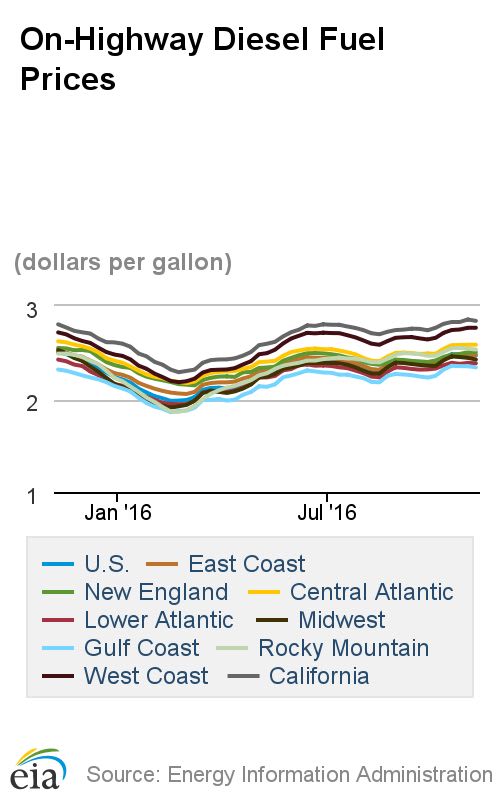
The national price of on-highway diesel fuel dropped by 0.9 cents last week, settling at $2.47 per gallon at the pump. The price is 3.2 cents cheaper than it was in the same week a year ago.
Prices changes fluctuated by region, with the largest price drop occurring in the Midwest, falling 1.8 cents. The largest increase came to the Central Atlantic region, where prices gained 0.1 cent last week.
Source: EIA
Gasoline prices were mostly flat as well, with the average national price of regular gasoline increasing by 0.3 cent to $2.233 per gallon. The price is virtually the same as it was in this week of 2015 – just 0.2 cents less.
The largest decrease in gasoline prices was in the Gulf Coast region, where prices fell 2.7 cents for the week. This was offset by a 6.4-cent increase per gallon in the Central Atlantic region.
Once again the crude oil market reacted to the prospect of a production freeze as prices ended the day slightly higher, according to a Wall Street Journal Report.
A representative of the Organization of the Petroleum Exporting Countries indicated that the group is committed to freezing oil production in order to reduce the global supply glut, which should have the effect of increasing crude oil prices. While some countries were rumored to be against a production freeze, analysts are now feeling more optimistic about a deal.
The market also experienced a bump from the FBI reiterating that presidential candidate Hillary Clinton would not be charged based on newly discovered emails. The remarks were interpreted as benefitting Clinton’s chances on Election Day and the stock market, in general, has seemed to favor this outcome over a win by Donald Trump.
More Fuel Smarts

How Volvo Updated Its D13 for EPA 2027 [Watch]
Volvo’s updated D13 promises lower emissions without sacrificing performance or fuel economy. Take a closer look at what changed inside the engine in this HDT Spotlight video.
Read More →
Diesel Price Spike Shortens Payback for Natural Gas Trucks, Report Says
Energy Vision estimates fleets could recover the higher purchase price of an RNG-fueled Class 8 tractor in 1.3 to 2.8 years under current fuel-price scenarios.
Read More →
Calstart Becomes Catalyst Mobility, Reflecting Broader Focus
Calstart is now Catalyst Mobility, reflecting the nonprofit’s growing national role in clean transportation, including zero-emission trucks, infrastructure and incentive programs.
Read More →

Record Diesel Prices Squeeze Trucking Fleets
Average U.S. diesel prices have climbed to nearly $6 a gallon, surpassing the 2022 record as tight refinery capacity and Middle East disruptions keep fuel costs elevated.
Read More →
Sponsored•September 9, 2026
How Fuel Delivery Shapes Engine Performance
Fuel delivery depends on more than what happens at the injector. For fleet, maintenance and technical professionals, looking at the full path from pump to injector can provide useful context for understanding engine performance.
Read More →
East Coast Port Launches $45M Electric Truck Push
The Port Authority of New York and New Jersey announced millions in incentives for zero-emission drayage trucks, yard tractors, and new charging hubs near the port.
Read More →
California Bill Could Shed Light on Electric Truck Prices
Why do battery-electric Class 8 trucks remain so expensive? A California bill headed to Gov. Gavin Newsom would give fleets and state agencies more visibility into what manufacturers charge.
Read More →
Detroit Opens Orders for EPA 2027 Engines
Detroit isn’t starting from scratch to meet EPA 2027 diesel emissions standards. Its Gen 6 DD13 and DD15 engines keep much of today’s platform while updating the fuel and aftertreatment systems.
Read More →
Zero-Emission Truck Corridor Planned for West Coast
California, Oregon, Washington, British Columbia and Baja California are coordinating plans for truck charging and hydrogen fueling from Canada to Mexico.
Read More →
A Closer Look at Kenworth’s Electric T880E Vocational Truck [Video]
Learn more about Kenworth's T880E battery-electric vocational truck at the Paccar Technical Center, including its range, applications, upfitting considerations, and PTO options, in this HDT Spotlight video.
Read More →