





Related: How Nikola Plans to Make Hydrogen the Truck Fuel of the Future
Dana to Provide e-Propulsion for Hydrogen Fuel Development Project
The three-year Alberta Zero-Emissions Truck Electrification Collaboration project will see two hydrogen fuel cell electric trucks pulling loads of up to 140,000 pounds on 430-mile round trips between Calgary and Edmonton, Alberta, beginning next year.
August 1, 2019
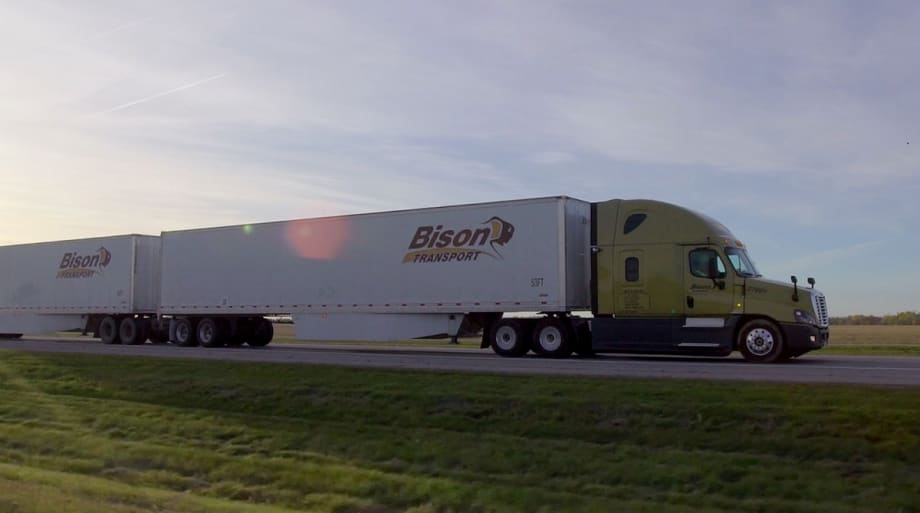
Two long-combination B-train vehicles operated by Bison Transport and Trimac Transportation will travel up to 430 miles on return trips between terminals in Edmonton and Calgary, Alberta, on a single hydrogen fill.
Photo via Bison Transport
3 min to read
When the Alberta Zero-Emissions Truck Electrification Collaboration project gets under way next year, the two 140,000-pound B-train tractor-trailers to be used in the test will be driven by Dana's Spicer Electrified e-Propulsion systems with TM4 Sumo HP motor-inverters.
The trucks are part of a three-year, $11.2 million initiative sponsored in part by the Government of Alberta to design and test heavy-duty, extended-range, hydrogen fuel cell electric hybrid trucks.
"Dana is pleased to have been selected as a key partner for this enterprising hydrogen fuel project. It marks another step in the innovation continuum as the industry transitions to zero-emission transportation," said Mark Wallace, president of Dana Commercial Vehicle Driveline Technologies.
"The consortium partners share a common vision in advancing clean technologies, and we welcome the opportunity to provide Spicer electrodynamic solutions as part of these collective efforts," he added.
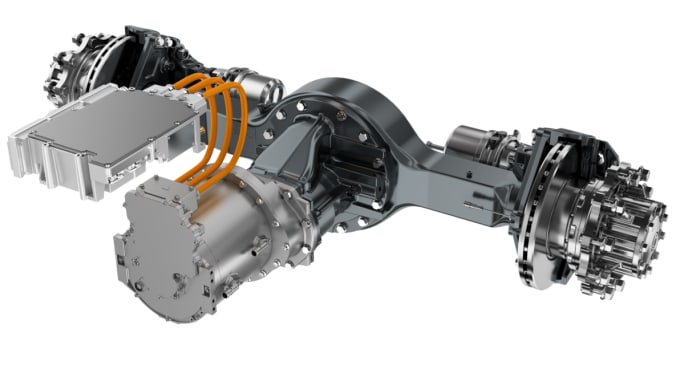
The trucks in the test will be powered by Dana's eS6200r e-Drive Axle with the Sumo HP motor and inverter. Dana did not elaborate on the motor's ratings except to say it would be roughly equal to the 500- to 550-hp diesel powertrains currently used in that application.
Photo via Dana
Dana said its custom Spicer e-System is optimized for the Canadian market with a hauling capacity of 140,000 pounds. The system's compact design reduces weight and allows for more hydrogen fuel storage, while high-speed helical gearing provides greater overall drivetrain efficiency, per the company. Dana’s TM4 Sumo HP motor-inverter system was specifically designed for high-power applications, and for use with multi-speed gearboxes.
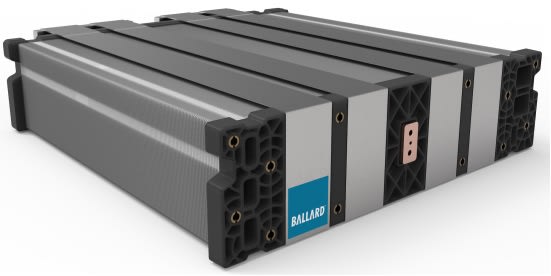
Ballard Power Systems' FCGen-LCS heavy-duty liquid cooled stacks, designed to deliver long-term performance and low total lifecycle cost, feature reusable, low-cost carbon plates in a compact stack design.
Photo via Ballard Power Systems
"That kind of weight will require additional gearing with a multi-speed approach to get the startability needed at low speed and the gradeability needed at mid-speed and top speed," said Dana's senior manager for commercial vehicle product planning, Harry Trost.
"We are leveraging one of the new motors we are developing, the Sumo HP,” he continued. “It produces a power level similar to what that type of Canadian linehaul application would have today, roughly in the 500 to 550 horsepower range. It will have similar performance as those vehicles have today."
The trucks will travel up to 430 miles on return trips between terminals in Edmonton and Calgary on a single hydrogen fill. They will be operated by Trimac Transportation and Bison Transport.
Ballard Power Systems will provide the fuel cell modules to power the two trucks. Each will have three FCmove-HD fuel cell modules using Ballard’s LCS technology– with each generating 70 kilowatts of power.
"The tractor-trailers being used in the AZETEC project are the first fuel cell electric vehicles of this size and capacity to be built and tested anywhere in the world," said Ballard's chief commercial officer, Rob Campbell. "We are delighted to expand Ballard’s participation in FCEV truck trials across a growing range of sizes and classes, as we demonstrate the compelling value proposition that fuel cells offer for heavy- and medium-duty motive applications requiring long range, rapid refueling, heavy payloads, and route flexibility."
The fueling infrastructure for the project will be generated by Praxair Services, Canada Inc., leveraging its existing oil and gas hydrogen infrastructure. Hydrogen will be transported under a "drop and swap" model that will move fuel between the Praxair facility and a centralized depot in Edmonton.
Hydrogen will be produced through the steam methane reforming process due to the readily available supply of natural gas in Alberta. SMR is a process in which methane from natural gas is heated with steam, usually with a catalyst, to produce a mixture of carbon monoxide and hydrogen used in organic synthesis and as a fuel. In energy, SMR is the most widely used process for the generation of hydrogen.
"The abundant natural gas supply in Alberta is part of the impetus behind why they selected that hydrogen source, supporting the local economies makes a lot of sense and it's a good process for creating hydrogen," said Trost.
The AZETEC project is scheduled to run until mid-2022. At the conclusion of the three-year project, it is estimated that the trucks will have carried approximately 12 million ton-miles of freight.
More Fuel Smarts

How Volvo Updated Its D13 for EPA 2027 [Watch]
Volvo’s updated D13 promises lower emissions without sacrificing performance or fuel economy. Take a closer look at what changed inside the engine in this HDT Spotlight video.
Read More →
Diesel Price Spike Shortens Payback for Natural Gas Trucks, Report Says
Energy Vision estimates fleets could recover the higher purchase price of an RNG-fueled Class 8 tractor in 1.3 to 2.8 years under current fuel-price scenarios.
Read More →
Calstart Becomes Catalyst Mobility, Reflecting Broader Focus
Calstart is now Catalyst Mobility, reflecting the nonprofit’s growing national role in clean transportation, including zero-emission trucks, infrastructure and incentive programs.
Read More →

Record Diesel Prices Squeeze Trucking Fleets
Average U.S. diesel prices have climbed to nearly $6 a gallon, surpassing the 2022 record as tight refinery capacity and Middle East disruptions keep fuel costs elevated.
Read More →
Sponsored•September 9, 2026
How Fuel Delivery Shapes Engine Performance
Fuel delivery depends on more than what happens at the injector. For fleet, maintenance and technical professionals, looking at the full path from pump to injector can provide useful context for understanding engine performance.
Read More →
East Coast Port Launches $45M Electric Truck Push
The Port Authority of New York and New Jersey announced millions in incentives for zero-emission drayage trucks, yard tractors, and new charging hubs near the port.
Read More →
California Bill Could Shed Light on Electric Truck Prices
Why do battery-electric Class 8 trucks remain so expensive? A California bill headed to Gov. Gavin Newsom would give fleets and state agencies more visibility into what manufacturers charge.
Read More →
Detroit Opens Orders for EPA 2027 Engines
Detroit isn’t starting from scratch to meet EPA 2027 diesel emissions standards. Its Gen 6 DD13 and DD15 engines keep much of today’s platform while updating the fuel and aftertreatment systems.
Read More →
Zero-Emission Truck Corridor Planned for West Coast
California, Oregon, Washington, British Columbia and Baja California are coordinating plans for truck charging and hydrogen fueling from Canada to Mexico.
Read More →
A Closer Look at Kenworth’s Electric T880E Vocational Truck [Video]
Learn more about Kenworth's T880E battery-electric vocational truck at the Paccar Technical Center, including its range, applications, upfitting considerations, and PTO options, in this HDT Spotlight video.
Read More →