




Daimler's Redundant Chassis for Autonomous-Truck Operation
What happens if a critical system stops working on a driverless truck? Daimler says it has the answer in a chassis designed specifically for autonomous technology.

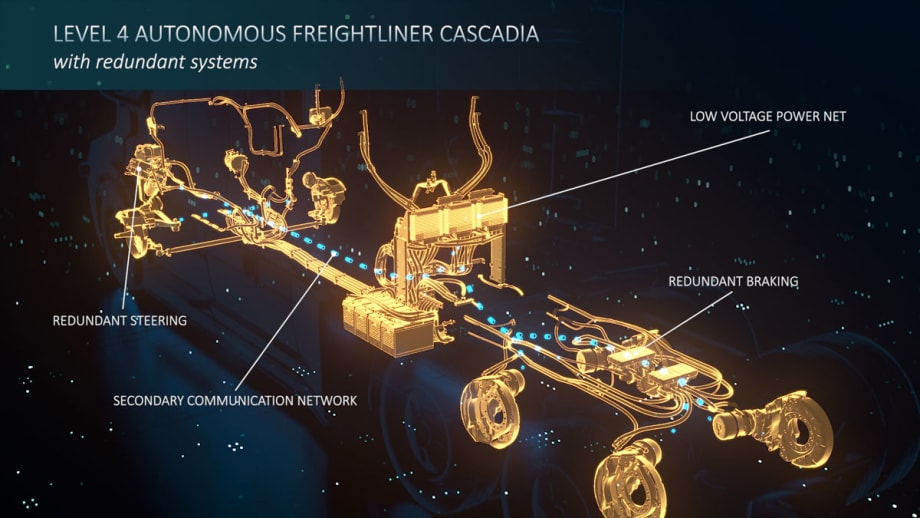
In combination with third-party autonomous driving software from Waymo and Torc Robotics, the Freightliner L4 redundant chassis offers customers full SAE Level 4 autonomous driving capabilities, according to the company.
Illustration: Daimler Trucks
Daimler Truck, which is working with both Waymo and its subsidiary Torc Robotics in developing autonomous trucks, has shared some details about how it is developing a truck specifically designed for SAE Level 4 autonomous driving, including redundancy systems needed for safe and reliable operations.
The braking system, the steering system, the low voltage power net, and the network communications have all been designed as redundant systems. If any of the primary systems encounter a fault, the Level 4 vehicle will be able to monitor, assess, and deploy its backup systems to control the truck safely.
Based on the Freightliner Cascadia, the redundant truck chassis is being developed for Waymo Via based on their specifications, according to a news release from the company. A first version of the truck was delivered earlier this year for integration of the Waymo Driver, the autonomous driving system.
If a fault is deemed critical to the operation of the vehicle, the autonomous driving system will allow the truck to follow a safety protocol and be able to execute a “minimal-risk maneuver” to come to a safe stop.
The Redundant System Architecture
More than 1,500 new and unique requirements have been identified by Waymo Via. The engineering team at Daimler Trucks North America is developing and implementing these requirements during the vehicle development process.
For example, while today’s pneumatic braking systems have fail-safe operational attributes, Daimler Truck’s Level 4 vehicles have an additional layer of electronic redundancy, using two electronic control units – a primary and a secondary system. Together, they ensure full brake performance, to safely execute a minimal-risk maneuver in case one system is not operating properly.
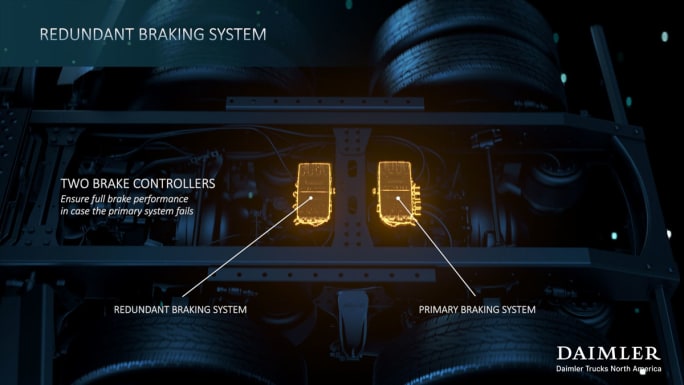
Daimler Truck’s Level 4 truck uses two electronic control units for the brakes – a primary and a secondary system.
Illustration: Daimler Trucks
The same logic applies to the steering system, which has two servo motors. In case of an electronic or hydraulic failure, the backup servo motor also receives the requested steering angle from the autonomous driving system and can react accordingly.
Constant communication between these key systems ensures that there is no loss of critical information flow among the controllers. That’s why Daimler Truck has included a secondary communication network to key devices, which is also protected by cybersecurity requirements. As for the demanding power consumption by all the ECUs and sensors in an autonomous truck, a robust low voltage power net is required. Developed at DTNA, the power net system ensures constant energy flow to critical systems.
Scalable Solution
In combination with third-party autonomous driving software, this redundant chassis offers customers full SAE Level 4 autonomous driving capabilities, according to the company.
As part of Daimler Truck’s dual-track strategy, the truck manufacturer is working together with two autonomous technology partners, Waymo Via and Torc Robotics, offering multiple routes to commercialization.
Redundant systems are also key in Daimler’s autonomous-truck development with Torc Robotics, but the approach is different. Daimler Truck and Torc teams are collaborating seamlessly to create a deep integration of software and hardware, in comparison to the Waymo partnership, where Daimler Truck is developing a customized Freightliner Cascadia truck chassis with redundant systems for Waymo Via based on Waymo's specific requirements. This first chassis is developed to meet exactly their needs and will enable the seamless integration of the Waymo Driver.
Daimler Truck has the capability to tailor and scale this Level 4 truck chassis to the autonomous driving specifications of both technology partners.
Torc Robotics CEO Michael Fleming stressed the need for a chassis designed for autonomous trucks in a recent interview with HDT. "Every single aspect and component on the next generation of trucks from Daimler — from the wheel-ends, to the hubs, to the axles, all the way up to engines and powertrain — are being completely redesigned from scratch to work with our technology on a deeply integrated level," he said. "This idea that we’re just going to keep adding sensor after sensor to these trucks without eventually reinventing the chassis from the ground up doesn’t make any sense."
More Equipment

How Volvo Updated Its D13 for EPA 2027 [Watch]
Volvo’s updated D13 promises lower emissions without sacrificing performance or fuel economy. Take a closer look at what changed inside the engine in this HDT Spotlight video.
Read More →
Michelin Tire Improves Efficiency and Durability for Regional Fleets
The Michelin X Multi Energy D2 is a regional haul drive tire engineered to help fleets improve fuel efficiency, durability and traction in demanding stop-and-go operations.
Read More →
ZF Expands Commercial Vehicle Push in North America
ZF is expanding its North American commercial-vehicle presence with new transmission applications, electrification, trailer technology and autonomous-driving systems.
Read More →
Tesla Wants a Self-Driving Semi. Are Cameras Enough?
Could Tesla’s camera-only autonomous driving technology work on an 80,000-pound Semi? In this commentary, HDT's Deborah Lockridge takes a look at Tesla, Cybercab, and how autonomous trucks see the road.
Read More →
Kodiak: Driverless Long-Haul Truck Launch on Track for 2026
Kodiak AI says its driverless long-haul safety case is 93% complete and it remains on track to begin commercial operations by year-end 2026.
Read More →
What DOT’s Automated Vehicle Strategy Means for Trucking
The U.S. Department of Transportation issued a new automated-vehicle strategy that outlines plans for driverless-truck regulations, cross-state freight corridors, and federal safety standards.
Read More →
East Coast Port Launches $45M Electric Truck Push
The Port Authority of New York and New Jersey announced millions in incentives for zero-emission drayage trucks, yard tractors, and new charging hubs near the port.
Read More →
PlusAI Going Public to Fund Autonomous Truck Launch
A SPAC deal could provide PlusAI with up to $300 million as it works toward a 2027 commercial launch of factory-built autonomous trucks.
Read More →
NHTSA Moves to Rewrite Truck Fuel-Economy Rules
The National Highway Traffic Safety Administration says it lacks authority to regulate medium- and heavy-duty truck engines separately from complete vehicles, but the existing standards have not yet been eliminated.
Read More →
Detroit Opens Orders for EPA 2027 Engines
Detroit isn’t starting from scratch to meet EPA 2027 diesel emissions standards. Its Gen 6 DD13 and DD15 engines keep much of today’s platform while updating the fuel and aftertreatment systems.
Read More →