





Related: Sustainability Key Motivator for Early Fleet Adopters of Clean Vehicle Technologies
Daimler Trucks North America ‘Not Standing Still’ on Electric Trucks
The COVID-19 pandemic has not significantly affected Daimler Trucks North America’s work on medium- and heavy-duty battery-electric trucks, and despite production shutdowns due to the pandemic, the company is back to building vehicles at the same rate it was before the pandemic hit.
August 17, 2020
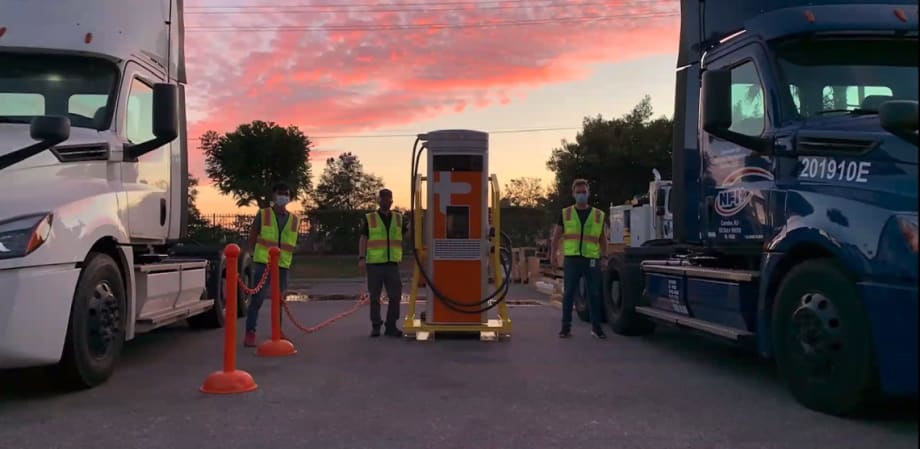
Freightliner teams have been working through the pandemic to deploy electric trucks and charging stations.
Photo: Daimler Trucks North America
8 min to read
The COVID-19 pandemic has not significantly affected Daimler Trucks North America’s work on medium- and heavy-duty battery-electric trucks, and despite production shutdowns due to the pandemic, the company is back to building vehicles at the same rate it was before the pandemic hit.
“It’s been a tough year,” President and CEO Roger Nielsen said In a Zoom call with truck-media reporters Aug. 17. He said the company had nearly 15,000 people on furlough at one point in April, as its nine North American manufacturing locations shut down temporarily due COVID-19 precautions. Some customer-facing parts of its business, such as parts distribution centers and dealers, continued operating throughout.
In early June, DTNA announced it was beginning to reopen all nine of its manufacturing locations in North America following a three-month hiatus due to the COVID-19 pandemic.
Today, Nielsen said, DTNA is building vehicles at same rate it was before the pandemic hit. Of course, that three-month hiatus will lower the total volume for the year, he said. July was a good month for retail sales, he said, with about 27,000 Class 6-8 sold in the U.S., Canada, and Mexico. “If we run to 27,000 a month for the rest of the year, the market will run around 310,000 vehicles, compared to about 492,000 last year. It’s definitely not going to be 2019 for sure, but it’s still been strong.”
Much of that, he said, is replacement demand. Truck sales in 2015 were strong, and last year fleets started trading in those trucks. That’s continuing in 2020, he said, as fleets that put fewer miles on trucks each year, such as dedicated fleets, get to their 450,000-500,000-mile mark and fleets look to replace them.
“We’re well into the fourth quarter in backlog and we’re taking a lot of orders already for 2021,” he said. “The level of [monthly] business we’re seeing is about what we were expected for 2020, but we took that hit in q2 as America took a pause to see how we handle this.”
Although there have been some challenges in the supply chain for parts and components, Nielsen said, “to the point where we have to change production schedules, maybe shut down a couple of days, there hasn’t been a shortage yet that brought us to our knees.”
Social Justice
In addition to the pandemic, Nielsen said, the country has been rocked by “the impact of the outcry from the murder of George Floyd.” With DTNA being based in Portland, where there have been both peaceful protests and “late-night riots,” Nielsen said, “for sure it’s affected our social conscience, and we’ve come on with very strong messages some that were just activated today about how DTNA is taking action. We are not going to sit silently by. We believe as a major corporation we have a voice, and a strong voice, with operations in nearly every major city, between us and our dealers. We have the ability to put our voice and our power behind that.”
However, he explained, before it went public with a campaign, it was important for DTNA to look inside its own company. “It starts within,” Nielsen said, and DTNA went through a “huge effort on education and training” about social injustice.
“We’ve learned quite a bit on what our own actions are that lead to people feeling uncomfortable. So now that we want to make a stand on that publicly. You’ll see us use that voice. We don’t want to make political statements, so you’ll see us be a little careful over the het 90 days or so until we get past the election.”
Its efforts will go beyond public advertising and communication efforts, he said, with efforts to develop and support minority-owned dealerships and fleets.
The Future is Electric
In 2019, Nielsen spoke at ACT Expo and proclaimed that “the future is electric.”
He hasn't changed his mind.
“We are not standing still,” he said in the Aug. 17 media call, pandemic or no. “We are now well into our process of putting a battery-electric vehicle on the road.” In fact, the changes Nielsen cited more than a year ago seem to be accelerating, he said, noting the recent memorandum of understanding signed by 15 states and the District of Columbia last month to accelerate electric-truck and bus deployment, “and a lot more announcements out there from a lot more players,” he said. “We’ve been on this road for quite some time,” he said, noting that he handed the keys to an electric eM2 to Penske in December of 2018 as the first truck in the new Electric Innovation Fleet.
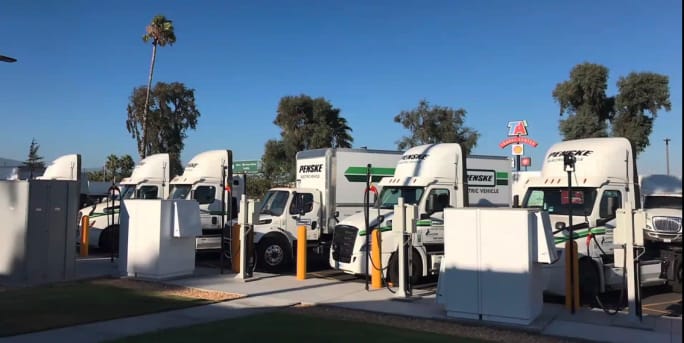
Penske's Innovation Fleet deployment has eCascadias and eM2 medium-duty electric trucks deployed with a variety of customers.
Photo: Daimler Trucks North America
Nielsen said DTNA has delivered the 20 eCascadias and the 10 eM2s of the Innovation Fleet, and it’s working closely with NFI and Penske to learn how the vehicles operate, infrastructure challenges, the cost of operation, what it takes to maintain them, and business operational changes that need to be made in the fleets’ businesses.
In addition, DTNA has a consulting group helping fleets navigate incentives, get the right charging infrastructure in place, the right permits, etc.
NFI is running the eCascadias in port drayage operations in southern California. Penske is deploying its eCascadias and eM2 medium-duty trucks with a variety of different customers, making for about a dozen unique customers in various applications.
Freightliner recently announced that its Innovation Fleet has accumulated more than 300,000 miles in real-world use by customers. The 30-vehicle Freightliner Electric Innovation Fleet started operation in late 2018 to provide feedback and real-world use data on the integration of battery electric trucks in large-scale fleet operations. The latest two trucks to be put into operation were Penske customers Blackhorse and U.S. Foods, testing the eCascadias in food-distribution operations.
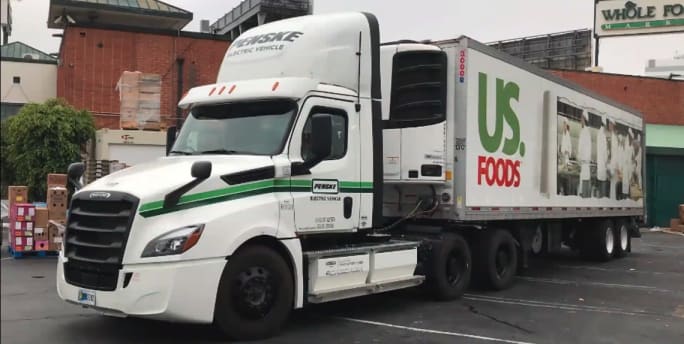
Some of the latest eCascadias have been deployed in grocery and foodservice delivery.
Photo: Daimler Trucks North America
“Even during the pandemic, we put our team on the road making sure these trucks get deployed,” Nielsen said. This “co-creation” process, he said, “has put us many steps ahead,” helping engineers figure out what might go wrong, what needs to be maintained, how to address driver concerns, identifying odd bumps and noises, and so on.
'Co-Creating' Electric Trucks With Fleets
“The adoption of battery-electric vehicles isn’t going to happen by showing a few renderings and concepts,” he said. “It’s putting these trucks into real operations. What are the fears of the drier, what is their range anxiety tolerance, all those things you can’t get with a professional test driver.”
As an example, he said, DTNA is working with customers on the best settings for their applications in handling hills. Does it make sense for it to emulate a diesel engine’s engine brake coming on at a certain speed? Or are there better settings that take advantage of the truck’s ability to generate energy to recharge the battery on a downhill coast?
“It’s grueling, it is iterative, but it’s necessary to deliver on what our customers need… a business partner that’s going to keep them running at the lowest possible costs.”
Because it’s so important, he said, DTNA decided to go beyond the initial 30 trucks of the Innovation Fleet. In early March, Freightliner announced it would put six heavy-duty Freightliner eCascadias and two medium-duty eM2 106 trucks into customer hands, calling it the Freightliner Customer Experience Fleet. J.B. Hunt is delivering intermodal freight to Walmart with an eCascadia. Ryder just took delivery of an eCascadia and an eM2 to put into its dedicated routes.
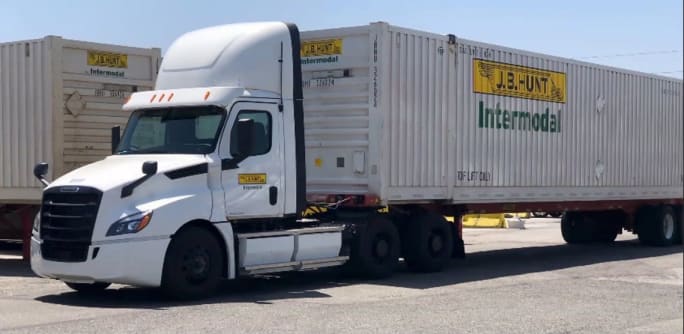
J.B. Hunt recently delivered its first electric-powered intermodal load.
Photo: Daimler Trucks North America
DTNA also has more than 100 orders for its Jouley electric school bus from Thomas Built Buses, including an order from Dominion Energy, which is looking to use the buses to store wind and solar energy collected during the summer months. And it is working to get its recently announced MT50E electrified walk-in van ready to hit the road as well. Both are powered by a system from Proterra.
Looking to the vocational market, utility trucks will be the first area where DTNA will work on electrification. “Those who are repairing the electric infrastructure, that’s where there’s a lot of interest, and more on the medium-duty side than on the heavy-duty side," Nielsen said.
Electric-Truck Charging
Although DTNA is working with public utilities and others on public charging options, Nielsen said it would be unrealistic to expect that a public charging infrastructure would be ready to go at the same time the trucks are ready to go on the market.
He showed one photo of an eCascadia parked at a passenger-car charger in a residential area as an example of how the BEV deployment team has had to be creative at times.
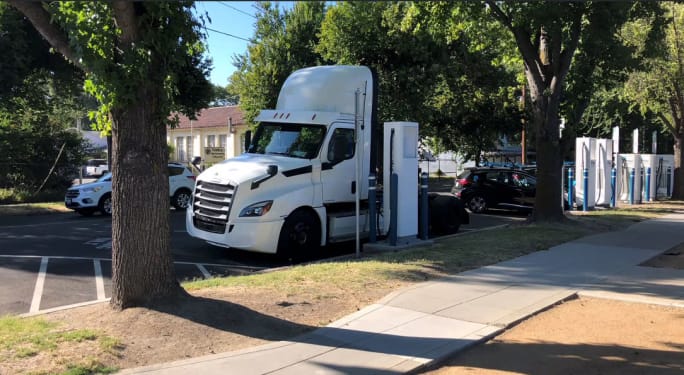
While deploying an eCascadia, the team had to get creative in finding charging options.
Photo: Daimler Trucks North America
That’s why it’s been focusing on “depot charging,” installing charging stations at fleet locations where trucks come back to charge.
So far, he said, there are 60 chargers in place that DTNA has helped to install, with another 150 on the drawing board. “We’re out there giving the complete solution to our customers in order to get the miles and the time on these trucks so we can prove out the technology.
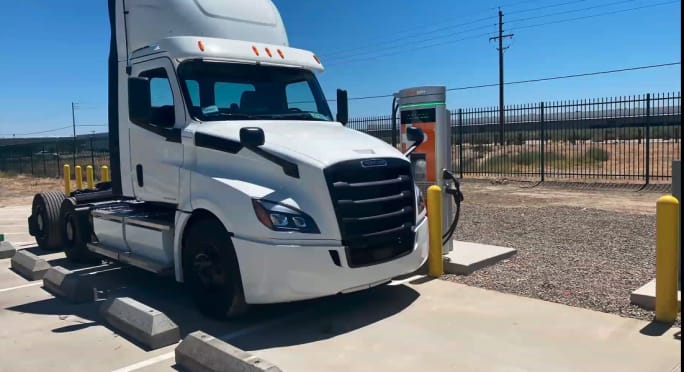
Daimler Trucks North America is focusing on a "depot charging" strategy for its initial electric truck deployments.
Photo: Daimler Trucks North America
“I would say the public charging infrastructure [is] not to the point where you could rely upon it as a fleet to supply your fleet with energy on irregular routes,” he said. “It’s going to come; we’re working with utility companies and with what we’re doing with Charin, we will get there.”
CharIn is the Charging Interface Initiative, a group focused on promoting a global standard for charging electric vehicles.
Overall, Nielsen said, the company is still “roughly on schedule” to bring out its next version of battery-electric trucks, incorporating lessons learned from this co-creation process, in early 2022. “There’s still a lot of testing between now and then.”
More Fuel Smarts

How Volvo Updated Its D13 for EPA 2027 [Watch]
Volvo’s updated D13 promises lower emissions without sacrificing performance or fuel economy. Take a closer look at what changed inside the engine in this HDT Spotlight video.
Read More →
Diesel Price Spike Shortens Payback for Natural Gas Trucks, Report Says
Energy Vision estimates fleets could recover the higher purchase price of an RNG-fueled Class 8 tractor in 1.3 to 2.8 years under current fuel-price scenarios.
Read More →
Calstart Becomes Catalyst Mobility, Reflecting Broader Focus
Calstart is now Catalyst Mobility, reflecting the nonprofit’s growing national role in clean transportation, including zero-emission trucks, infrastructure and incentive programs.
Read More →

Record Diesel Prices Squeeze Trucking Fleets
Average U.S. diesel prices have climbed to nearly $6 a gallon, surpassing the 2022 record as tight refinery capacity and Middle East disruptions keep fuel costs elevated.
Read More →
Sponsored•September 9, 2026
How Fuel Delivery Shapes Engine Performance
Fuel delivery depends on more than what happens at the injector. For fleet, maintenance and technical professionals, looking at the full path from pump to injector can provide useful context for understanding engine performance.
Read More →
East Coast Port Launches $45M Electric Truck Push
The Port Authority of New York and New Jersey announced millions in incentives for zero-emission drayage trucks, yard tractors, and new charging hubs near the port.
Read More →
California Bill Could Shed Light on Electric Truck Prices
Why do battery-electric Class 8 trucks remain so expensive? A California bill headed to Gov. Gavin Newsom would give fleets and state agencies more visibility into what manufacturers charge.
Read More →
Detroit Opens Orders for EPA 2027 Engines
Detroit isn’t starting from scratch to meet EPA 2027 diesel emissions standards. Its Gen 6 DD13 and DD15 engines keep much of today’s platform while updating the fuel and aftertreatment systems.
Read More →
Zero-Emission Truck Corridor Planned for West Coast
California, Oregon, Washington, British Columbia and Baja California are coordinating plans for truck charging and hydrogen fueling from Canada to Mexico.
Read More →
A Closer Look at Kenworth’s Electric T880E Vocational Truck [Video]
Learn more about Kenworth's T880E battery-electric vocational truck at the Paccar Technical Center, including its range, applications, upfitting considerations, and PTO options, in this HDT Spotlight video.
Read More →