




CVSA Releases 2010 Out-of-Service Criteria
The Commercial Vehicle Safety Alliance is releasing the 2010 North American Standard Out-of-Service Criteria
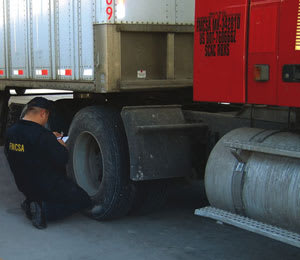
The Commercial Vehicle Safety Alliance is releasing the 2010 North American Standard Out-of-Service Criteria.
Every year for 20 years, CVSA has updated and publishing the OOSC, which becomes effective throughout North America every April 1. The OOSC is used by specially trained and certified state, provincial, territorial, and federal law enforcement personnel in identifying Critical Vehicle Inspection Item violations following a roadside inspection. Officers finding these out-of-service violations can prohibit a motor carrier or operator from driving or operating a commercial motor vehicle for a specified period of time or until the defective condition is corrected.
The OOSC is a component of the North American Standard Inspection Program, and is developed through a collaborative process that includes government and industry experts and which is focused on the issues most critical to maintaining the safe operations of commercial vehicles on our roadways.
"It is in the best interests of every driver and motor carrier to be familiar with the North American Standard Out-of-Service Criteria," said Stephen A. Keppler, CVSA's Interim Executive Director. "Knowing which commercial motor vehicle violations have been identified as being the most serious is helpful because it provides necessary focus in properly maintaining vehicles and it saves lives. It also helps prevent unnecessary delays and down time in transit as a result of having a driver or vehicle placed out-of-service."
Roadside inspection results are used in part to identify motor carriers that present a high degree of risk to the motoring public. As a result, the data collected helps in determining which transportation companies will be selected for review under FMCSA's new Comprehensive Safety Analysis (CSA 2010) initiative.
"With full implementation of CSA 2010 activities on the horizon, such as the new Carrier Safety Measurement System, knowing the 'Criteria' in advance can assist a motor carrier ensure the accuracy of the roadside inspection data collected and contained within a motor carrier's safety profile." said Larry G. Woolum, Regulatory Affairs Director of the Ohio Trucking Association and Chair of CVSA's Associate Advisory Committee.
"The information collected during a roadside inspection provides the foundation for data-driven traffic safety initiatives. As a result, the importance of this issue cannot be understated, as it has strong implications to not only CSA 2010 but all of our traffic safety programs," said Buzzy France, CVSA's President. "Commercial motor vehicle safety continues to be a challenge and we need the involvement of all affected parties to help us better understand these issues and put into place practical solutions. As commercial vehicle inspectors, our continued diligence will help us reach our ultimate goal of saving lives."
More info: www.cvsa.org.
More Safety & Compliance

From One Generation to the Next: How Mentorship Builds Safer Truck Drivers
After three decades in trucking, Harold Perry shares what he's learned about driver safety, mentorship, and helping the next generation build confidence behind the wheel.
Read More →
FMCSA Pauses Biennial-Update Enforcement Amid Motus Transition
Carriers whose updates were due on or after June 1 have more time, while FMCSA works to stabilize its new registration system and warns of phishing sites impersonating its new carrier registration system, Motus.
Read More →
ZF Expands Commercial Vehicle Push in North America
ZF is expanding its North American commercial-vehicle presence with new transmission applications, electrification, trailer technology and autonomous-driving systems.
Read More →
Truck Drivers Need More Than Another Alert
Fleets have more visibility into truck health, safety events, and driver activity than ever. The next challenge is turning all that information into useful guidance for the person who has to decide what to do next.
Read More →
Tesla Wants a Self-Driving Semi. Are Cameras Enough?
Could Tesla’s camera-only autonomous driving technology work on an 80,000-pound Semi? In this commentary, HDT's Deborah Lockridge takes a look at Tesla, Cybercab, and how autonomous trucks see the road.
Read More →
What DOT’s Automated Vehicle Strategy Means for Trucking
The U.S. Department of Transportation issued a new automated-vehicle strategy that outlines plans for driverless-truck regulations, cross-state freight corridors, and federal safety standards.
Read More →
NYC Expands Speed, Pedestrian Safety Tech Across Fleet
New York City is expanding intelligent speed assistance and pedestrian-alert systems across its municipal fleet, moving the technologies from pilot programs into vehicle procurement and retrofit requirements.
Read More →
FMCSA Removes 110 Truck Driver Training Schools from Certified ELDT List
Federal regulators also are targeting more than 160 additional training providers and launching a nationwide audit of third-party CDL skills testers as part of a broader crackdown on trucking fraud.
Read More →
Beyond DOT Compliance: What Makes a Trucking Fleet Truly Safe?
A trucking fleet can follow every rule and still make unsafe decisions. The real test comes when safety conflicts with freight, productivity, or cost.
Read More →
Hours of Service Pilot Programs: FMCSA Readies for 2027 Rollout
Two pilot programs could eventually reshape hours-of-service rules, giving truck drivers options to pause their 14-hour clock or use longer split sleeper rest periods.
Read More →