





Related – Q&A: Convoy on a Better Way to Connect Truckers and Shippers
Convoy Go Makes Drop and Hook Available to Small Carriers
Convoy Go is a new drop-and-hook marketplace that lets any U.S. trucking company or owner-operator haul pre-loaded trailers.
April 18, 2019
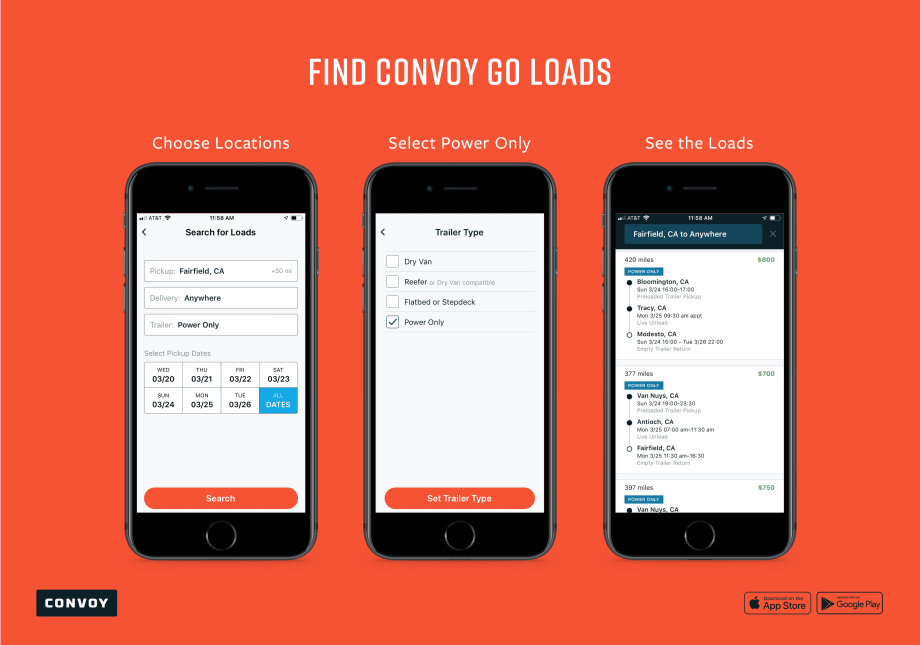
Image courtesy Convoy
2 min to read

Image courtesy Convoy
Convoy Go is a new drop-and-hook marketplace that lets any U.S. trucking company or owner-operator haul pre-loaded trailers.
It’s the latest extension for Convoy, is a nationwide trucking network and platform that allows carriers and owner-operators to find loads via a free mobile app and get paid quickly.
Drop shipments (pre-loaded trailers) currently represent the majority of Fortune 500 company shipments, Convoy says, but traditionally most of these shipments have been serviced by large asset-based carriers. This new app allows smaller operations to handle drop-and-hook freight as well.
With its drop-and-hook marketplace, Convoy says Convoy Go creates a seamless “grab and go” system, where carriers simply bring their power unit, pick up a pre-loaded trailer, and hit the road. The new service uses Convoy’s Universal Trailer Pool announced nearly a year ago. This nationwide pool of Convoy-managed trailers can be used by any driver in Convoy’s network, with no rental fees.
“Convoy’s data shows that up to a third of the cost of truck freight in the U.S. is attributable to time spent either waiting for appointments, or waiting at the dock to load and unload,” said Tito Hubert, product lead for Convoy Go. “This massive amount of waste has a direct impact on increased transportation costs, decreased drivers’ earnings and reduced overall trucking capacity for shippers. We built Convoy Go to enable drivers to increase their productivity and earnings, all while providing shippers with greater capacity.”
Convoy Go reduces driver wait time in facilities from an average of three hours to less than an hour and provides 5 to 10 hour appointment windows, according to Convoy.
Since Convoy initially piloted this offering in 2017, the company has worked with select shippers and thousands of drivers to tune the model across the Northeast, Southeast, South and West regions. Today, the program is available to all shippers and carriers nationwide.
“In the past I was able to do three to four loads a week per truck, but now, with Convoy Go, I can consistently do six loads per week per truck,” said Eduardo Canales, from Canales Trucking. “We are a small company with two trucks and, in the past, we rarely did power only loads. Now, we operate almost exclusively power-only loads with Convoy. The main upside is that the wait time is very short. We are in and out of facilities in 45 minutes versus more than four hours for live loads. Also, Convoy allows us to have power-only head-hauls and power only backhauls, which allows us to work more miles.”
More Fleet Management

Sponsored•September 16, 2026
Color Match Smarter: Tools That Restore & Perform
For fleet managers and collision repair professionals keeping heavy-duty trucks on the road, getting the color right the first time isn't just about appearance — it's about efficiency, turnaround time, and bottom-line results. Discover how today's digital color tools are transforming the repair process from guesswork to precision.
Read More →
FMCSA Pauses Biennial-Update Enforcement Amid Motus Transition
Carriers whose updates were due on or after June 1 have more time, while FMCSA works to stabilize its new registration system and warns of phishing sites impersonating its new carrier registration system, Motus.
Read More →
Sponsored•September 14, 2026
2026 Blueprint for Countering Smarter Supply Chain Theft
Cargo theft is no longer just the cost of doing business. It's a multi-billion-dollar criminal enterprise exploiting vulnerabilities across your fleet, drivers, and supply chain.
Read More →


Sponsored•September 1, 2026
How Telematics Improves Visibility, Control, and Performance in Refrigerated Fleets
Explore how telematics help refrigerated fleets improve visibility, uptime, efficiency, compliance, and cargo protection across connected cold chain operations.
Read More →
What the U.S.-Canada Trade War Means for Trucking
Escalating U.S.-Canada tariffs could disrupt cross-border freight, reduce truck volumes, raise costs, and create new uncertainty for carriers on both sides of the border.
Read More →
What Are Trucking’s Top Concerns for 2026?
The American Transportation Research Institute wants to know what's worrying trucking fleet managers, drivers, and other stakeholders in its annual Industry Issues survey.
Read More →
American Trucking Associations Looks for a New Leader
ATA President and CEO Chris Spear abruptly left his job at the association on August 21, at a pivotal time for the trucking industry.
Read More →
Public Wi-Fi Cybersecurity Risks: How Truck Drivers and Fleets Can Protect Their Data
Public Wi-Fi can expose truck drivers and fleets to credential theft, malware, and other cyber threats. Here’s how to reduce the risk on the road.
Read More →
For Nicky Cupp, Fleet Innovation Starts With Frustration
HDT Truck Fleet Innovator Nicky Cupp turns everyday pain points at Fraley & Schilling into opportunities for better technology and smarter processes.
Read More →
Adam Buttgenbach’s Approach to Electric Trucks: Start With Where They Fit
HDT Truck Fleet Innovator Adam Buttgenbach helped PepsiCo build one of North America’s largest EV fleets by focusing on where electric trucks make operational sense.
Read More →