




ConMet Aims to Address TRU Emissions Regs with Zero-Emission Trailer
The power behind ConMet’s zero-emission trailer comes from its Preset Plus Electric Hub. The in-wheel electric motor is paired with a ConMet PreSet Plus hub assembly, engineered to capture wasted braking energy and repurpose it as electricity.

ConMet’s Preset Plus Electric Hub in-wheel electric motor is paired with a ConMet PreSet Plus hub assembly in ConMet's zero-emission trailer.
Photo: ConMet
ConMet’s eMobility division is investing in electric trailer technology to decrease emissions and reduce brake wear on transport refrigeration units (TRUs). The announcement was made on Sept. 12 at the Technology & Maintenance Council Fall Meeting in Cleveland, Ohio.
The power behind ConMet’s zero-emission trailer comes from its Preset Plus Electric Hub (eHub). The in-wheel electric motor is paired with a ConMet PreSet Plus hub assembly, engineered to capture wasted braking energy and repurpose it as electricity.
The electricity is stored in a high-capacity, lightweight battery that sits beneath the trailer, which then powers the electric reefer to keep a fully loaded trailer cool without the need for diesel fuel. The energy can also power the eHub motors for robust, decentralized propulsion of the vehicle, while allowing quieter navigation in restrictive urban routes.
Hello Cleveland and #TMC 2021!@ConMet is kicking the show off this morning with a look at its new Zero Emissions 53-foot trailer. Essentially the entire trailer is powered by the company’s smart, regenerative wheel hubs/energy capture system. Powerful enough to run a reefer unit pic.twitter.com/nBxjE69Zz0
— Jack Roberts (@By_JackRoberts) September 12, 2021
The eHub debuted in 2019, but the updated design has been simplified for modularity, a better mechanical fit, manufacturing scalability, and updated software controls.
ConMet eMobility identified TRUs for the first eHub application, because the California Air Resource Board is set to enact a new set of regulations on TRU emissions by 2025, with more states expected to follow.
“The eHub system is now the most efficient way to completely replace the need for internal combustion engines in transport refrigeration units,” said Marc Trahand, vice president and general manager of ConMet eMobility at TMC.
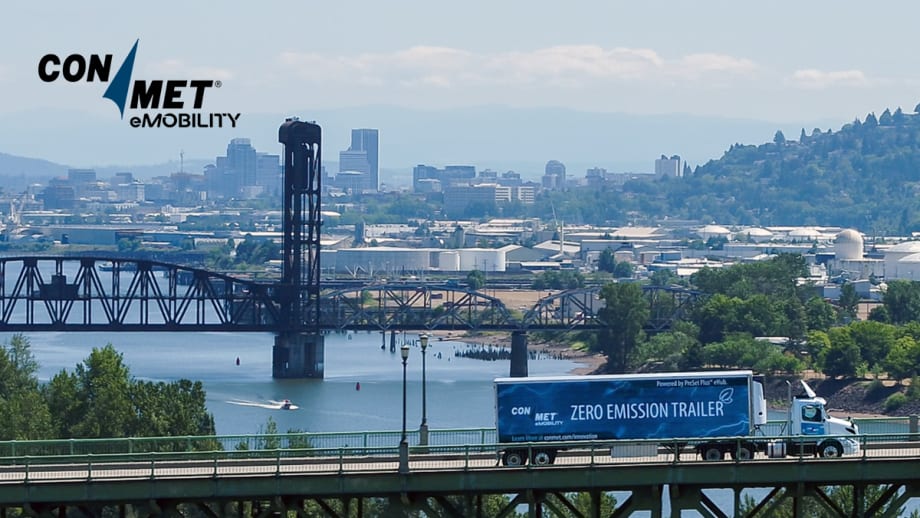
The zero-emission trailer’s regenerative power eliminates the need for shore power, and its modular packages allow for customization to fit all vehicle types, lengths, and sizes.
ConMet eMobility is already in negotiations for a commercialization partnership to provide zero-emissions packages nationwide.
More Equipment

How Volvo Updated Its D13 for EPA 2027 [Watch]
Volvo’s updated D13 promises lower emissions without sacrificing performance or fuel economy. Take a closer look at what changed inside the engine in this HDT Spotlight video.
Read More →
Michelin Tire Improves Efficiency and Durability for Regional Fleets
The Michelin X Multi Energy D2 is a regional haul drive tire engineered to help fleets improve fuel efficiency, durability and traction in demanding stop-and-go operations.
Read More →
ZF Expands Commercial Vehicle Push in North America
ZF is expanding its North American commercial-vehicle presence with new transmission applications, electrification, trailer technology and autonomous-driving systems.
Read More →
Tesla Wants a Self-Driving Semi. Are Cameras Enough?
Could Tesla’s camera-only autonomous driving technology work on an 80,000-pound Semi? In this commentary, HDT's Deborah Lockridge takes a look at Tesla, Cybercab, and how autonomous trucks see the road.
Read More →
Kodiak: Driverless Long-Haul Truck Launch on Track for 2026
Kodiak AI says its driverless long-haul safety case is 93% complete and it remains on track to begin commercial operations by year-end 2026.
Read More →
What DOT’s Automated Vehicle Strategy Means for Trucking
The U.S. Department of Transportation issued a new automated-vehicle strategy that outlines plans for driverless-truck regulations, cross-state freight corridors, and federal safety standards.
Read More →
East Coast Port Launches $45M Electric Truck Push
The Port Authority of New York and New Jersey announced millions in incentives for zero-emission drayage trucks, yard tractors, and new charging hubs near the port.
Read More →
PlusAI Going Public to Fund Autonomous Truck Launch
A SPAC deal could provide PlusAI with up to $300 million as it works toward a 2027 commercial launch of factory-built autonomous trucks.
Read More →
NHTSA Moves to Rewrite Truck Fuel-Economy Rules
The National Highway Traffic Safety Administration says it lacks authority to regulate medium- and heavy-duty truck engines separately from complete vehicles, but the existing standards have not yet been eliminated.
Read More →
Detroit Opens Orders for EPA 2027 Engines
Detroit isn’t starting from scratch to meet EPA 2027 diesel emissions standards. Its Gen 6 DD13 and DD15 engines keep much of today’s platform while updating the fuel and aftertreatment systems.
Read More →