




CN & BNSF Explain Merger Benefits
Following a merger agreement late last year, Canadian National Railway Company and Burlington Northern Santa Fe Corporation recently outlined how the combined businesses would become more efficient.
Following a merger agreement late last year, Canadian National Railway Company and Burlington Northern Santa Fe Corporation recently outlined how the combined businesses would become more efficient.
The companies expect the merger will:
* Create an extensive, efficient single-line network across Canada and the central and western United States that will deliver faster, more reliable service and better information to customers.
* Establish new single-line north-south traffic routes that will provide more direct and efficient lanes that bypass congested areas, open new markets to shippers and their customers, and move products efficiently between Canada and the U.S.
* Create truck-competitive service in key corridors that is expected to give shippers viable alternatives to high trucking costs, reducing truck traffic on highways.
* Be low risk and stand apart from certain recent rail consolidations. The combination will not eliminate a parallel competitor, divide an existing railroad or cut key personnel.
Combined, CN and BNSF would currently operate about 50,000 route-miles of track, employ about 67,000 people and have combined revenue of approximately US$12.5 billion (Cdn$18.5 billion).
The combination is subject to, among other things, approval by the shareholders of both companies, as well as to customary regulatory approvals. CN will proceed with a Plan of Arrangement that will be submitted to the Quebec Superior Court to confirm that the combination is fair to CN shareholders. The combination will also be subject to approval by the United States Surface Transportation Board. The companies expect that all required regulatory approvals can be obtained and the transaction completed by mid-2001.
Through its subsidiary, The Burlington Northern and Santa Fe Railway Company, BNSF, headquartered in Forth Worth, Texas, operates one of the largest rail networks in North America, with 33,500 route miles of track covering 28 states and two Canadian provinces.
Canadian National Railway Company spans Canada and mid-America, from the Atlantic and Pacific oceans to the Gulf of Mexico, serving the ports of Vancouver, Prince Rupert, B.C., Montreal, Halifax, New Orleans, and Mobile, Ala., and the key cities of Toronto, Buffalo, Chicago, Detroit, Memphis, St. Louis, and Jackson, Miss., with connections to all points in North America.
More Fleet Management

What the U.S.-Canada Trade War Means for Trucking
Escalating U.S.-Canada tariffs could disrupt cross-border freight, reduce truck volumes, raise costs, and create new uncertainty for carriers on both sides of the border.
Read More →
What Are Trucking’s Top Concerns for 2026?
The American Transportation Research Institute wants to know what's worrying trucking fleet managers, drivers, and other stakeholders in its annual Industry Issues survey.
Read More →
American Trucking Associations Looks for a New Leader
ATA President and CEO Chris Spear abruptly left his job at the association on August 21, at a pivotal time for the trucking industry.
Read More →
Public Wi-Fi Cybersecurity Risks: How Truck Drivers and Fleets Can Protect Their Data
Public Wi-Fi can expose truck drivers and fleets to credential theft, malware, and other cyber threats. Here’s how to reduce the risk on the road.
Read More →
For Nicky Cupp, Fleet Innovation Starts With Frustration
HDT Truck Fleet Innovator Nicky Cupp turns everyday pain points at Fraley & Schilling into opportunities for better technology and smarter processes.
Read More →
Adam Buttgenbach’s Approach to Electric Trucks: Start With Where They Fit
HDT Truck Fleet Innovator Adam Buttgenbach helped PepsiCo build one of North America’s largest EV fleets by focusing on where electric trucks make operational sense.
Read More →
Deen Albert: Let Automation Do the Math, People Make the Decisions
HDT Truck Fleet Innovator Deen Albert makes sure people are still at the heart of operations at Grand Island Express, even while adopting artificial intelligence tools. AI-assisted dispatch helped boost revenue 25% with the same number of trucks.
Read More →
Trimble’s New AI Agent Takes Aim at Fleet Back-Office Busywork
Arc Agent works across Trimble TMS products to automate repetitive tasks such as freight orders, maintenance, invoices, fuel costs and more.
Read More →
How HDT’s 2026 Truck Fleet Innovators Are Rethinking Fleet Operations
Meet five trucking leaders who are challenging assumptions, solving operational problems, and putting innovative ideas to work.
Read More →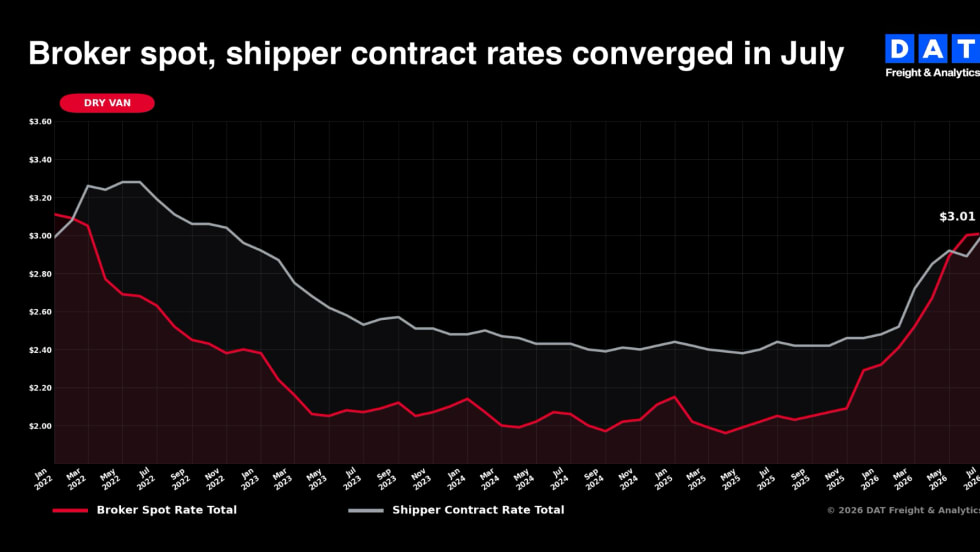
Tight Trucking Capacity Pushes Rates Higher Even as Freight Volumes Fall
“Spot rates moving ahead of contract rates have historically signaled a tightening market, but we haven’t seen a capacity-driven market quite like this one,” said DAT's Dean Croke.
Read More →