




Class 8 Orders Remain Steady in July
North American Class 8 orders in July were between 25,800 to 26,500 units, virtually unchanged compared to June’s orders.

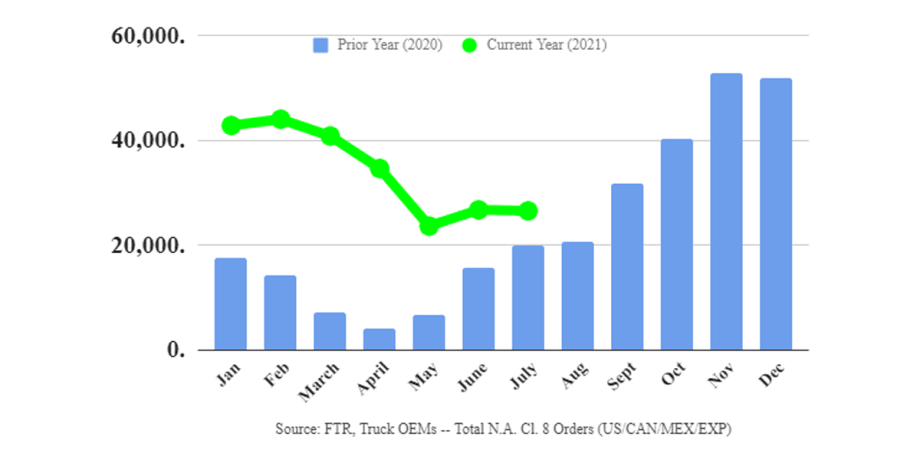
The July Class 8 order total is essentially equal with June, as the industry is in a holding pattern at the bottom of this order cycle.
Graph: FTR
North American Class 8 orders for July were between 25,800 to 26,500 units, down about 1% month over month and virtually unchanged compared to June’s orders.
Orders improved 25% year over year, FTR reported, with Class 8 orders now totaling 394,000 units for the previous 12 months.
The July order total is essentially equal with June, as the industry is in a holding pattern at the bottom of this order cycle. Ordering for 2022 has commenced at most OEMs but remains delayed some due to cost uncertainty and the possibility of enduring supply chain bottlenecks, FTR officials said in a press release.
“July ordering was similar to June in that OEMs took a limited number of orders for delivery in 2022,” said Don Ake, vice president of commercial vehicles for FTR. “Fleets need a significant number of new trucks right now and they perceive this need will continue throughout next year. However, OEMs are having difficulty establishing reasonable 2022 pricing, with commodity and other costs elevated. It is uncertain if current higher production costs are transitory or will persist into 2022.”
Also complicating the situation is that shortages of semiconductors have limited Class 8 production, Ake said.
“It is estimated that supply of trucks is falling approximately 25% behind market demand,” he said. “We are running out of time for OEMs to catch up. Most of the unproduced orders will roll into the first quarter of 2022. If those months are already booked solid, it creates even more headaches for the industry. Things won’t approach any degree of normalcy for months. Until semiconductors begin flowing into the OEMs in sufficient qualities, we will be playing catch up.”
ACT President and Senior Analyst Kenny Vieth said: “Underlying drivers of commercial vehicle demand are considerably hotter than they were three summers back, with 6-plus percent GDP growth, capacity constraints across multiple shipping modes, at/near-record trucking freight rates, surging carrier profits and record used equipment valuations providing deep support for Class 8 demand.”
More Equipment

How Volvo Updated Its D13 for EPA 2027 [Watch]
Volvo’s updated D13 promises lower emissions without sacrificing performance or fuel economy. Take a closer look at what changed inside the engine in this HDT Spotlight video.
Read More →
Michelin Tire Improves Efficiency and Durability for Regional Fleets
The Michelin X Multi Energy D2 is a regional haul drive tire engineered to help fleets improve fuel efficiency, durability and traction in demanding stop-and-go operations.
Read More →
ZF Expands Commercial Vehicle Push in North America
ZF is expanding its North American commercial-vehicle presence with new transmission applications, electrification, trailer technology and autonomous-driving systems.
Read More →
Tesla Wants a Self-Driving Semi. Are Cameras Enough?
Could Tesla’s camera-only autonomous driving technology work on an 80,000-pound Semi? In this commentary, HDT's Deborah Lockridge takes a look at Tesla, Cybercab, and how autonomous trucks see the road.
Read More →
Kodiak: Driverless Long-Haul Truck Launch on Track for 2026
Kodiak AI says its driverless long-haul safety case is 93% complete and it remains on track to begin commercial operations by year-end 2026.
Read More →
What DOT’s Automated Vehicle Strategy Means for Trucking
The U.S. Department of Transportation issued a new automated-vehicle strategy that outlines plans for driverless-truck regulations, cross-state freight corridors, and federal safety standards.
Read More →
East Coast Port Launches $45M Electric Truck Push
The Port Authority of New York and New Jersey announced millions in incentives for zero-emission drayage trucks, yard tractors, and new charging hubs near the port.
Read More →
PlusAI Going Public to Fund Autonomous Truck Launch
A SPAC deal could provide PlusAI with up to $300 million as it works toward a 2027 commercial launch of factory-built autonomous trucks.
Read More →
NHTSA Moves to Rewrite Truck Fuel-Economy Rules
The National Highway Traffic Safety Administration says it lacks authority to regulate medium- and heavy-duty truck engines separately from complete vehicles, but the existing standards have not yet been eliminated.
Read More →
Detroit Opens Orders for EPA 2027 Engines
Detroit isn’t starting from scratch to meet EPA 2027 diesel emissions standards. Its Gen 6 DD13 and DD15 engines keep much of today’s platform while updating the fuel and aftertreatment systems.
Read More →