




Cargo Thieves Shift Tactics as High-Value Shipments Drive Record Losses
Cargo theft incidents held steady in the third quarter, but criminals shifted tactics and targeted higher-value freight.

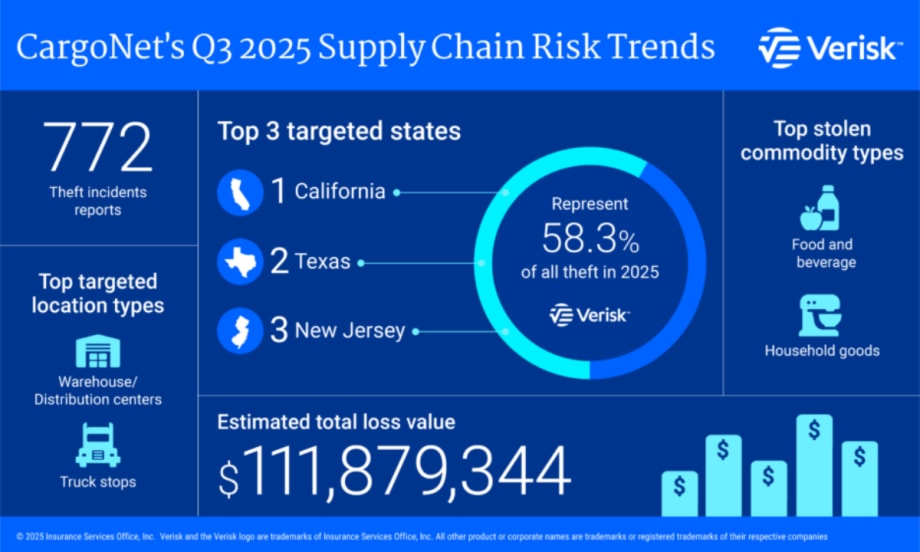
CargoNet reports $111.9M in Q3 losses, with thefts concentrated in California, Texas, and New Jersey and targeting food, beverage, and household goods shipments.
Photo: Verisk
Organized crime groups are changing tactics and increasingly focusing on high-value cargo, according to CargoNet’s third-quarter 2025 cargo theft analysis. While overall cargo theft numbers remained stable, losses surged to more than $111 million across the U.S. and Canada, making it one of the costliest quarters ever recorded, according to a news release..
Organized Groups Refine Tactics
CargoNet, a Verisk business specializing in cargo theft prevention, said its data shows organized criminal networks are adapting to new anti-fraud tools used across the logistics industry.
Some groups are moving away from complex schemes such as proof-of-delivery fraud or carrier authority takeovers. Instead, they are opting for direct, opportunistic thefts of unattended loaded trailers, particularly in Southern California, the Bay Area, Phoenix, and Lake Tahoe.
At the same time, other groups are advancing their use of social engineering to bypass security systems. These criminals gather detailed information on shipments—such as brokerage names, carrier assignments, and contact information for specific employees—and then impersonate legitimate company representatives to reroute freight to fraudulent destinations.
CargoNet expects these tactics to become more common in the fourth quarter as thieves increasingly use load board data and public logistics information to identify and research high-value targets.
“The industry is facing more sophisticated, organized operations that can mimic legitimate business interactions,” said Keith Lewis, vice president of operations at CargoNet. “These groups are exploiting gaps in information security to redirect shipments before they ever reach the carrier.”
Theft Volume Stable, But Losses Spike
CargoNet recorded 772 cargo theft events in the third quarter of 2025, up just 1% from the same period in 2024 and down 10% from the previous quarter. Despite the modest change in volume, the total financial impact jumped sharply.
The average value per stolen shipment doubled year-over-year to $336,787, up from $168,448 in Q3 2024. High-value thefts, such as enterprise computer hardware, cryptocurrency mining equipment, and copper, drove much of the increase.
Regional Hotspots Shift East
While California and Texas remain high-theft regions with 11% and 12% year-over-year increases, the New York City metropolitan area emerged as a new hotspot. Cargo thefts in New Jersey rose 110%, and Pennsylvania saw a 33% increase.
“The NYC metro area is becoming both a theft hub and a redistribution point for stolen cargo,” Lewis said. “Its proximity to major ports, distribution centers, and consumer markets makes it especially vulnerable.”
CargoNet also reported increased theft activity along key freight corridors in the Mid-Atlantic and Great Lakes regions, where organized groups may be targeting trucks passing through dense logistics hubs rather than local shipments.
Cargo Theft Commodity Trends: Food, Metals, and Tech
Several commodity categories saw sharp increases in cargo theft compared to 2024:
Meat and seafood: up 189%, from 18 events to 52
Copper: up nearly fivefold, from 10 to 47 thefts
High-tech goods: including enterprise servers and crypto mining equipment, frequently targeted for their high resale value
Food and beverage commodities continued to lead all categories with 170 theft events, followed by household goods (92) and metals (65). CargoNet also noted a small uptick in toys and games thefts heading into the holiday season.
Supply Chain Implications
The data suggests criminal groups are moving toward targeted, intelligence-driven cargo theft, where stolen goods can be quickly resold or repurposed. CargoNet noted that many high-tech items were transported as standard dry goods — making them more susceptible to traditional theft methods.
“As tactics evolve, so must the industry’s response,” Lewis said. “Enhanced information sharing, stronger vetting processes, and cybersecurity awareness are now critical parts of cargo theft prevention.”
CargoNet continues to work with law enforcement agencies and industry partners to support investigations and provide data to help mitigate theft. The organization urges fleets and logistics providers to report suspicious activity to authorities before contacting CargoNet.
More Fleet Management

Color Match Smarter: Tools That Restore & Perform
For fleet managers and collision repair professionals keeping heavy-duty trucks on the road, getting the color right the first time isn't just about appearance — it's about efficiency, turnaround time, and bottom-line results. Discover how today's digital color tools are transforming the repair process from guesswork to precision.
Read More →
FMCSA Pauses Biennial-Update Enforcement Amid Motus Transition
Carriers whose updates were due on or after June 1 have more time, while FMCSA works to stabilize its new registration system and warns of phishing sites impersonating its new carrier registration system, Motus.
Read More →
2026 Blueprint for Countering Smarter Supply Chain Theft
Cargo theft is no longer just the cost of doing business. It's a multi-billion-dollar criminal enterprise exploiting vulnerabilities across your fleet, drivers, and supply chain.
Read More →


How Telematics Improves Visibility, Control, and Performance in Refrigerated Fleets
Explore how telematics help refrigerated fleets improve visibility, uptime, efficiency, compliance, and cargo protection across connected cold chain operations.
Read More →
What the U.S.-Canada Trade War Means for Trucking
Escalating U.S.-Canada tariffs could disrupt cross-border freight, reduce truck volumes, raise costs, and create new uncertainty for carriers on both sides of the border.
Read More →
What Are Trucking’s Top Concerns for 2026?
The American Transportation Research Institute wants to know what's worrying trucking fleet managers, drivers, and other stakeholders in its annual Industry Issues survey.
Read More →
American Trucking Associations Looks for a New Leader
ATA President and CEO Chris Spear abruptly left his job at the association on August 21, at a pivotal time for the trucking industry.
Read More →
Public Wi-Fi Cybersecurity Risks: How Truck Drivers and Fleets Can Protect Their Data
Public Wi-Fi can expose truck drivers and fleets to credential theft, malware, and other cyber threats. Here’s how to reduce the risk on the road.
Read More →
For Nicky Cupp, Fleet Innovation Starts With Frustration
HDT Truck Fleet Innovator Nicky Cupp turns everyday pain points at Fraley & Schilling into opportunities for better technology and smarter processes.
Read More →
Adam Buttgenbach’s Approach to Electric Trucks: Start With Where They Fit
HDT Truck Fleet Innovator Adam Buttgenbach helped PepsiCo build one of North America’s largest EV fleets by focusing on where electric trucks make operational sense.
Read More →