




Cargo Theft Hits New Highs in 2010
Cargo theft rose by 4.1 percent in 2010, to 899 cargo theft incidents (an average of 75 per month) the most ever recorded, according to FreightWatch International, Austin, Texas
Cargo theft rose by 4.1 percent in 2010, to 899 cargo theft incidents (an average of 75 per month) the most ever recorded, according to FreightWatch International, Austin, Texas.
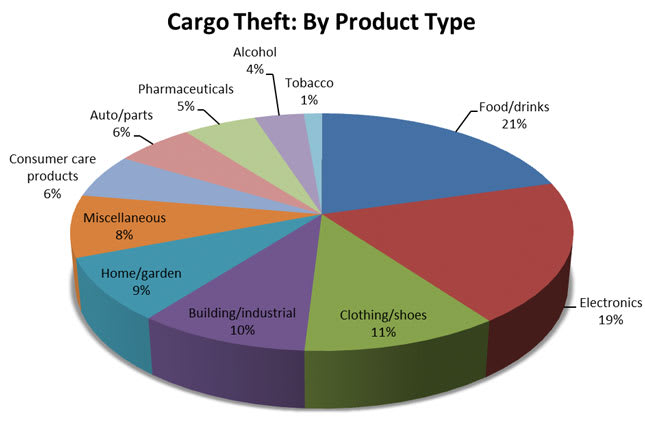
The food and beverage industry was the most heavily hit by cargo theft, accounting for 21 percent of total theft activity, with an average loss value of $125,000 per incident. It was closely followed by the electronics sector, accounting for 19 percent of all cargo theft and an average loss per incident of $512,000.
In the food and drinks product category, the goods most commonly stolen were raw products
such as rice, sugar, tea and coffee (40). Also popular among thieves were meats (33) and
canned/bottled drinks (31).
In the electronics product category, FreightWatch recorded 42 cases of television theft (the most
of any single product), 33 computer/laptop hardware thefts and 15 cell‐phone theft incidents.
The average loss value per incident in 2010 was recorded at $471,200. This is a decrease of 17%
from 2009, when the average loss value per incident was recorded at $572,800. Pharmaceuticals once again measured as the highest per‐incident value, averaging $3.78 million,
with tobacco second at $1.26 million and electronics third at $512,000.
Of the 899 incidents, 724 (81%) were full truckload or container thefts and 31 were warehouse burglaries (3.4%). Violence was involved in 1.3% of the incidents (10 hijackings and two
warehouse robberies).
While California, Florida and Texas all saw slight decreases in the number of cargo theft incidents
recorded in 2010, New Jersey smashed the charts with a 142% increase, recording 121 cargo
theft incidents in 2010, compared with 50 in 2009.
Freightwatch identified multiple-trailer thefts as an important trend In 2010. FreightWatch recorded 46 theft incidents in which cargo criminals stole multiple trailers in the same incident. "While not an entirely new M.O., the rate of occurrence far surpasses any previous year, demonstrating that criminals are aiming to increase their take‐per‐theft ratio," the report notes. "This M.O. increases the profitability of their efforts while keeping their risk of exposure (from multiple theft incidents) low."
More Safety & Compliance

A Camera Isn't a Safety Program. Here's What Brokers Are Screening for Now
Footage alone may not be enough to pass broker vetting processes. Here's what counts as a defensible safety program now.
Read More →
Marijuana and Trucking’s Drug-Testing Dilemma
Marijuana is getting stronger, laws are changing, and drug tests still can’t reliably establish impairment. What does that mean for truck drivers and the fleets that employ them?
Read More →
PrePass, Kodiak Connect Driverless Trucks to Roadside Enforcement
The system will allow enforcement agencies to verify Enhanced Inspection information and decide whether Kodiak’s autonomous trucks can bypass roadside screening sites.
Read More →

From One Generation to the Next: How Mentorship Builds Safer Truck Drivers
After three decades in trucking, Harold Perry shares what he's learned about driver safety, mentorship, and helping the next generation build confidence behind the wheel.
Read More →
FMCSA Pauses Biennial-Update Enforcement Amid Motus Transition
Carriers whose updates were due on or after June 1 have more time, while FMCSA works to stabilize its new registration system and warns of phishing sites impersonating its new carrier registration system, Motus.
Read More →
ZF Expands Commercial Vehicle Push in North America
ZF is expanding its North American commercial-vehicle presence with new transmission applications, electrification, trailer technology and autonomous-driving systems.
Read More →
Truck Drivers Need More Than Another Alert
Fleets have more visibility into truck health, safety events, and driver activity than ever. The next challenge is turning all that information into useful guidance for the person who has to decide what to do next.
Read More →
Tesla Wants a Self-Driving Semi. Are Cameras Enough?
Could Tesla’s camera-only autonomous driving technology work on an 80,000-pound Semi? In this commentary, HDT's Deborah Lockridge takes a look at Tesla, Cybercab, and how autonomous trucks see the road.
Read More →
What DOT’s Automated Vehicle Strategy Means for Trucking
The U.S. Department of Transportation issued a new automated-vehicle strategy that outlines plans for driverless-truck regulations, cross-state freight corridors, and federal safety standards.
Read More →
NYC Expands Speed, Pedestrian Safety Tech Across Fleet
New York City is expanding intelligent speed assistance and pedestrian-alert systems across its municipal fleet, moving the technologies from pilot programs into vehicle procurement and retrofit requirements.
Read More →