





Commentary — The Rush to Battery-Electric Trucks: Putting the Cart Before the Horse
California Trucking Association Challenges CARB's Advanced Clean Fleets Rule
California's zero-emission truck regulations "represent a vast overreach that threatens the security and predictability of the nation’s goods movement industry,” said the California Trucking Association in a legal challenge.
October 18, 2023
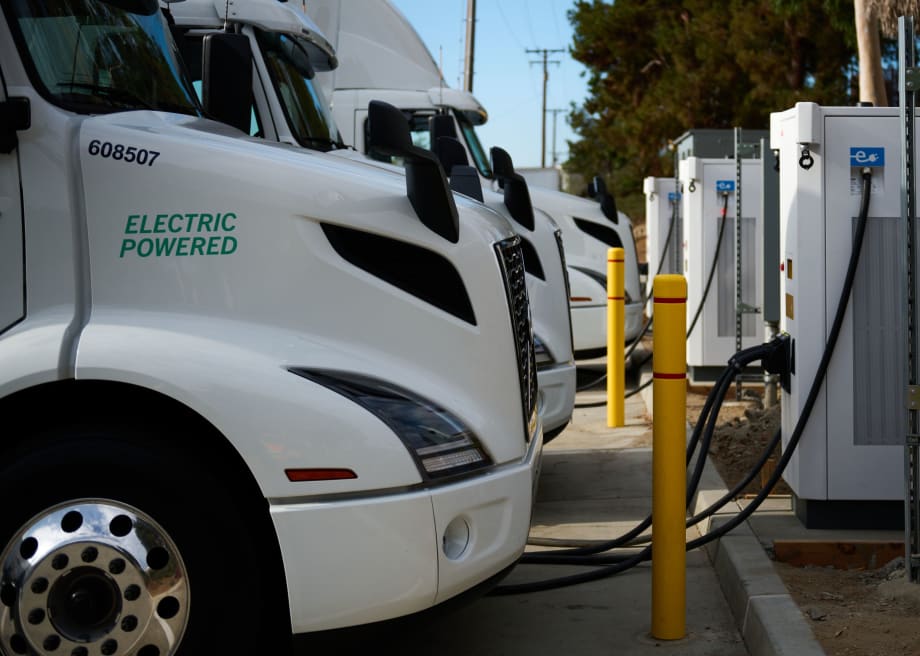
Charging infrastructure is a stumbling block in the way of fast electric truck adoption.
Photo: Volvo Trucks/Prologis
3 min to read
The California Trucking Association is challenging California’s Advanced Clean Fleets zero-emissions trucks mandate in court.
The Advanced Clean Fleets regulation would require motor carriers operating in the state to transition their trucks to zero-emission vehicles — some as soon as Jan. 1. The state’s goal is to have fleets operating in the state be 100% electric by 2035, 2040 or 2045, depending on size and type of truck. And that doesn’t apply only to fleets domiciled in California.
The regulation was approved only in late April, following waivers issued by the federal Environmental Protection Agency in March that were required in order for the California Air Resources Board to move forward with the rule.
CTA's lawsuit seeks a preliminary and permanent injunction barring the California Air Resources Board from implementing or enforcing the regulation.
“CARB’s efforts are in service to the laudable goal of decreasing emissions from commercial vehicles, but represent a vast overreach that threatens the security and predictability of the nation’s goods movement industry,” said CTA in its lawsuit.
CTA: Federal Laws Pre-Empt Advanced Clean Fleets Rules
The association said in its suit, filed Oct. 16 with the U.S. District Court for the Eastern District of California, that the ACF conflicts with the Federal Clean Air Act and the Federal Aviation Administration Authorization Act of 1994.
“Congress has expressly preempted state and local rules that ‘relate to’ the control of emissions from new motor vehicles and state and local rules that ‘relate to’ a price, route, or service of any motor carrier,” CTA said.
The Advanced Clean Fleets rule includes:
Regulations designed to phase in zero-emission vehicles to fleets for state and local governments.
Regulations designed to phase in zero-emission vehicles for high-priority fleets (including fleets with 50 or more trucks or with annual revenue of $50 million or more)
Regulations designed to phase them in for drayage fleets.
A 100% zero-emission vehicle sales mandate effective in 2036.
“Because the ACF regulation is aimed at transforming not only the vehicles sold within California’s borders, but virtually any vehicle that enters those borders, CARB has disregarded what the United States Supreme Court has declared to be Congress’s carefully calibrated regulatory scheme,” the lawsuit said.
American Trucking Associations President and CEO Chris Spear on Oct. 16, in his state of the industry speech at ATA's annual management conference, said ATA "stands alongside the California Trucking Association as they file suit against the California Air Resources Board,” calling CARB “an unelected, ill-informed band of extremists who have no clue the impact their [zero-emission truck] timelines and targets will have on our economy."
Even sustainability-minded fleets that have been trying to get ahead of the regulations have had problems with battery-electric trucks on back order and charging infrastructure installation delays.
More Fuel Smarts

How Volvo Updated Its D13 for EPA 2027 [Watch]
Volvo’s updated D13 promises lower emissions without sacrificing performance or fuel economy. Take a closer look at what changed inside the engine in this HDT Spotlight video.
Read More →
Diesel Price Spike Shortens Payback for Natural Gas Trucks, Report Says
Energy Vision estimates fleets could recover the higher purchase price of an RNG-fueled Class 8 tractor in 1.3 to 2.8 years under current fuel-price scenarios.
Read More →
Calstart Becomes Catalyst Mobility, Reflecting Broader Focus
Calstart is now Catalyst Mobility, reflecting the nonprofit’s growing national role in clean transportation, including zero-emission trucks, infrastructure and incentive programs.
Read More →

Record Diesel Prices Squeeze Trucking Fleets
Average U.S. diesel prices have climbed to nearly $6 a gallon, surpassing the 2022 record as tight refinery capacity and Middle East disruptions keep fuel costs elevated.
Read More →
Sponsored•September 9, 2026
How Fuel Delivery Shapes Engine Performance
Fuel delivery depends on more than what happens at the injector. For fleet, maintenance and technical professionals, looking at the full path from pump to injector can provide useful context for understanding engine performance.
Read More →
East Coast Port Launches $45M Electric Truck Push
The Port Authority of New York and New Jersey announced millions in incentives for zero-emission drayage trucks, yard tractors, and new charging hubs near the port.
Read More →
California Bill Could Shed Light on Electric Truck Prices
Why do battery-electric Class 8 trucks remain so expensive? A California bill headed to Gov. Gavin Newsom would give fleets and state agencies more visibility into what manufacturers charge.
Read More →
Detroit Opens Orders for EPA 2027 Engines
Detroit isn’t starting from scratch to meet EPA 2027 diesel emissions standards. Its Gen 6 DD13 and DD15 engines keep much of today’s platform while updating the fuel and aftertreatment systems.
Read More →
Zero-Emission Truck Corridor Planned for West Coast
California, Oregon, Washington, British Columbia and Baja California are coordinating plans for truck charging and hydrogen fueling from Canada to Mexico.
Read More →
A Closer Look at Kenworth’s Electric T880E Vocational Truck [Video]
Learn more about Kenworth's T880E battery-electric vocational truck at the Paccar Technical Center, including its range, applications, upfitting considerations, and PTO options, in this HDT Spotlight video.
Read More →