




Related: Electric Trucks - Zap in the Pan?
BorgWarner Talks Hybrids, Electric Trucks at NACV Show
BorgWarner expects the hybrid and electric commercial vehicle market to see a 32.9% compound annual growth rate, increasing from 49,000 units in 2017 to 115,000 units in 2020.
by Staff
September 25, 2017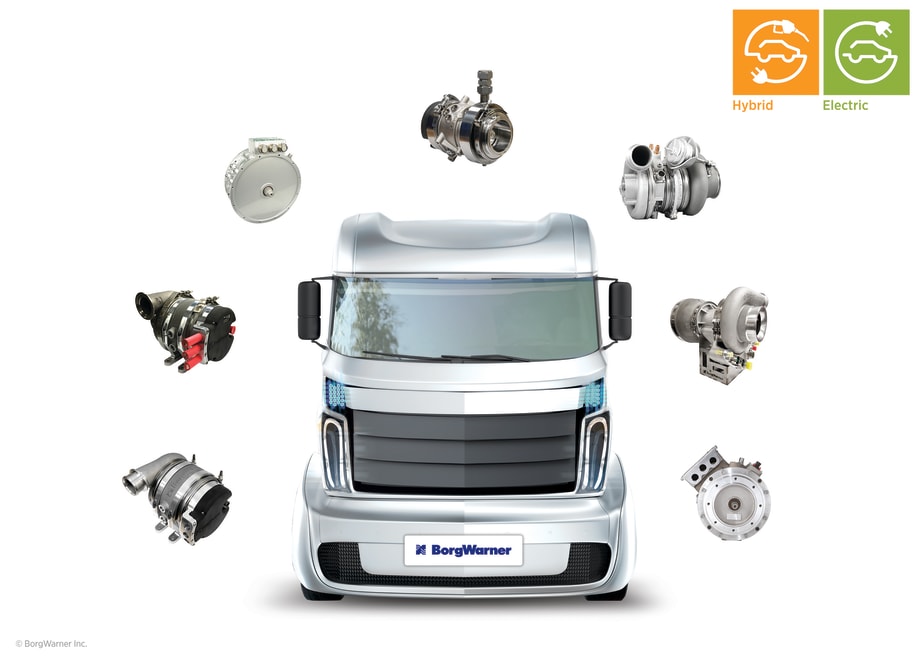
BorgWarner offers the growing hybrid and electric commercial vehicle market a broad product portfolio to help meet emissions regulations and fuel economy goals. Image: BorgWarner
2 min to read
BorgWarner offers the growing hybrid and electric commercial vehicle market a broad product portfolio to help meet emissions regulations and fuel economy goals.Image: BorgWarner
ATLANTA — BorgWarner expects the hybrid and electric commercial vehicle market to see a 32.9% compound annual growth rate, increasing from 49,000 units in 2017 to 115,000 units in 2020. The company based its forecast on the Global Commercial Vehicle Engine, Aftertreatment and Transmission Forecast Annual report by Knibb, Gormezano and Partners (KGP).
BorgWarner says it is already offering the commercial market a broad product portfolio in this segment to help fleets meet emissions regulations and fuel economy goals. It is showcasing its range of combustion, hybrid and electric technologies this week at the North American Commercial Vehicle Show, in Atlanta.
“The growth drivers in commercial vehicle propulsion systems are changing. While environmental impact and fuel economy continue to be key concerns, truck and transit fleets are now confronted with new challenges from a growing list of urban areas where combustion engines are restricted due to zero-emissions zones and noise-sensitive areas,” said Christopher P. Thomas, chief technology officer, BorgWarner. “BorgWarner’s latest technologies will help bring new, cleaner hybrid and electric options to larger fleet vehicles.”
Featuring High Voltage Hairpin (HVH) stator winding technology, BorgWarner’s HVH410 and HVH250 electric motors provide a power output of up to 402 horsepower and peak efficiencies of over 95%. HVH410 electric motors deliver a maximum torque of 1,475 lb.-ft. for class 7 and 8 hybrid and electric applications, while HVH250 electric motors deliver a maximum torque of 314 lb.-ft.
In addition, BorgWarner’s 48-volt high-efficiency motor/generators provide high system efficiency and improved energy recovery capability to meet increasing power demands.
BorgWarner’s eBooster electrically driven compressor has already been applied within the market and is designed for smaller commercial engines with less than 5 liters of displacement. A larger unit is also in development for engines with up to 13 liters of displacement.
BorgWarner’s eTurbo technology is designed to generate power for recharging vehicle batteries. The eTurbo is being developed in two sizes to serve both small and large commercial vehicle engines.
Further examples of electrified turbomachinery are also in development both internally and with customers, including an ORC (Organic Rankine Cycle) expander with electrical output, an eTurbocompounding turbine generator, and a gas turbine range extender for use on commercial electric vehicles.
More Fuel Smarts

Why Diesel Price Relief Efforts May Fall Short
Diesel prices have eased from September’s record high, but doubts about additional Russian supply and limits on dyed-diesel tax relief mean trucking fleets still face expensive fuel. And prices could go higher.
Read More →
Why Small Fuel Savings Matter in Trucking
Can better fuel economy help pay for driver raises? In this podcast, GP Transco explains how small efficiency gains create room to reinvest in its people.
Read More →
How GP Transco Cuts Trucking Fuel Costs, a Tenth of a Gallon at a Time
What’s another tenth of a mile per gallon worth? GP Transco shares how equipment upgrades and driver coaching turn small gains into meaningful fuel savings.
Read More →
Electric Yard Tractors Move Beyond Pilots
Operating-cost savings have overtaken sustainability goals as the leading reason surveyed fleets are adopting battery-electric terminal tractors, according to new NACFE research.
Read More →
Geotab Links Fleet Card to Vehicle Data
The new card combines fuel discounts with telematics-based purchase controls. Geotab’s analysis also points to potential savings from choosing lower-priced fuel stops.
Read More →
Fleet Economics Shape Electric Truck Outlook
ACT Research expects costs, charging infrastructure, and technology improvements to drive zero-emission commercial vehicle adoption as federal regulations and incentives retreat.
Read More →
Wex Adds Cardless Fuel Payments for Over-the-Road Customers
A new fuel card feature for Wex customers offers convenience and security.
Read More →
New California Law Could Shed Light on Electric Truck Prices
Why do battery-electric Class 8 trucks remain so expensive? A California bill signed by Gov. Gavin Newsom would give fleets and state agencies more visibility into what manufacturers charge.
Read More →
How Volvo Updated Its D13 for EPA 2027 [Watch]
Volvo’s updated D13 promises lower emissions without sacrificing performance or fuel economy. Take a closer look at what changed inside the engine in this HDT Spotlight video.
Read More →
Diesel Price Spike Shortens Payback for Natural Gas Trucks, Report Says
Energy Vision estimates fleets could recover the higher purchase price of an RNG-fueled Class 8 tractor in 1.3 to 2.8 years under current fuel-price scenarios.
Read More →