





Learn more about blockchain: 5 Things to Know About Blockchain
Blockchain, Once Overhyped, is Finding Real Transportation Use Cases
Five years after blockchain technology burst onto the transportation scene, you may wonder whatever happened to it.
October 12, 2022
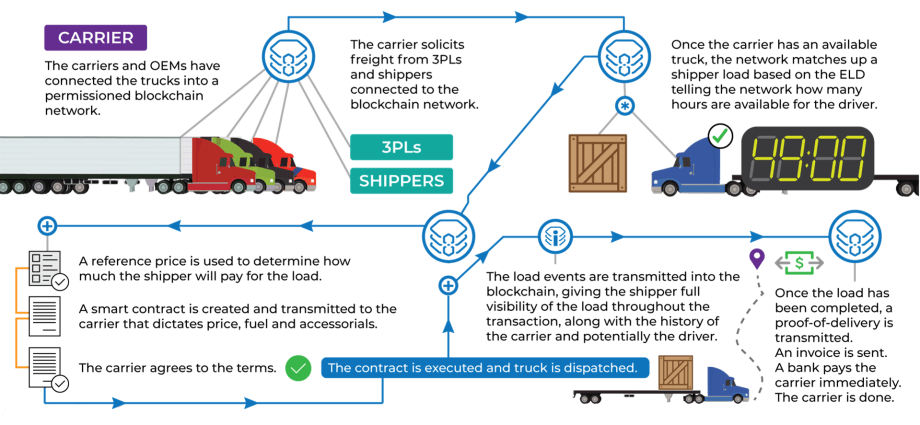
An example of how blockchain technology could work in trucking.
Image: Blockchain in Transport Alliance
5 min to read
Five years after blockchain technology burst onto the transportation scene, you may wonder whatever happened to it.
In 2017, blockchain was touted as the answer to transportation woes ranging from supply-chain visibility to outdated EDI (electronic data interchange) technology. A new group, the Blockchain in Trucking Alliance, was formed to advance the adoption of blockchain technology by trucking.
BiTA was launched by Craig Fuller, CEO and managing director of TransRisk, with founding partners such as McLeod Software, Triumph Business Capital, U.S. Xpress, Convoy, 10-4 Systems, and Fleet Complete. By the end of the year, it had broadened its focus to all transportation and changed its name to the Blockchain in Transport Alliance. Companies such as Penske and UPS joined the group.
With blockchain-capable transactions, BITA contended, the trucking industry could gain several benefits, such as immediate payments to drivers upon delivery, self-directing fuel and maintenance payments, complete automated settlements, and infinite recording of carrier history and safety.
Blockchain is a combination of technologies that allow transactions between parties via a trusted, shared ledger. Each transaction is coded into a block, which becomes part of a chain of blocks. Entries or changes to the chain cannot be made without authorization of all participating members. The most well-known use of blockchain technology involves cryptocurrencies, such as Bitcoin.
The Blockchain in Trucking Alliance offered this definition when it launched: “To put it simply, a blockchain is like a database — it’s a way of storing records of value and transactions.” The key is that the database is “immutable.” An IBM white paper on the subject noted that in traditional transactions, each party keeps its own record (or ledger) of each transaction. That leads to each participant having its “own version of the truth,” instead of one version of the truth that all participants agree is correct.
Everyone jumped on the bandwagon. But five years later, we’ve seen only a handful of trucking applications using blockchain.
Blockchain's Hype Cycle
With recent cryptocurrency scandals casting a shadow on blockchain in general, trucking reporters at the McLeod Software User Conference asked company officials about the current status of the technology for transportation.
Ken Craig, CIO for McLeod Software and a member of the board of directors for the Blockchain in Transport Alliance, referred to a recent report from Gartner on where blockchain stands in the company’s Hype Cycle of Emerging Technologies.
“Smart contracts and tokens are just computer code and are independent of the greed and corruption of the ‘centralized’ bad actors that took advantage of them,” explained Gartner VP Analyst Avivah Litan in a blog post. “In fact, bad guys experiment with new technologies much faster and earlier than the good guys do. That’s a historical fact. It takes time for the ‘good use cases’ to catch up, and it takes even more time for fraud and security controls to be deployed.”
Blockchain technologies have matured enough to support many business applications, she said, but there haven't really been any "killer apps" for the technology. Instead, we are seeing gradual improvements using blockchain technologies. Some innovations, such as blockchain wallets and smart contracts, are expected to reach maturity in less than five years, Litan said. Overall, Gartner expects that the majority of blockchain innovations will reach maturity within two to 10 years.
As Craig said, a lot of early blockchain adopters couldn’t provide a value. “It’s at least a two- to five-year process, and it shouldn’t be done without a business case,” he said.
Both Craig and Gartner cite the food chain as an example of a business case where blockchain technology makes sense.
Major food companies such as Nestle, Tyson, and Walmart are using or testing blockchain to improve traceability, deter fraud, and improve responses to contamination and food-borne illness, according to Scott Haskell with the Institute for Food Laws and Regulations at Michigan State University. And changes in the works at the U.S. Food and Drug Administration could help drive the adoption of blockchain in the food chain with more extensive regulations on food traceability.
Even back in 2017, the 22nd Annual Third-Party Logistics Study warned that it would take a coordinated effort to drive adoption of blockchain in transportation. The study found that while 30% of 3PLs and 16% of shippers saw blockchain as a potential application, they had yet to engage with the technology.
“Blockchain has the potential to make significant improvements in security, transparency, and governance, but only in supply chains where there is value in controlling consumer risk, valuable goods or complying with regulations,” said Ken Toombs, global head of Infosys Consulting, at the time. “Shippers and 3PLs will need to work together to drive value from blockchain, using lessons collectively learned from missteps with other emerging technologies, like Radio Frequency Identification (RFID).”
New Life for Blockchain in Transport Alliance?
While many BiTA members have left the organization, said Craig, the group has reinvented itself. No longer a TransRisk project, he said, it’s now a 501(c) organization.
“We’re still working on standards” for blockchain, he said, and the group already has produced several for the industry.
A few months ago, the IEEE Industry Standards and Technology Organization, an international federation of industry groups dedicated to the advancement of standardized technologies for the benefit of industry, announced the BITA Standards Council as its newest member program.
Incorporated as a 501(c)(6) in March, the BITA Standards Council "has the mission to publish, and certify open-source standards to facilitate global commerce, initially with a focus on blockchain-enabled technologies in the transportation and logistics industries," said the IEEE announcement.
“By standardizing the data formats of attributes on transportation blockchain platforms, we will improve interoperability within the industry and create efficiencies in the supply chain and track and trace applications” said Dale Chrystie, BSC President and Business Fellow, Blockchain Strategist, for FedEx, in a news release.
“[Blockchain] still has life, but the life is driven by business use cases, not technical hype,” Craig said. “There are several good practical use cases in the trucking industry. It’s still alive and well — we just need to look at it as a technology.”
More Fleet Management

Why Private Fleets Are Taking More Freight
Private fleets are putting their own trucks on demanding customers and high-cost lanes as companies seek greater control over service, costs, and capacity.
Read More →
Sponsored•September 16, 2026
Color Match Smarter: Tools That Restore & Perform
For fleet managers and collision repair professionals keeping heavy-duty trucks on the road, getting the color right the first time isn't just about appearance — it's about efficiency, turnaround time, and bottom-line results. Discover how today's digital color tools are transforming the repair process from guesswork to precision.
Read More →
FMCSA Pauses Biennial-Update Enforcement Amid Motus Transition
Carriers whose updates were due on or after June 1 have more time, while FMCSA works to stabilize its new registration system and warns of phishing sites impersonating its new carrier registration system, Motus.
Read More →


Sponsored•September 14, 2026
2026 Blueprint for Countering Smarter Supply Chain Theft
Cargo theft is no longer just the cost of doing business. It's a multi-billion-dollar criminal enterprise exploiting vulnerabilities across your fleet, drivers, and supply chain.
Read More →
Sponsored•September 1, 2026
How Telematics Improves Visibility, Control, and Performance in Refrigerated Fleets
Explore how telematics help refrigerated fleets improve visibility, uptime, efficiency, compliance, and cargo protection across connected cold chain operations.
Read More →
What the U.S.-Canada Trade War Means for Trucking
Escalating U.S.-Canada tariffs could disrupt cross-border freight, reduce truck volumes, raise costs, and create new uncertainty for carriers on both sides of the border.
Read More →
What Are Trucking’s Top Concerns for 2026?
The American Transportation Research Institute wants to know what's worrying trucking fleet managers, drivers, and other stakeholders in its annual Industry Issues survey.
Read More →
American Trucking Associations Looks for a New Leader
ATA President and CEO Chris Spear abruptly left his job at the association on August 21, at a pivotal time for the trucking industry.
Read More →
Public Wi-Fi Cybersecurity Risks: How Truck Drivers and Fleets Can Protect Their Data
Public Wi-Fi can expose truck drivers and fleets to credential theft, malware, and other cyber threats. Here’s how to reduce the risk on the road.
Read More →
For Nicky Cupp, Fleet Innovation Starts With Frustration
HDT Truck Fleet Innovator Nicky Cupp turns everyday pain points at Fraley & Schilling into opportunities for better technology and smarter processes.
Read More →