




Biden: Cummins Building 'Clean Energy Future Made in America'
In just a few weeks, Cummins will begin manufacturing electrolyzers in the U.S., a key part of green hydrogen production, and announced more than $1 billion in investments for production of its fuel-agnostic engines.
April 3, 2023

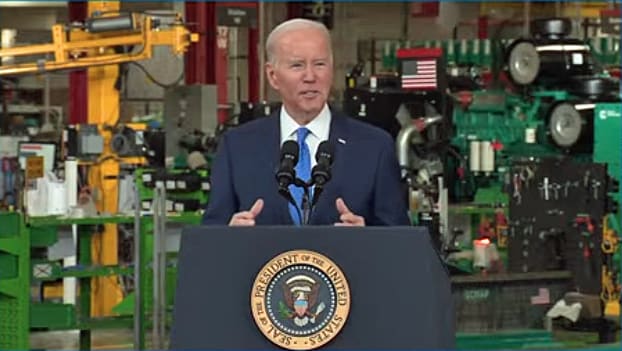
President Biden visited Cummins Power Generation Facility in Fridley, Minnesota, as part of his administration’s “Investing in America” tour.
Screen Capture of White House YouTube live stream
3 min to read
As Cummins prepares to start manufacturing electrolyzers in the U.S. to produce clean hydrogen, the company announced that it is investing more than $1 billion across its U.S. engine manufacturing network in Indiana, North Carolina, and New York to produce cleaner engines — an investment that President Joe Biden highlighted as part of his administration’s “Investing in America” tour.
On Monday, April 3, President Biden visited Cummins Power Generation Facility in Fridley, Minnesota, Touting a “clean energy future made in America,” the president said that federal government incentives allow companies like Cummins to manufacture clean-energy technology in the U.S.
“When Cummins first manufactured hydrogen electrolyzers, they had to make them overseas,” he said. “Now, thanks to the Inflation Reduction Act, they are going to be manufactured here in America for the first time.
“Before the pandemic, the supply chain wasn’t something most Americans spent much time thinking about,” Biden said. Now, “instead of relying on equipment made oversees in places like China, supply chains will again be made in America.”
In the future, he said, trucks made in America will be powered by clean hydrogen made in America.
“In just a few weeks, we will begin manufacturing one of the key pieces of technology for green hydrogen production that will help decarbonize our economy and drive the clean energy transition – the electrolyzer,” said Jennifer Rumsey, Cummins President and CEO, in a news release ahead of the visit. “Support from the Biden administration and Congress with legislation like the Bipartisan Infrastructure Law and Inflation Reduction Act are driving the clean energy economy forward in the United States and critical to our decarbonization efforts.”
The investment will provide upgrades to support Cummins new fuel-agnostic engine platforms that will run on low-carbon fuels, including natural gas, diesel, and eventually hydrogen to help decarbonize trucking fleets.
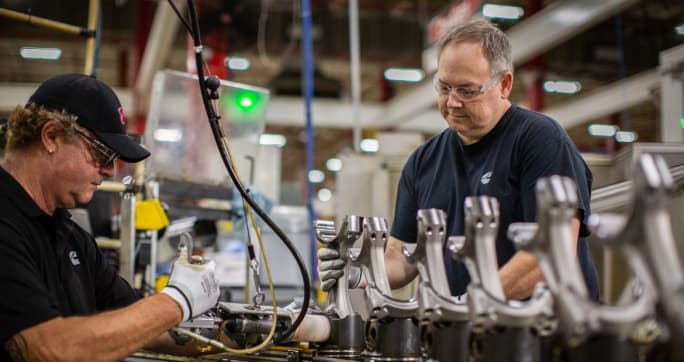
President Biden touted the number of jobs being created with investments like Cummins' in clean energy.
Photo: Cummins
Jamestown Engine Plant and the First Fuel-Agnostic Engines
Cummins plans to invest $452 million in its Jamestown Engine Plant to upgrade its 998,000-square-foot facility in Western New York to produce its new fuel-agnostic internal combustion engine platform.
The X15N is part of the new fuel-agnostic 15L engine platform produced at JEP. Cummins customers, including Walmart, Werner, Matheson, and National Ready Mix, among others, are beginning to test the very first X15N engines. Walmart will receive the first field test unit later in April. Cummins notes this is the first 15L advanced engine platform running on renewable natural gas.
Cummins recently unveiled its X10 fuel-agnostic 10L engine.
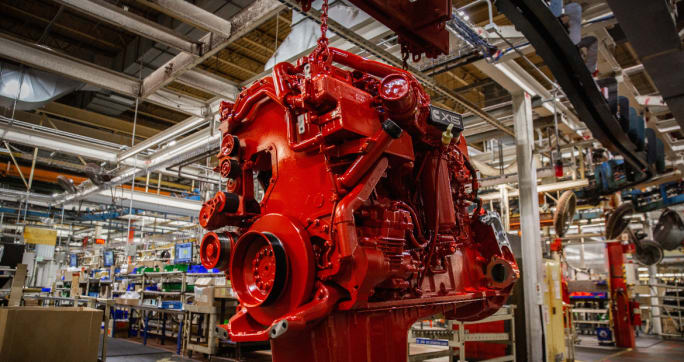
Cummins plans to invest $452 million in its Jamestown Engine Plant to upgrade its 998,000-square-foot facility in Western New York to produce its new fuel-agnostic internal combustion engine platform.
Photo: Cummins
Cummins U.S. Electrolyzer Production
At the Fridley facility, Accelera by Cummins — Cummins’ new zero-emission technology brand — will soon manufacture electrolyzers, which are a critical piece of the green hydrogen economy.
Hydrogen produced by electrolyzers can power hydrogen fuel cell vehicles and is used in industrial processes such as steel production. Building electrolyzers in Fridley is helping to bring the supply chain for zero-emissions vehicles to the United States, particularly in heavy trucking industries.
The Cummins Power Systems factory is a 1.1-million-square-foot facility, concentrating on design, product, service engineering and manufacturing. With a $10 million investment, Fridley will dedicate 89,000 square feet of the existing facility to electrolyzer production starting April 24.
More Equipment

How Volvo Updated Its D13 for EPA 2027 [Watch]
Volvo’s updated D13 promises lower emissions without sacrificing performance or fuel economy. Take a closer look at what changed inside the engine in this HDT Spotlight video.
Read More →
Michelin Tire Improves Efficiency and Durability for Regional Fleets
The Michelin X Multi Energy D2 is a regional haul drive tire engineered to help fleets improve fuel efficiency, durability and traction in demanding stop-and-go operations.
Read More →
ZF Expands Commercial Vehicle Push in North America
ZF is expanding its North American commercial-vehicle presence with new transmission applications, electrification, trailer technology and autonomous-driving systems.
Read More →
Tesla Wants a Self-Driving Semi. Are Cameras Enough?
Could Tesla’s camera-only autonomous driving technology work on an 80,000-pound Semi? In this commentary, HDT's Deborah Lockridge takes a look at Tesla, Cybercab, and how autonomous trucks see the road.
Read More →
Kodiak: Driverless Long-Haul Truck Launch on Track for 2026
Kodiak AI says its driverless long-haul safety case is 93% complete and it remains on track to begin commercial operations by year-end 2026.
Read More →
What DOT’s Automated Vehicle Strategy Means for Trucking
The U.S. Department of Transportation issued a new automated-vehicle strategy that outlines plans for driverless-truck regulations, cross-state freight corridors, and federal safety standards.
Read More →
East Coast Port Launches $45M Electric Truck Push
The Port Authority of New York and New Jersey announced millions in incentives for zero-emission drayage trucks, yard tractors, and new charging hubs near the port.
Read More →
PlusAI Going Public to Fund Autonomous Truck Launch
A SPAC deal could provide PlusAI with up to $300 million as it works toward a 2027 commercial launch of factory-built autonomous trucks.
Read More →
NHTSA Moves to Rewrite Truck Fuel-Economy Rules
The National Highway Traffic Safety Administration says it lacks authority to regulate medium- and heavy-duty truck engines separately from complete vehicles, but the existing standards have not yet been eliminated.
Read More →
Detroit Opens Orders for EPA 2027 Engines
Detroit isn’t starting from scratch to meet EPA 2027 diesel emissions standards. Its Gen 6 DD13 and DD15 engines keep much of today’s platform while updating the fuel and aftertreatment systems.
Read More →