




BestPass Says it Can Cut Number of Transponders Needed for Tolls
A company that got its start as a way for New York State Motor Truck members to more easily manage their tolls says with a new transponder it will cover nearly all toll facilities nationwide by the end of the year and eliminate the need to have half a dozen transponders in a truck.

A company that got its start as a way for New York State Motor Truck members to more easily manage their tolls says with a new transponder it will cover nearly all toll facilities nationwide by the end of the year and eliminate the need to have half a dozen transponders in a truck.
Bestpass provides single-source payment and streamlined toll management services to fleets and announced its new Horizon transponder and an expanded network at the Mid-America Trucking Show in Louisville, Ky., Friday.
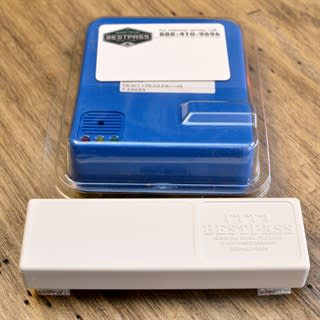
In conjunction with the company's E-ZPass-compatible transponder, the new Bestpass Horizon transponder will allow for single source toll account management for the major toll facilities not currently part of E-ZPass -- eventually removing the need for five to seven transponders.
The Horizon transponder is currently undergoing testing with early adopter fleets in Kansas and Florida. Once initial testing is complete, fleets including Schneider, Werner, Prime, and others have committed to deploying the new solution.
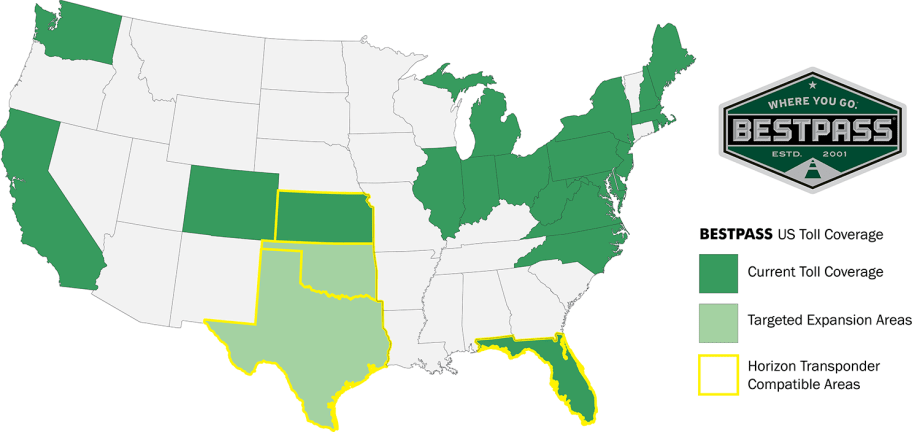
The Bestpass Horizon transponder’s introduction coincides with the planned completion of affiliations with tolling authorities across North America. The addition of the Kansas Turnpike and Florida’s Turnpike, including the range of all other SunPass tolled facilities in Florida, will result in a significant number of toll road miles that are heavily traversed by commercial vehicles being added to the Bestpass service.
John Andrews, CEO, took over the helm of BestPass about four years ago. He originally joined the company as a software developer. In 2010, the company had four employees and 18,000 transponders, handing about $50 million in tolls a year. This year it has 30 employees and 145,000-plus transponders, with $322 million annual usage.
He emphasized that the company is still owned by the New York Motor Truck association so it maintains a trucker-centric business philosophy. "We do make a little bit of money, but our goal is to solve toll problems."
Andrews explained that tolling is the most unmanaged large expense in trucking -- yet it is the third to sixth largest daily expense, he said.
"E-tolling sounds like a good idea, but it shifts all the cash reimbursement that used to happen to a driver to a back office accounting function. They're spending time dealing with 33 different toll agencies. That's where we live. We have a help desk, a service center, we offload that pain."
The Bestpass solution includes E-ZPass coverage for the group’s 26 toll agencies in 15 states and the new Horizon transponder for the bulk of the authorities outside of the E-ZPass electronic toll collection network. Bestpass also works with toll authorities that use license plate read systems. Maximizing benefits in those states, Bestpass can provide customers with toll discounts for plate reads that are generally not otherwise available.
By August, Bestpass plans to have toll discount and management programs in place with 99 percent of all U.S. tolled miles, excluding only a few bridges and HOV lanes. The company is working hard to bring its services to Oklahoma and Texas before the end of 2015, and anticipates adding coast-to-coast toll facility coverage in Canada sometime in 2016.
Bestpass also offers weigh station bypass functionality on its transponders,
More Fleet Management

Nominations Open for HDT Emerging Leaders
Heavy Duty Trucking is looking for accomplished trucking fleet professionals under 40 who are making an impact and helping lead the industry forward.
Read More →
Why Private Fleets Are Taking More Freight
Private fleets are putting their own trucks on demanding customers and high-cost lanes as companies seek greater control over service, costs, and capacity.
Read More →
Color Match Smarter: Tools That Restore & Perform
For fleet managers and collision repair professionals keeping heavy-duty trucks on the road, getting the color right the first time isn't just about appearance — it's about efficiency, turnaround time, and bottom-line results. Discover how today's digital color tools are transforming the repair process from guesswork to precision.
Read More →


FMCSA Pauses Biennial-Update Enforcement Amid Motus Transition
Carriers whose updates were due on or after June 1 have more time, while FMCSA works to stabilize its new registration system and warns of phishing sites impersonating its new carrier registration system, Motus.
Read More →
2026 Blueprint for Countering Smarter Supply Chain Theft
Cargo theft is no longer just the cost of doing business. It's a multi-billion-dollar criminal enterprise exploiting vulnerabilities across your fleet, drivers, and supply chain.
Read More →
How Telematics Improves Visibility, Control, and Performance in Refrigerated Fleets
Explore how telematics help refrigerated fleets improve visibility, uptime, efficiency, compliance, and cargo protection across connected cold chain operations.
Read More →
What the U.S.-Canada Trade War Means for Trucking
Escalating U.S.-Canada tariffs could disrupt cross-border freight, reduce truck volumes, raise costs, and create new uncertainty for carriers on both sides of the border.
Read More →
What Are Trucking’s Top Concerns for 2026?
The American Transportation Research Institute wants to know what's worrying trucking fleet managers, drivers, and other stakeholders in its annual Industry Issues survey.
Read More →
American Trucking Associations Looks for a New Leader
ATA President and CEO Chris Spear abruptly left his job at the association on August 21, at a pivotal time for the trucking industry.
Read More →
Public Wi-Fi Cybersecurity Risks: How Truck Drivers and Fleets Can Protect Their Data
Public Wi-Fi can expose truck drivers and fleets to credential theft, malware, and other cyber threats. Here’s how to reduce the risk on the road.
Read More →