




Bendix Expects Stability Control, Collision Avoidance Mandates
By the time 2020 rolls around, you can expect new trucks to be equipped with mandatory stability control and collision avoidance technology, according to Fred Andersky, director of government and industry affairs for Bendix.
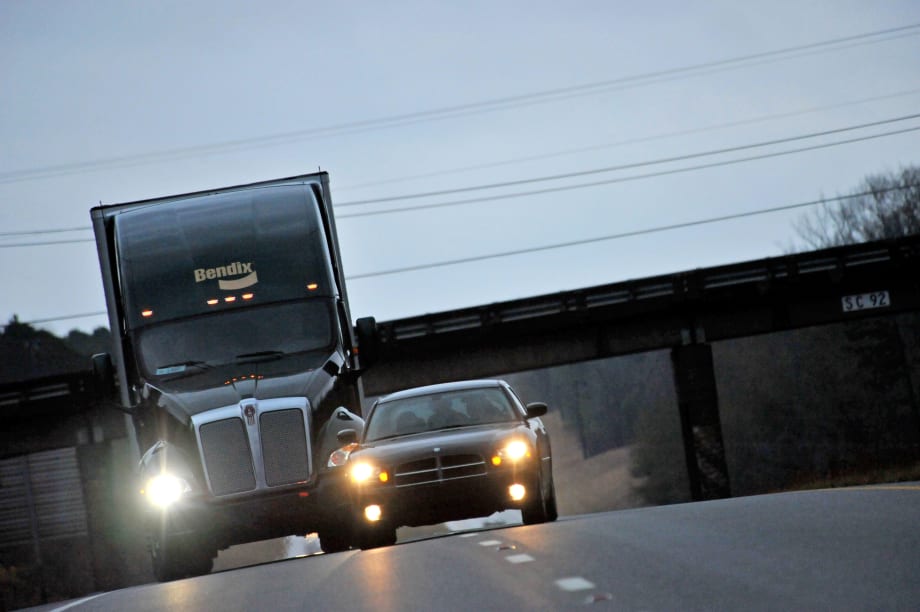
Bendix expects a mandate for collision avoidance systems.
Bendix expects a mandate for collision avoidance systems.
By the time 2020 rolls around, you can expect new trucks to be equipped with mandatory stability control and collision avoidance technology, according to Fred Andersky, director of government and industry affairs for Bendix.
Anderseky briefed reporters on his predictions for the future of truck safety technology regulation during the Mid-America Trucking Show last month in Louisville, Ky.
The final rule on the stability control mandate from the National Highway Traffic Safety Administration has been delayed for the third time, he says. The agency currently estimates it will be published in October.
The Notice of Proposed Rulemaking originally was published on May 23, 2012, requiring stability technology for commercial vehicles. NHTSA plans to have full-stability technology, also known as electronic stability control, – standard on tractors and motorcoaches in the future. The agency cites the higher level of effectiveness of ESP/ESC over RSC (Roll Stability Control) in helping drivers mitigate rollovers and loss-of-control situations.
Bendix expects the final rule will mandate electronic stability control for most model year 2017 heavy-duty air-braked tractors and for all motorcoaches.
"We do expect a final rule this year, but I think it will be more of a Christmas gift that a Halloween treat," Andersky said.
Andersky noted that market penetration for ESC is up to 18%, and that about 30% of the Class 6-8 vehicles sold in 2013 had some type of stability system. ESC, he said, outsold roll stability control by a three-to-two margin. Full-stability technology such as BendixESP is more comprehensive than roll-only stability since it addresses both roll and directional stability, says the company.
One oddity, he noted, is that so far you can't buy stability control for school buses. Bendix is working to see that change.
Last year Andersky predicted Bendix would hit the 300,000 mark for sales of its ESPElectronic Stability Program shortly after MATS 2014, but in fact the company reached that milestone before the March show. The company introduced Bendix ESP in early 2005. It took six full years for Bendix to reach 100,000 units sold, but only about half that time to triple it.
The next area Bendix sees a rulemaking forthcoming is what safety agencies are calling FCAM – forward collision avoidance and mitigation. He sees implementation of a mandate for these technologies, such as the Bendix Wingman Advance, in the 2019 timeframe.
Andersky predicts the mandate will require next-generation collision avoidance technologies that will not only warn of stationary objects in the vehicle's path, but actually brake to avoid hitting them. Look for a notice of proposed rulemaking next year or in 2016, he says.
Such technology is vital in the development of cars and trucks that can drive themselves. The issue with driverless vehicles, he says, is not the technology. What will keep them from being widely adopted in the near future are cost, public acceptance, privacy and liability issues. Who's responsible when two Google cars get in a crash? Predicting that it will be the mid 2020's at the earliest, Andersy said, "I'm not going to give up my CDL any time soon."
Related Stories:
May 2012: NHTSA Proposes Stability Control Mandate
May 2012: Major Trucking Players React Positively to NHTSA's Stability Control Proposal
More Safety & Compliance

FMCSA Pauses Biennial-Update Enforcement Amid Motus Transition
Carriers whose updates were due on or after June 1 have more time, while FMCSA works to stabilize its new registration system and warns of phishing sites impersonating its new carrier registration system, Motus.
Read More →
ZF Expands Commercial Vehicle Push in North America
ZF is expanding its North American commercial-vehicle presence with new transmission applications, electrification, trailer technology and autonomous-driving systems.
Read More →
Truck Drivers Need More Than Another Alert
Fleets have more visibility into truck health, safety events, and driver activity than ever. The next challenge is turning all that information into useful guidance for the person who has to decide what to do next.
Read More →
Tesla Wants a Self-Driving Semi. Are Cameras Enough?
Could Tesla’s camera-only autonomous driving technology work on an 80,000-pound Semi? In this commentary, HDT's Deborah Lockridge takes a look at Tesla, Cybercab, and how autonomous trucks see the road.
Read More →
What DOT’s Automated Vehicle Strategy Means for Trucking
The U.S. Department of Transportation issued a new automated-vehicle strategy that outlines plans for driverless-truck regulations, cross-state freight corridors, and federal safety standards.
Read More →
NYC Expands Speed, Pedestrian Safety Tech Across Fleet
New York City is expanding intelligent speed assistance and pedestrian-alert systems across its municipal fleet, moving the technologies from pilot programs into vehicle procurement and retrofit requirements.
Read More →
FMCSA Removes 110 Truck Driver Training Schools from Certified ELDT List
Federal regulators also are targeting more than 160 additional training providers and launching a nationwide audit of third-party CDL skills testers as part of a broader crackdown on trucking fraud.
Read More →
Beyond DOT Compliance: What Makes a Trucking Fleet Truly Safe?
A trucking fleet can follow every rule and still make unsafe decisions. The real test comes when safety conflicts with freight, productivity, or cost.
Read More →
Hours of Service Pilot Programs: FMCSA Readies for 2027 Rollout
Two pilot programs could eventually reshape hours-of-service rules, giving truck drivers options to pause their 14-hour clock or use longer split sleeper rest periods.
Read More →
New Guide Offers Pet Safety Tips for Truck Drivers
Hundreds of thousands of pets travel in truck cabs. A new safety guide from Volvo Trucks and the Center for Pet Safety offers practical advice for truck drivers who bring dogs and cats along for the ride.
Read More →