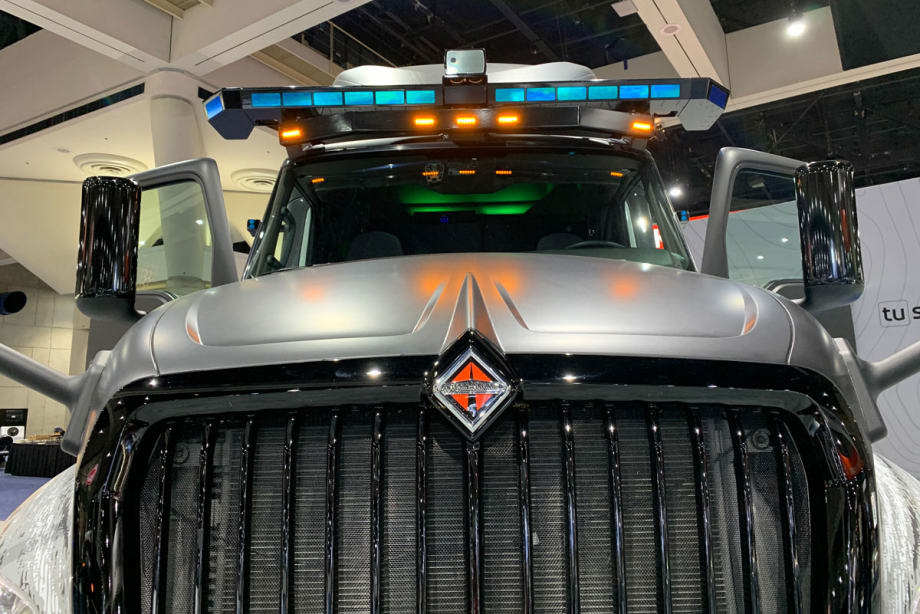
Autonomous-truck technology company TuSimple is cutting staff and focusing on research, development, and “operationalizing” its technology.
Autonomous-Truck Company TuSimple Announces Layoffs, Restructuring
Autonomous-truck technology company TuSimple is cutting staff and focusing on research, development, and “operationalizing” its technology.

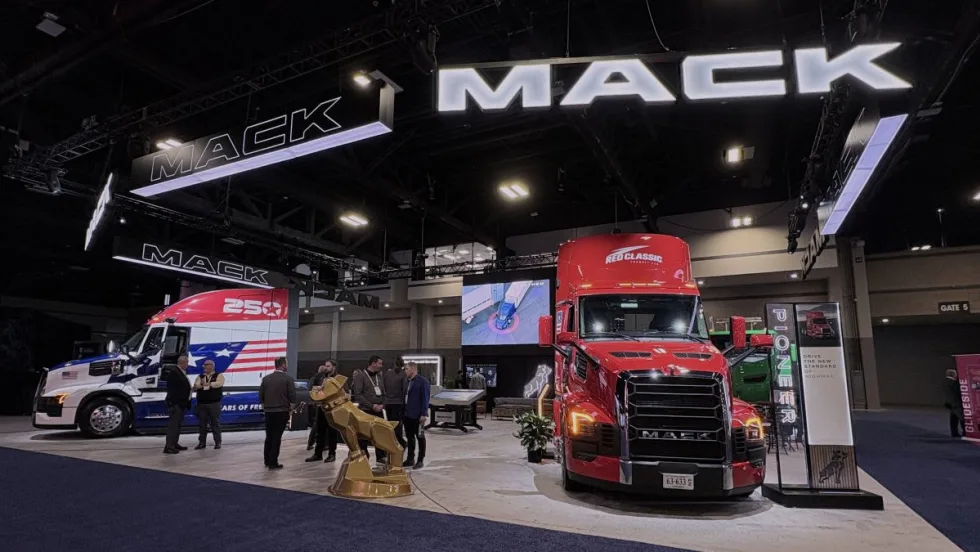
TuSimple exhibited at the American Trucking Associations' Management Conference and Exhibition in October.
Photo: Deborah Lockridge
The restructuring, announced Dec. 21, involves a 25% reduction of TuSimple’s total workforce, about 350 people. Of the remaining staff, 80% are in research and development, many of them engineers critical to hardware and software resilience, reliability, safety, and information security.
TuSimple has been operating as a motor carrier, running its autonomous-equipped trucks for shippers with revenue-producing freight. The most recent numbers in the federal SAFER system, from an MC-150 form filed in July 2021, indicated it was running 98 trucks under its motor carrier authority.
Now the company said it’s planning to scale back freight expansion, including unprofitable freight lanes and respective trucking operations. Trucking operations along those lanes use previous-generation autonomous software that provides limited value to the company's on-going technology development, according to the announcement. TuSimple plans to work with key shipping partners to operationalize its autonomous technology.
The majority of the restructuring is in TuSimple’s U.S. operations. The company continues to explore strategic alternatives for its Asia business, including a potential divestiture.
Downward Spiral?
TuSimple has had a challenging year.
In April, a TuSimple truck made contact with a concrete medium divider after a malfunction related to switching the truck to autonomous mode. That prompted the FMCSA to launch a “safety compliance investigation” of TuSimple.
In July, TuSimple launched an internal investigation into allegations of an improper relationship with Hydron Inc., started in 2021 by Mo Chen, TuSimple’s co-founder.
Jim Mullen, the former Federal Motor Carrier Safety Administration acting administrator who joined TuSimple in 2020, left the company at the end of September.
In October, there were reports that the Federal Bureau of Investigation, the Securities and Exchange Commission, and the Committee on Foreign Investment in the U.S., known as Cfius, were examining TuSimple’s relationship with Hydron.
Later that month, TuSimple fired co-founder Xiaodi Hou, CEO, president and chief technology officer, after its internal investigation found that the company shared confidential information with Hydron without relevant non-disclosure agreements in place, and some employees spent time working for Hydron.
In November, Cheng Lu returned to TuSimple, taking on his former role as CEO with the goal of setting the company on the path toward stability and long-term success.
In December, Navistar and TuSimple abruptly announced an end to their autonomous-truck partnership.
In the past 30 days, since Lu’s return, the company has named three independent directors to the board, reconstituted its board committees, including an independent audit committee in compliance with Nasdaq requirements, and stabilized the management team, including naming its interim CFO, Eric Tapia, as permanent CFO.
“It’s no secret that the current economic environment is difficult,” Lu said. “We must be prudent with our capital and operate as efficiently as possible.
More Equipment

SAF-Holland Redesigns Suspension Slider to Save Weight in On-Highway Trailers
SAF-Holland reengineered the UltraLite40 Slider for the ULX40 Mechanical Sliding Suspension and Axle System to reduce weight, improve durability, extend trailer life, and increase payload efficiency.
Read More →
Volvo Teases Next-Gen VNX as Platform Expansion Continues at TMC
Volvo Trucks North America highlighted new connectivity, safety tech and production investments at TMC. The OEM also signaled that a new heavy-haul flagship tractor is coming soon.
Read More →
SAF-Holland Introduces SmartSto System for Safer Tractor-Trailer Uncoupling
The system combines a fifth-wheel air release with stowage for air and electrical connections, helping prevent damage and reducing driver injury risk.
Read More →
SAF-Holland’s BrakeSight Aims to Take the Guesswork Out of Air Disc Brake Maintenance
New Haldex sensor technology from SAF-Holland integrates with telematics systems to give fleets continuous insight into air disc brake condition.
Read More →
Vanair Introduces Solar, Battery Power Ecosystem for Class 8 Trucks
The company’s expanded EPEQ ecosystem includes flexible solar panels, lithium batteries, hydraulic power systems, and a portable fast charger for electric trucks.
Read More →
Phillips Connect Expands Smart Trailer Platform with New Safety, Cargo and Equipment Intelligence
Phillips Connect Smart Trailer enhancements give fleets deeper operational insights from trailers -- even when another provider supplies basic GPS tracking.
Read More →
Accuride Unveils ProShield XGT Aluminum Wheel Coating at TMC
Accuride’s patent-pending surface-coating technology targets filiform corrosion and promises easier cleaning, longer-lasting gloss, and greater durability for aluminum truck wheels.
Read More →
Valvoline, Cummins Extend X15 Oil Drain Intervals to 100,000 Miles
New approval for Valvoline Premium Blue One Solution Gen2 allows fleets running Cummins X15 engines to extend oil drain intervals by up to 25,000 miles -- reaching intervals as high as 100,000 miles.
Read More →
A New Approach to Lighting Reliability
Peterson’s Genesis lighting system and repairable J560 connector target two persistent fleet problems: LED light failures and costly electrical connector downtime.
Read More →
The Hidden Cost of Delaying Truck Replacement
Many fleets extended truck replacement cycles during recent market disruptions. But holding equipment too long can lead to higher repair costs, longer downtime, and new operational risks.
Read More →