





Why Volvo Sees Autonomous Trucks as 'Revolutionary' Technology
Aurora Begins Nighttime Autonomous Operations
Aurora has expanded driverless operations on its Dallas-to-Houston route to now include nighttime driving.
July 31, 2025
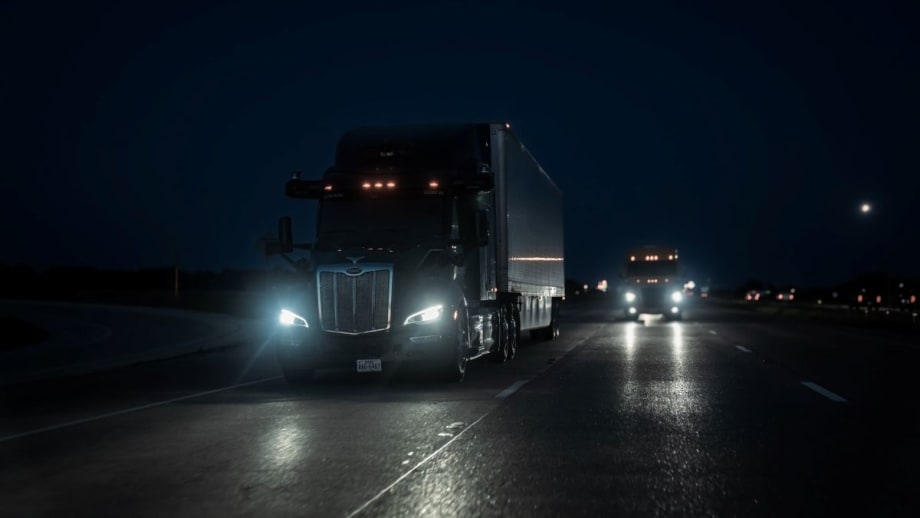
Aurora has begun nighttime autonomous operations in Texas.
Photo: Aurora Innovations
2 min to read
Aurora Innovation announced significant expansions of its commercial operations. The company said it surpassing 20,000 driverless miles at the end of June.
Additionally, Aurora’s driverless fleet has grown to three trucks.
And the company is driverless commercial operations at night and opening a Phoenix autonomous truck terminal.
“Efficiency, uptime, and reliability are important for our customers, and Aurora is showing we can deliver,” said Chris Urmson, co-founder and CEO of Aurora. “Just three months after launch, we’re running driverless operations day and night and we’ve expanded our terminal network to Phoenix. Our rapid progress is beginning to unlock the full value of self-driving trucks for our customers, which has the potential to transform the trillion-dollar trucking industry.”
Double Asset Utilization
Aurora has expanded driverless operations on its Dallas-to-Houston lane to now include nighttime driving.
This capability more than doubles truck utilization potential, Aurora said. It also significantly shortens delivery times on long-haul routes and creates a path to profitability for autonomous trucking.
Autonomous trucks can also make roads safer, the company said.
Due to low visibility and driver fatigue, a disproportionate 37% of fatal crashes involving large trucks occur at night.
The Aurora Driver reliably sees and understands the world around it day and night without ever getting tired, according to the company.
Powered by Aurora’s proprietary, long-range FirstLight Lidar, the Aurora Driver can detect objects in the dark more than 450 meters away, identifying pedestrians, vehicles, and debris up to 11-seconds sooner than a traditional driver.
Aurora Opens Phoenix Terminal
Aurora’s new terminal in Phoenix opened in June and exemplifies an infrastructure-light approach that resembles how Aurora plans to integrate with future customer endpoints.
This evolution optimizes for speed to market and enables Aurora’s plan to deliver freight directly to customer endpoints, the company said.
Fort Worth to Phoenix is nearly half the distance of the busy Atlanta to Los Angeles freight corridor, taking more than 15 hours to complete.
Self-driving trucks can halve transit times, especially on long routes that exceed the 11-hour driving limit for human drivers.
Aurora is currently making autonomous hauls on this lane for Hirschbach and Werner.
To further build on its commitment to industry-leading transparency, Aurora launched Aurora Driver Live, a publicly available livestream of its self-driving truck operations.
The livestream demonstrates the safety, reliability, and growing maturity of the Aurora Driver, offering a first-of-its-kind glimpse into the future of freight transportation.
More Fleet Management

Sponsored•September 16, 2026
Color Match Smarter: Tools That Restore & Perform
For fleet managers and collision repair professionals keeping heavy-duty trucks on the road, getting the color right the first time isn't just about appearance — it's about efficiency, turnaround time, and bottom-line results. Discover how today's digital color tools are transforming the repair process from guesswork to precision.
Read More →
FMCSA Pauses Biennial-Update Enforcement Amid Motus Transition
Carriers whose updates were due on or after June 1 have more time, while FMCSA works to stabilize its new registration system and warns of phishing sites impersonating its new carrier registration system, Motus.
Read More →
Sponsored•September 14, 2026
2026 Blueprint for Countering Smarter Supply Chain Theft
Cargo theft is no longer just the cost of doing business. It's a multi-billion-dollar criminal enterprise exploiting vulnerabilities across your fleet, drivers, and supply chain.
Read More →


Sponsored•September 1, 2026
How Telematics Improves Visibility, Control, and Performance in Refrigerated Fleets
Explore how telematics help refrigerated fleets improve visibility, uptime, efficiency, compliance, and cargo protection across connected cold chain operations.
Read More →
What the U.S.-Canada Trade War Means for Trucking
Escalating U.S.-Canada tariffs could disrupt cross-border freight, reduce truck volumes, raise costs, and create new uncertainty for carriers on both sides of the border.
Read More →
What Are Trucking’s Top Concerns for 2026?
The American Transportation Research Institute wants to know what's worrying trucking fleet managers, drivers, and other stakeholders in its annual Industry Issues survey.
Read More →
American Trucking Associations Looks for a New Leader
ATA President and CEO Chris Spear abruptly left his job at the association on August 21, at a pivotal time for the trucking industry.
Read More →
Public Wi-Fi Cybersecurity Risks: How Truck Drivers and Fleets Can Protect Their Data
Public Wi-Fi can expose truck drivers and fleets to credential theft, malware, and other cyber threats. Here’s how to reduce the risk on the road.
Read More →
For Nicky Cupp, Fleet Innovation Starts With Frustration
HDT Truck Fleet Innovator Nicky Cupp turns everyday pain points at Fraley & Schilling into opportunities for better technology and smarter processes.
Read More →
Adam Buttgenbach’s Approach to Electric Trucks: Start With Where They Fit
HDT Truck Fleet Innovator Adam Buttgenbach helped PepsiCo build one of North America’s largest EV fleets by focusing on where electric trucks make operational sense.
Read More →