




Study: State Enforcement Differences Undermine CSA Uniformity
A new study has confirmed that state enforcement disparities create uneven safety playing fields for motor carriers that have different operating patterns and mileage exposure in the lower 48 states.
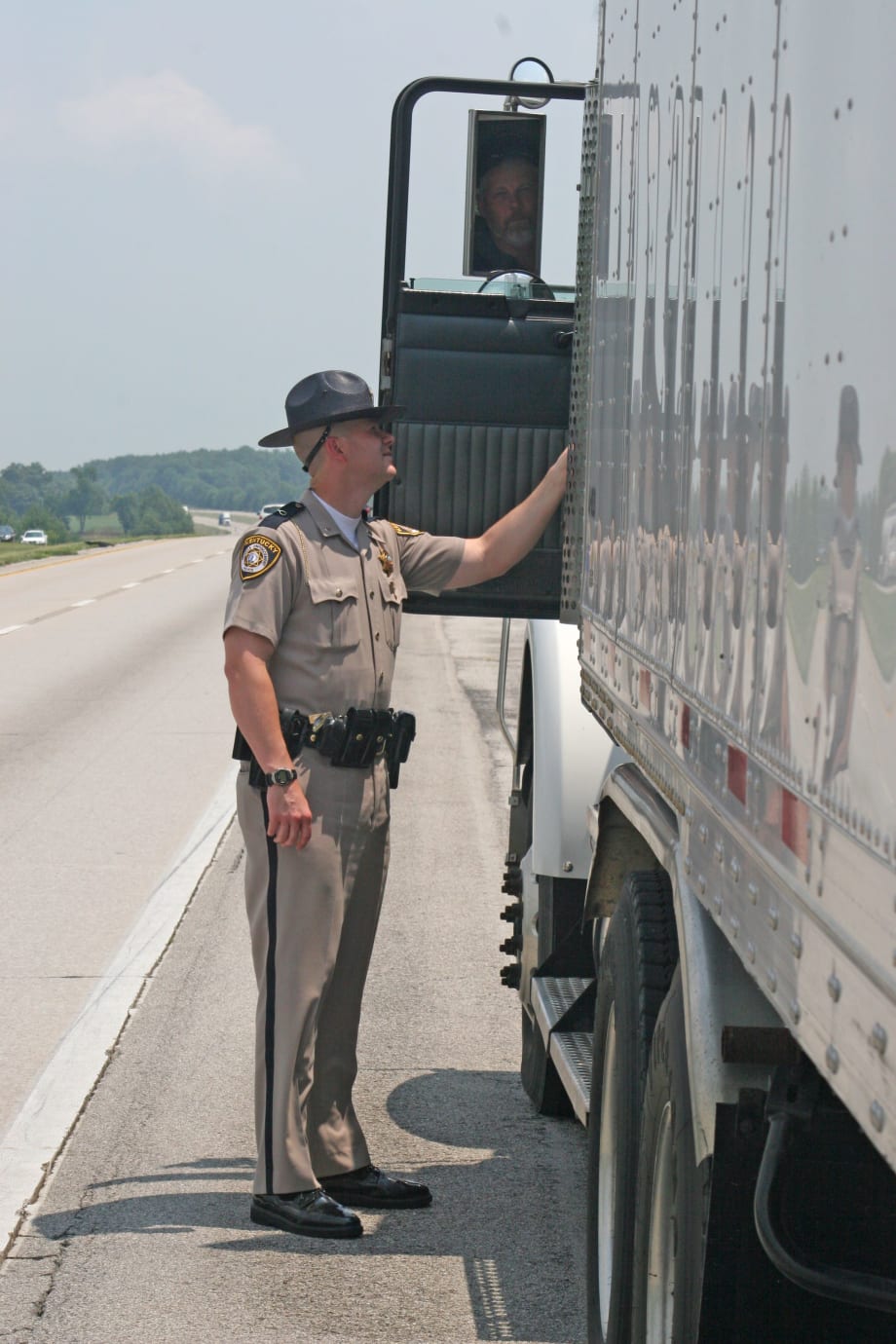
Differing truck enforcement between states means CSA numbers are not consistent, study finds. File Photo: Kentucky State Police
Differing truck enforcement between states means CSA numbers are not consistent, study finds.File Photo: Kentucky State Police
A new study has confirmed that state enforcement disparities create uneven safety playing fields for motor carriers that have different operating patterns and mileage exposure in the lower 48 states.
The American Transportation Research Institute, the research arm of the American Trucking Associations, this week released its study, Evaluating the Impact of Commercial Motor Vehicle Enforcement Disparities on Carrier Safety Performance.
“This assessment was ranked as the number one research issue for the industry during our annual [Research Advisory Committee] meeting in 2013 and its impact on the industry should be significant," said ATRI Research Advisory Committee Chairman Steve Niswander, who's also vice president of safety policy and regulatory relations for Oklahama-based tank carrier Groendyke Transportation.
ATRI says the analysis documents the necessity for some flexibility in developing enforcement strategies specific to a state’s needs, but also confirms that state enforcement disparities create uneven safety playing fields for carriers that have different operating patterns and mileage exposure in the lower 48 states.
Furthermore, the study finds, the different priorities and violation issuance rates across states dramatically undermine the uniformity of CSA – a supposedly standardized safety assessment program.
By simply crossing into an adjoining state, carrier BASIC scores can change markedly. For example, ATRI’s model calculated one carrier’s Hours-of-Service percentile decreasing by 4.2 points, but their Vehicle Maintenance percentile increasing by 12.2 points if state violation rates were normalized.
Finally, based on two nationally recognized violation lists most closely associated with future crash risk, ATRI’s research documents considerable variability in state emphasis on those violations that generate the greatest safety benefit.
ATRI’s research findings generate from four specific tasks:
State Data Metrics Compendium which compares and contrasts several dozen safety and operational metrics for the lower 48 states.
Relating Violations to Crash Risk Analysis reveals that while certain violations have a stronger relationship to crash risk, these violations may not be equitably emphasized across states.
State Enforcement Objective Case Studies evaluate the impact of six specific state enforcement priorities on actual safety outcomes.
Carrier Case Studies quantify the impact of state enforcement disparities on specific motor carrier safety measures within the Safety Measurement System (SMS), based on an ATRI-developed model that assesses the impact that standardizing state enforcement activities would have on SMS scores across seven carriers.
“ATRI’s study unequivocally quantifies what we know is a serious defect in the CSA scoring system – that carrier safety performance as represented by BASIC scores can be dramatically impacted by the states in which a carrier operates based on nothing more than the states’ varying enforcement priorities," says Brett Sant, Knight Transportation’s vice president of safety and risk management and a member of ATRI’s Research Advisory Committee.
"Until these disparities are rectified, peer-based comparisons within CSA’s scoring system will continue to be flawed and of little value as a tool for monitoring carrier and driver safety performance unless accounted for properly."
A copy of the study results is available from ATRI at www.atri-online.org.
More Safety & Compliance

FMCSA Pauses Biennial-Update Enforcement Amid Motus Transition
Carriers whose updates were due on or after June 1 have more time, while FMCSA works to stabilize its new registration system and warns of phishing sites impersonating its new carrier registration system, Motus.
Read More →
ZF Expands Commercial Vehicle Push in North America
ZF is expanding its North American commercial-vehicle presence with new transmission applications, electrification, trailer technology and autonomous-driving systems.
Read More →
Truck Drivers Need More Than Another Alert
Fleets have more visibility into truck health, safety events, and driver activity than ever. The next challenge is turning all that information into useful guidance for the person who has to decide what to do next.
Read More →
Tesla Wants a Self-Driving Semi. Are Cameras Enough?
Could Tesla’s camera-only autonomous driving technology work on an 80,000-pound Semi? In this commentary, HDT's Deborah Lockridge takes a look at Tesla, Cybercab, and how autonomous trucks see the road.
Read More →
What DOT’s Automated Vehicle Strategy Means for Trucking
The U.S. Department of Transportation issued a new automated-vehicle strategy that outlines plans for driverless-truck regulations, cross-state freight corridors, and federal safety standards.
Read More →
NYC Expands Speed, Pedestrian Safety Tech Across Fleet
New York City is expanding intelligent speed assistance and pedestrian-alert systems across its municipal fleet, moving the technologies from pilot programs into vehicle procurement and retrofit requirements.
Read More →
FMCSA Removes 110 Truck Driver Training Schools from Certified ELDT List
Federal regulators also are targeting more than 160 additional training providers and launching a nationwide audit of third-party CDL skills testers as part of a broader crackdown on trucking fraud.
Read More →
Beyond DOT Compliance: What Makes a Trucking Fleet Truly Safe?
A trucking fleet can follow every rule and still make unsafe decisions. The real test comes when safety conflicts with freight, productivity, or cost.
Read More →
Hours of Service Pilot Programs: FMCSA Readies for 2027 Rollout
Two pilot programs could eventually reshape hours-of-service rules, giving truck drivers options to pause their 14-hour clock or use longer split sleeper rest periods.
Read More →
New Guide Offers Pet Safety Tips for Truck Drivers
Hundreds of thousands of pets travel in truck cabs. A new safety guide from Volvo Trucks and the Center for Pet Safety offers practical advice for truck drivers who bring dogs and cats along for the ride.
Read More →