





Read next: Trucking Company Fights Back Against Nuclear Verdicts
ATRI Report on Smaller Verdicts and Settlements Suggests How to Battle Litigation
Read how a new report on the impact of smaller verdicts and settlements can help trucking companies counter plaintiffs' attorneys who believe in, "hit a truck, get a check."
November 18, 2021
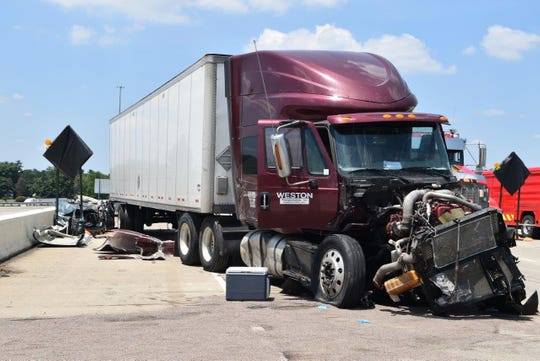
Cases in which carriers were accused of poor hiring or training practices had a correlation with cases in which drivers had previous driving or hours-of-service violations.
Photo: NTSB
5 min to read
We hear a lot about nuclear verdicts. But what about smaller verdicts as well as settlements? The types of awards trucking attorney Doug Marcello likes to call “death by paper cuts” can add up and be damaging to a trucking company, as well.
The American Transportation Research Institute explores this question in its new follow-up analysis to its 2020 report on The Impact of Nuclear Verdicts on the Trucking Industry.The new report investigates the impact of verdicts and settlements under $1 million on the trucking industry.
During its research on nuclear verdicts, ATRI determined that a different plaintiff litigation model is impacting the industry: small cases. The research used a new ATRI dataset of more than 600 cases resulting in either a settlement or verdict award of less than $1 million. The report provides rich insight into key crash characteristics and litigation factors that contribute to substantial payments to plaintiffs.
“There is a general consensus within the trucking industry that small verdicts and settlements are increasing in both frequency and severity,” noted the authors of the report. “The rise of these cases can be attributed to a multitude of factors, including loose state tort laws, negative public attitudes towards trucking, harsher legal restrictions in other industry sectors, litigation fraud and growing coordination among plaintiff attorneys.”
The report provides an overview of the small litigation landscape in the trucking industry as well as strategies to assist carriers and attorneys in preventing more costly litigation outcomes.
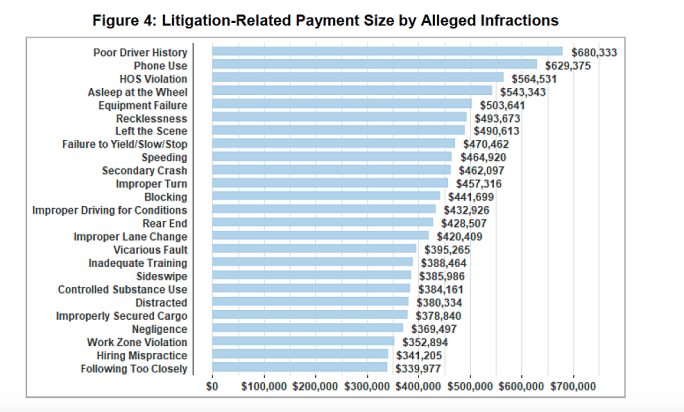
In terms of alleged infractions, a poor prior driving history yielded the highest average payment.
Credit:
From ATRI Report
5 Key Findings
ATRI identified five key findings from the report:
Settlements larger than verdicts: The study showed that settlement payments are approximately 37.7% larger than verdict awards, and 393% more likely to occur in incidents involving a fatality.
State venues matter: Certain states were more likely to have large litigation payments than others, ATRI found. Cases venued in California, Michigan, New Jersey and North Carolina had average litigation payments over 50% larger than the approximate national average.
Fatalities, severe injuries cost: Cases involving fatalities were 966% and those involving severe injury were 199% more likely to result in payments over $600,000. Incidents involving a severe injury were 217% more likely to settle and 199% more likely to result in payments to plaintiffs over $600,000.
Carrier practices, driver behavior can be your downfall: Cases in which carriers were accused of poor hiring or training practices had a correlation with cases in which drivers had previous driving or hours-of-service violations.
Expert witnesses help: The use of defense experts resulted in a 25.5% reduction in average verdict award size.
“This analysis proves a theory that I have always had; there are two markets as to the value of cases – the settlement market and the trial market, said Doug Marcello, attorney at Marcello & Kivisto LLC. “There should be one market, and that is what a case is objectively worth.”
Trial trepidation
Marcello said one of the key takeaways from the study is that fleets should be more willing to try cases. “The looming specter of a nuclear verdict has created a fear to take cases to trial,” he said. “Statistically, even before this nuclear era, only 5-10% of lawsuits were decided by trial. I believe it is even less now.
“Trial trepidation is the product of concerns that a runaway verdict will close a trucking company or end an insurance career. In fact, in ‘The Reptile Theory’ espouses a mediation tactic of confronting an insurance adjuster with the career-ending impact of misevaluating a case and failing to settle,” he explains.
“Are trials a risk? To an extent, yes. Should all cases go to trial? Not necessarily. But must all cases settle before trial? Absolutely not. Doing so will send a message that you will cave, no matter how outrageous the demand. And, as we know, word gets around.”
The ATRI study, he said, gives fleets a source of data to consider when analyzing the risks and values in making a trial/settle decision.
Invest in experts
Marcello said the study also points to the potential benefit of paying for experts to help reduce verdicts and settlements.
The ATRI study found that the use of defense experts was significant in predicting lower verdict awards. In fact, the study found where the defense used an expert, the verdict was 25.5% lower than average.
“From a strategic standpoint, you have sent a message to the plaintiff’s attorney that is not ‘hit a truck, get a check,’” Marcello said. It also puts pressure on the plaintiff’s attorney to shell out for their own expert and risk not recovering that money.

A fleet hiring outside experts to testify sends a message to the plaintiff's attorney that it's not going to just roll over and write a check.
Credit:
From ATRI Report
Analyzing risk factors
The ATRI study provides an analysis of potential risk based by analyzing the key factors: type of injuries and the alleged infraction. The highest average payments, not surprisingly, were in death cases. These payments were 42% higher than non-fatal accidents.
However, this was followed by plaintiffs with pre-existing conditions and claims of lower extremity injuries (foot and leg). The susceptibility to increased injury and medical expenses of the pre-existing condition can account for this finding, Marcello said.
In terms of alleged infractions, a poor prior driving history yielded the highest average payment. “In today’s tight driver's market, this is particularly challenging,” Marcello noted.
This was followed by phone use, hours-of-service violations, and asleep at the wheel.
“All of these are the types of infractions that engender the most reaction and correlate to the general misconceptions of jurors that these are rampant in our industry, contrary to the facts and reality,” Marcello said. “And the argument that these can only be prevented by a large verdict plays right into the reptile argument.”
For access to the full report visit ATRI’s website.
More Fleet Management

Sponsored•September 16, 2026
Color Match Smarter: Tools That Restore & Perform
For fleet managers and collision repair professionals keeping heavy-duty trucks on the road, getting the color right the first time isn't just about appearance — it's about efficiency, turnaround time, and bottom-line results. Discover how today's digital color tools are transforming the repair process from guesswork to precision.
Read More →
FMCSA Pauses Biennial-Update Enforcement Amid Motus Transition
Carriers whose updates were due on or after June 1 have more time, while FMCSA works to stabilize its new registration system and warns of phishing sites impersonating its new carrier registration system, Motus.
Read More →
Sponsored•September 14, 2026
2026 Blueprint for Countering Smarter Supply Chain Theft
Cargo theft is no longer just the cost of doing business. It's a multi-billion-dollar criminal enterprise exploiting vulnerabilities across your fleet, drivers, and supply chain.
Read More →


Sponsored•September 1, 2026
How Telematics Improves Visibility, Control, and Performance in Refrigerated Fleets
Explore how telematics help refrigerated fleets improve visibility, uptime, efficiency, compliance, and cargo protection across connected cold chain operations.
Read More →
What the U.S.-Canada Trade War Means for Trucking
Escalating U.S.-Canada tariffs could disrupt cross-border freight, reduce truck volumes, raise costs, and create new uncertainty for carriers on both sides of the border.
Read More →
What Are Trucking’s Top Concerns for 2026?
The American Transportation Research Institute wants to know what's worrying trucking fleet managers, drivers, and other stakeholders in its annual Industry Issues survey.
Read More →
American Trucking Associations Looks for a New Leader
ATA President and CEO Chris Spear abruptly left his job at the association on August 21, at a pivotal time for the trucking industry.
Read More →
Public Wi-Fi Cybersecurity Risks: How Truck Drivers and Fleets Can Protect Their Data
Public Wi-Fi can expose truck drivers and fleets to credential theft, malware, and other cyber threats. Here’s how to reduce the risk on the road.
Read More →
For Nicky Cupp, Fleet Innovation Starts With Frustration
HDT Truck Fleet Innovator Nicky Cupp turns everyday pain points at Fraley & Schilling into opportunities for better technology and smarter processes.
Read More →
Adam Buttgenbach’s Approach to Electric Trucks: Start With Where They Fit
HDT Truck Fleet Innovator Adam Buttgenbach helped PepsiCo build one of North America’s largest EV fleets by focusing on where electric trucks make operational sense.
Read More →