




ATA’s Spear Blasts “Mad Dash” CARB Emissions Timelines
American Trucking Associations CEO and President Chris Spear calls emissions compliance deadlines “unrealistic” for the trucking industry at the Technology & Maintenance Council Annual Meeting.

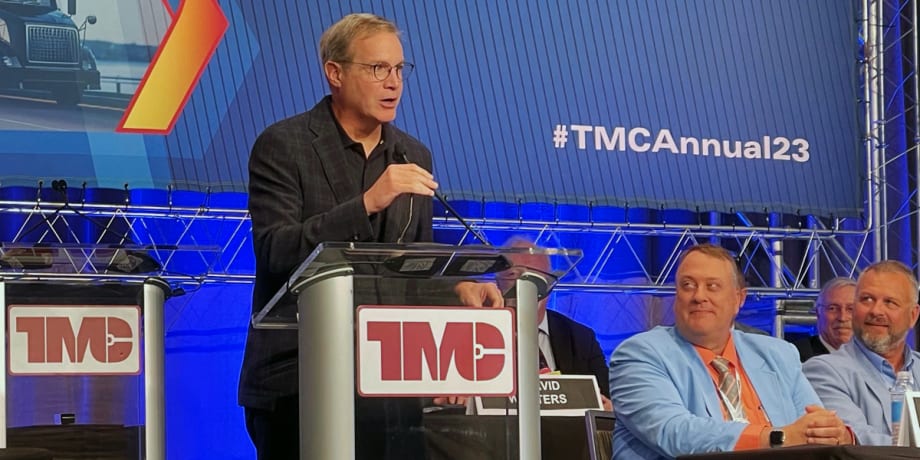
American Trucking Associations CEO and President Chris Spear calls emissions compliance deadlines “unrealistic” for the trucking industry at the the Technology & Maintenance Council Annual Meeting.
Photo: Jack Roberts
American Trucking Associations CEO and President Chris Spear called on members of the Technology and Maintenance Council to join together to push back against what he called “unrealistic” diesel exhaust emissions mandates emanating from the California Air Resource Board and the U.S. Environmental Protection Agency.
“The next decade could fundamentally reshape our industry if we do not speak loudly and rationally and with volume to our lawmakers,” Spear told attendees at the Town Hall Meeting in the Orlando Convention Center on Feb. 27. “Our industry is now faced with unachievable CARB emissions goals. And for 40 years, this industry has reshaped its emissions outcomes to the point that 98% of emissions have been removed from our tailpipes. And we are committed to removing the remaining 1.5% of emissions that remain. But just not on the timeline that California thinks is doable. These mad emissions dashes are going to fail. And the people behind them are going to be embarrassed when they do. And it is ATA’s job to put these issues front and center before our lawmakers.”
Despite the growing move toward battery-electric trucks, Spear said electrification will not solve emission issues in the short term.
“Where are the minerals needed for these battery systems — lithium, graphite and cobalt to name a few — going to come from? China? The Congo? The government says it will open new mining leases here in the U.S. But we all know how long that will take. I look at TMC as problem solvers, and call on its member to join ATA in helping mold regulations that will solve these emissions problems. But do so in a responsible way.”
Investing for the Long Haul
Citing the ongoing trucking manpower shortage, particularly for drivers and technicians, Spear also urged TMC members to reaffirm their ongoing commitment to training and recruiting.
“TMC understands that training is the foundation of any industry’s success,” Spear said. “And I say that it is paramount that we extend that idea by attracting new talent by investing in ... every new individual we hire into trucking. We need to send a message: ‘You have a future if you join the trucking industry.’ We need to promote that fact that this industry offers good pay without the expensive investment in a college education. And we need to make it clear that we will invest in you if you join trucking and stay with us for the long haul. That is a message that we need to relay to the country today.”
Spear also noted that ATA remained engaged with Congress and was working both parties in an extremely partisan environment.
“The new Congress has a three-vote margin, a split Senate, and a we have a Democratic administration," he said. "Regardless, our job is to remind them that we matter. We are the glue of this economy. We are an integral part of the supply chain. We are now through the darkest days of the pandemic supply chain issues. And our economy continues to be No. 1 in the world. Our job at ATA is to make sure your story is told at the highest levels of our government. We make sure that your elected officials have a granular understanding of why trucking matters, and that they don’t forget it. And our voice is much louder, and more clear, if we are all united in delivering that message.”
More Fuel Smarts

How Volvo Updated Its D13 for EPA 2027 [Watch]
Volvo’s updated D13 promises lower emissions without sacrificing performance or fuel economy. Take a closer look at what changed inside the engine in this HDT Spotlight video.
Read More →
Diesel Price Spike Shortens Payback for Natural Gas Trucks, Report Says
Energy Vision estimates fleets could recover the higher purchase price of an RNG-fueled Class 8 tractor in 1.3 to 2.8 years under current fuel-price scenarios.
Read More →
Calstart Becomes Catalyst Mobility, Reflecting Broader Focus
Calstart is now Catalyst Mobility, reflecting the nonprofit’s growing national role in clean transportation, including zero-emission trucks, infrastructure and incentive programs.
Read More →

Record Diesel Prices Squeeze Trucking Fleets
Average U.S. diesel prices have climbed to nearly $6 a gallon, surpassing the 2022 record as tight refinery capacity and Middle East disruptions keep fuel costs elevated.
Read More →
How Fuel Delivery Shapes Engine Performance
Fuel delivery depends on more than what happens at the injector. For fleet, maintenance and technical professionals, looking at the full path from pump to injector can provide useful context for understanding engine performance.
Read More →
East Coast Port Launches $45M Electric Truck Push
The Port Authority of New York and New Jersey announced millions in incentives for zero-emission drayage trucks, yard tractors, and new charging hubs near the port.
Read More →
California Bill Could Shed Light on Electric Truck Prices
Why do battery-electric Class 8 trucks remain so expensive? A California bill headed to Gov. Gavin Newsom would give fleets and state agencies more visibility into what manufacturers charge.
Read More →
Detroit Opens Orders for EPA 2027 Engines
Detroit isn’t starting from scratch to meet EPA 2027 diesel emissions standards. Its Gen 6 DD13 and DD15 engines keep much of today’s platform while updating the fuel and aftertreatment systems.
Read More →
Zero-Emission Truck Corridor Planned for West Coast
California, Oregon, Washington, British Columbia and Baja California are coordinating plans for truck charging and hydrogen fueling from Canada to Mexico.
Read More →
A Closer Look at Kenworth’s Electric T880E Vocational Truck [Video]
Learn more about Kenworth's T880E battery-electric vocational truck at the Paccar Technical Center, including its range, applications, upfitting considerations, and PTO options, in this HDT Spotlight video.
Read More →