




Related: Using Technology to Manage Trucks in Stormy Weather
As Hurricane Matthew Approaches, States Prepare for Emergency
With Hurricane Matthew strengthening to a Category 4 storm before making landfall, states from Florida through North Carolina are preparing for the worst with road closures, evacuations and suspensions of certain transportation rules.
by Staff
October 6, 2016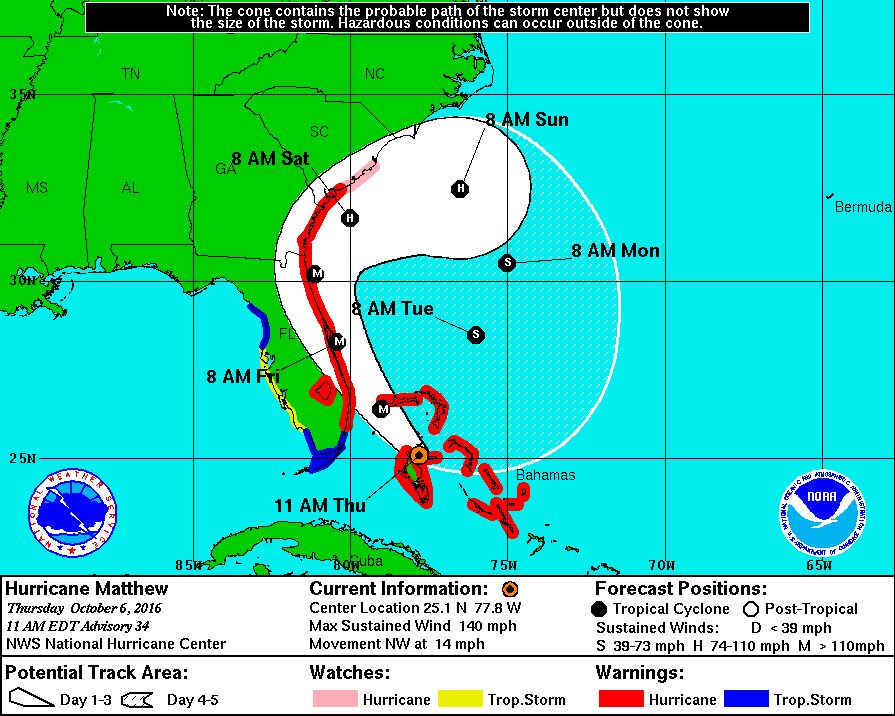
Source: National Weather Service
3 min to read
Source: National Weather Service
With Hurricane Matthew strengthening to a Category 4 storm before making landfall, states from Florida through North Carolina are preparing for the worst with road closures, evacuations and suspensions of certain transportation rules.
The storm is expected to hit Florida first on the night of Oct. 6. Gov. Rick Scott declared a state of emergency and urged Florida residents to evacuate dangerous areas, telling reporters at a morning briefing, “This storm will kill you.”
As a Category 4 hurricane with sustained winds of up to 145 mph, Matthew is expected to be historically destructive. The areas of Florida directly in its path have not seen a storm this severe since 1850, according to the Washington Post.
Around 1.5 million Florida residents live in areas designated for evacuation, and the state has suspended tolls on sections of major highways like the Florida Turnpike and Interstate 75, according to the Miami Herald.
By declaring a state of emergency, Florida will implement the reversal of traffic on roads and highways to better handle traffic coming out of evacuation zones. The state will also suspend certain trucking regulations, including hours of service, size and weight restrictions for vehicles transporting emergency equipment, services, supplies or agricultural commodities. However, size and weight limits still apply on the state's bridges and similar structures.
South Carolina and North Carolina have also declared states of emergency suspending certain regulations for trucks traveling through those states.
In South Carolina, truck weight limits have been increased to 90,000 pounds; a permit is still required for vehicles larger than that. Hours of service has also been suspended for truckers during the emergency.
South Carolina is asking its residents to get at least 100 miles from the coast and is reversing traffic on Interstate 26 for evacuation. Lane reversals will also occur on Interstate 526 in North Charleston and Interstate 77 in Columbia.
North Carolina is also suspending certain size and weight restrictions up to 90,000 pounds and in other specific circumstances. Hours of service will also be waived for anyone transporting essential fuels, food, water, medical supplies, feed for farm animals, livestock or poultry and for vehicles used to restore utilities. North Carolina has issued mandatory evacuation orders for certain high-risk areas near the coast, but the impact of the hurricane is not expected to be as harsh as in the lower states.
Georgia has also issued mandatory evacuations for around 50,000 residents in coastal areas to the east of Interstate 95. Eastbound lanes of Interstate 26 are designated contra-flow lanes and will be reversed in the event of a mandatory evacuation from coastal Georgia, according to the Georgia Department of Transportation.
American Trucking Associations is urging drivers to take appropriate precautions and avoid any areas affected by the storm if possible.
"As we all continue to track and monitor Hurricane Matthew, we encourage drivers - commercial and commuter alike - to make good travel decisions," said Chris Spear ATA president and CEO. "There is no delivery or trip that is worth putting yourself or others in harm's way."
The trucking industry will be critical to recovery after the storm, stated Spear, as trucks would deliver goods to meet the needs of communities affected by Matthew.
"Every day, trucks deliver essentials like water, food and fuel to communities across the country, and once this storm passes, trucks delivering these critical goods will be on the move, delivering them to people who need them most," said Spear.
More Safety & Compliance

FMCSA Pauses Biennial-Update Enforcement Amid Motus Transition
Carriers whose updates were due on or after June 1 have more time, while FMCSA works to stabilize its new registration system and warns of phishing sites impersonating its new carrier registration system, Motus.
Read More →
ZF Expands Commercial Vehicle Push in North America
ZF is expanding its North American commercial-vehicle presence with new transmission applications, electrification, trailer technology and autonomous-driving systems.
Read More →
Truck Drivers Need More Than Another Alert
Fleets have more visibility into truck health, safety events, and driver activity than ever. The next challenge is turning all that information into useful guidance for the person who has to decide what to do next.
Read More →
Tesla Wants a Self-Driving Semi. Are Cameras Enough?
Could Tesla’s camera-only autonomous driving technology work on an 80,000-pound Semi? In this commentary, HDT's Deborah Lockridge takes a look at Tesla, Cybercab, and how autonomous trucks see the road.
Read More →
What DOT’s Automated Vehicle Strategy Means for Trucking
The U.S. Department of Transportation issued a new automated-vehicle strategy that outlines plans for driverless-truck regulations, cross-state freight corridors, and federal safety standards.
Read More →
NYC Expands Speed, Pedestrian Safety Tech Across Fleet
New York City is expanding intelligent speed assistance and pedestrian-alert systems across its municipal fleet, moving the technologies from pilot programs into vehicle procurement and retrofit requirements.
Read More →
FMCSA Removes 110 Truck Driver Training Schools from Certified ELDT List
Federal regulators also are targeting more than 160 additional training providers and launching a nationwide audit of third-party CDL skills testers as part of a broader crackdown on trucking fraud.
Read More →
Beyond DOT Compliance: What Makes a Trucking Fleet Truly Safe?
A trucking fleet can follow every rule and still make unsafe decisions. The real test comes when safety conflicts with freight, productivity, or cost.
Read More →
Hours of Service Pilot Programs: FMCSA Readies for 2027 Rollout
Two pilot programs could eventually reshape hours-of-service rules, giving truck drivers options to pause their 14-hour clock or use longer split sleeper rest periods.
Read More →
New Guide Offers Pet Safety Tips for Truck Drivers
Hundreds of thousands of pets travel in truck cabs. A new safety guide from Volvo Trucks and the Center for Pet Safety offers practical advice for truck drivers who bring dogs and cats along for the ride.
Read More →