




Another HOS Listening Session Planned for Mid-America Show; Ferro Stresses CSA 2010
The Federal Motor Carrier Safety Administration will hold another hours of service listening session at the Mid-America Trucking Show, said Administrator Anne Ferro. This will be the fifth such session the agency has held in preparation for revisions to the current rule. Ferro said the agency aims to complete a draft rewrite of the rule by the middle of July. The draft will go to the White House Office of Management and Budget for vettin
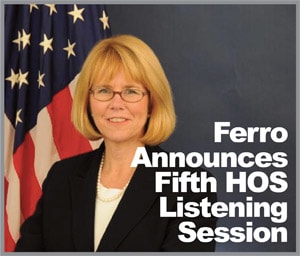
The Federal Motor Carrier Safety Administration will hold another hours of service listening session at the Mid-America Trucking Show, said Administrator Anne Ferro.
This will be the fifth such session the agency has held in preparation for revisions to the current rule. Ferro said the agency aims to complete a draft rewrite of the rule by the middle of July. The draft will go to the White House Office of Management and Budget for vetting
, and then be published as a proposed rule and opened to public comment.
The Mid-America show, which draws thousands of drivers and owner-operators as well as fleet executives and industry vendors, will be held in Louisville, Ky., March 25 - 27. Details about the date and time of the listening session are not yet available.
Ferro, speaking to trucking executives gathered on Capitol Hill for the annual Winter Leadership meeting of American Trucking Associations, also stressed the agency's commitment to its newest safety program, CSA 2010.
She acknowledged concerns among carriers about the details of the program but said, "I want to assure you that CSA 2010 will come out this year."
Comprehensive Safety Analysis 2010 is a fundamental revision of the way the agency regulates trucking. Essentially, it is designed to allow the agency to make more productive use of the data it collects on carriers and drivers.
Development of the program has been under way for more than five years, and the first phase is scheduled to be rolled out this summer, based in part on what has been learned in a number of states that have been testing a pilot version. A second part must go through the rulemaking process, including a period of public comment.
The program is multi-layered and complex, and while the industry in general has embraced the concept, there are concerns about how the details will work.
For example, carriers in Minnesota, one of the states that have been pilot-testing the program, have learned that there are inconsistencies among states - and even within states - in the way that violations are enforced and recorded. Minnesota Trucking Association also reported to FMCSA that carriers find it very difficult to get states to correct mistakes in the data records that the agency will use to determine carrier performance.
Ferro acknowledged that for the system to work the data has to be good.
"We hear those concerns," she said. "We are trying to respond to them."
She said that FMCSA will give carriers a chance to look at their data before the program is rolled out this summer, and added: "This is not going to be a program we get right from the get-go. It will certainly impact carriers and it's causing some confusion and concern today. But we are committed as an agency to work together with individual carriers, our division administrators and their staff, our law enforcement partners who have been part of the project development and our CSA 2010 team at headquarters … to get it right."
Ferro, who was the president of the Maryland Motor Truck Association before taking the FMCSA job, referenced her experience in the industry in calling for carrier support for the program.
"I know that you know that one fatality is one too many," she told the carrier executives. "Too many of you in this room have had first-hand experience with that as employers, as friends, as family members and we are absolutely committed along with you to get out from under that. We must continue to shift that bar much more significantly than we have in the past. CSA 2010 is the foundation and the game-changer to get us there. I am absolutely committed to stick with it and make it work very well for all of us."
Ferro also took on criticism that the agency's recent ban on truck drivers texting while behind the wheel is too difficult to enforce.
"Is it tough to enforce? You bet. Did we know that going in? Absolutely. But that doesn't relieve us from the obligation of saying this is an unsafe behavior, you hold the keys to change it, and we need to make sure everybody understands that it's also illegal."
She said that the agency is working on a proposed rule that will address texting and other distraction issues but promised an "open process" that takes carriers' use of onboard technologies into account.
More Drivers

Platform Science Adds Dispatch and Safety Tools
Four additions to PS Fleet help fleets monitor loads, manage driver coaching, share truck locations and adjust video system settings.
Read More →
When Language Stops the Truck: The Return of ELP Out-of-Service Orders
English language proficiency rules for commercial drivers aren’t new, but renewed out-of-service enforcement has raised the stakes. Here’s what carriers need to know before a driver reaches a roadside inspection.
Read More →
Samsara Launches Custom AI Agent Builder
Agent Studio lets fleets create AI tools for hours-of-service monitoring, reporting and driver support, including agents that communicate by phone.
Read More →
Trucker Path Expands Reserved Parking Network
Trucker Path has added close to 6,000 more truck parking spaces to its Trucker Path Reserved Parking Network with the addition of Safe Truck Parking.
Read More →
EEOC Sues Texas Trucking Company Over Driver Age Limits
The agency says Trancasa USA rejected applicants over 65 and applied tougher driving-record standards to those over 60.
Read More →
Nussbaum, Roehl Announce Second Driver Pay Increase This Year
This year has seen a swath of major truck driver pay increases as freight capacity has tightened.
Read More →
From One Generation to the Next: How Mentorship Builds Safer Truck Drivers
After three decades in trucking, Harold Perry shares what he's learned about driver safety, mentorship, and helping the next generation build confidence behind the wheel.
Read More →
Truck Drivers Need More Than Another Alert
Fleets have more visibility into truck health, safety events, and driver activity than ever. The next challenge is turning all that information into useful guidance for the person who has to decide what to do next.
Read More →
FMCSA Removes 110 Truck Driver Training Schools from Certified ELDT List
Federal regulators also are targeting more than 160 additional training providers and launching a nationwide audit of third-party CDL skills testers as part of a broader crackdown on trucking fraud.
Read More →
Hours of Service Pilot Programs: FMCSA Readies for 2027 Rollout
Two pilot programs could eventually reshape hours-of-service rules, giving truck drivers options to pause their 14-hour clock or use longer split sleeper rest periods.
Read More →