




Also of note: Gauging the Future of Diesel with DTF’s Allen Schaeffer
Analysis: Clean Diesel Truck Adoptions Jumping in Southwest, Northwest
Nearly half the commercial trucks operating in EPA Regions 9 and 10 are now powered by the newest-generation of Near-Zero Emissions diesel engines, according to analysis by the Diesel Technology Forum.
by Heavy Duty Trucking Staff
July 23, 2021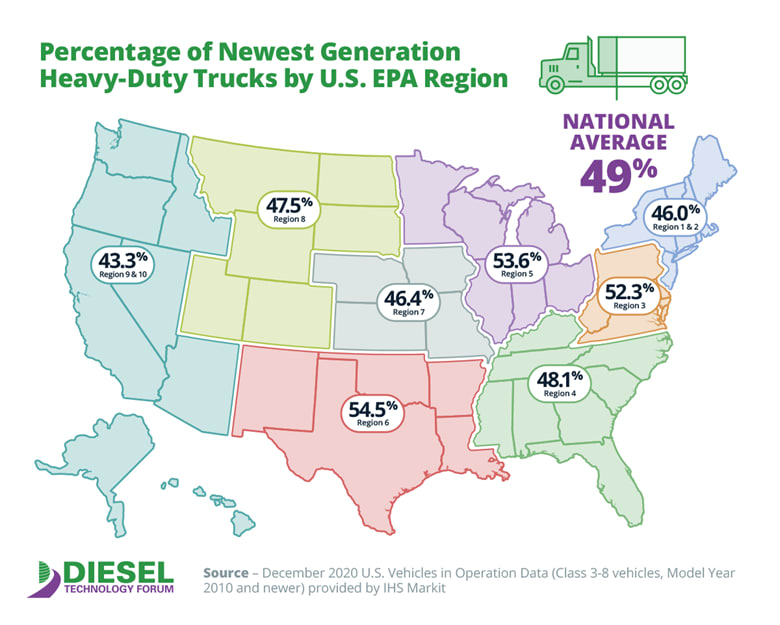
Nationwide, the newest near-zero-emissions diesel trucks now make up almost half of the more than 11 million diesel-powered commercial vehicles on U.S. roads
Image: Diesel Technology Forum
2 min to read
Nearly half the commercial trucks operating in EPA Regions 9 and 10 are now powered by the newest-generation of Near-Zero Emissions diesel engines, according to Diesel Technology Forum ‘s analysis of 2020 U.S. vehicles in operation data (Class 3-8) provided by IHS Markit.
Those two EPA regions take in the entire Southwest and Northwest as well as Hawaii and Alaska. Now standing at exactly 43.3%, the share of new technology diesel trucks in the regions expanded by 6.6% between July 2019 and December 2020.
Nevada and Washington both saw a 19% increase in the number of new technology diesel trucks in operation in their states. California saw a 17% increase in the number of new technology diesels in operation compared to 2019.
Diesel Technology Forum pointed out that beginning in 2010, all new heavy-duty trucks have been equipped with selective catalytic reduction (SCR) and particulate control technologies. DTF said these combine to achieve stringent Environmental Protection Agency emissions requirements for nitrogen oxide (NOx) emissions of no more than 0.20 grams per brake horsepower hour (g/BHP-hr). This is in addition to particulate matter (PM) emissions levels of no more than 0.01 g/BHP-hr.
Almost 50% nationwide
Nationwide, the newest, cleanest, near-zero-emissions diesel truck technologies now make up almost half of the more than 11 million diesel-powered commercial vehicles on U.S. roads, per the DTF analysis.
Since 2007, these newest-generation diesel trucks have eliminated 202 million tons of carbon dioxide (CO2), 27 million tons of NOx, and saved almost 20 billion gallons of diesel and 472 million barrels of crude oil. “Put into context,” DTF said in a press release, “the emissions and fuel savings attributable to new-generation diesel engines in commercial trucks equates to making 43 million cars all-electric or creating 42,000 wind turbines on land five times the size of Washington, DC.”
DTF also noted that by 2030, thanks to the continued increase of newest-generation diesel-powered vehicles, these savings are projected to grow to 1.3 billion tons of CO2, 47 million tons of NOx, 2.7 million tons of PM, 130 billion gallons of diesel, and 3.1 billion barrels of crude oil.
According to Vehicles in Operation Data (2019-2020) from IHS Markit, a total of 15 states are at or above the national average for the percentage of clean diesel Class 3-8 commercial vehicles (all U.S.: 49%) while 23 states are growing their clean diesel fleets faster than the national average (all U.S.: 6.3%) A full state-by-state breakdown is available on the DTF website: https://www.dieselforum.org/in-your-state.
More Fuel Smarts

Electric Yard Tractors Move Beyond Pilots
Operating-cost savings have overtaken sustainability goals as the leading reason surveyed fleets are adopting battery-electric terminal tractors, according to new NACFE research.
Read More →
Geotab Links Fleet Card to Vehicle Data
The new card combines fuel discounts with telematics-based purchase controls. Geotab’s analysis also points to potential savings from choosing lower-priced fuel stops.
Read More →
Fleet Economics Shape Electric Truck Outlook
ACT Research expects costs, charging infrastructure, and technology improvements to drive zero-emission commercial vehicle adoption as federal regulations and incentives retreat.
Read More →

Wex Adds Cardless Fuel Payments for Over-the-Road Customers
A new fuel card feature for Wex customers offers convenience and security.
Read More →
New California Law Could Shed Light on Electric Truck Prices
Why do battery-electric Class 8 trucks remain so expensive? A California bill signed by Gov. Gavin Newsom would give fleets and state agencies more visibility into what manufacturers charge.
Read More →
How Volvo Updated Its D13 for EPA 2027 [Watch]
Volvo’s updated D13 promises lower emissions without sacrificing performance or fuel economy. Take a closer look at what changed inside the engine in this HDT Spotlight video.
Read More →
Diesel Price Spike Shortens Payback for Natural Gas Trucks, Report Says
Energy Vision estimates fleets could recover the higher purchase price of an RNG-fueled Class 8 tractor in 1.3 to 2.8 years under current fuel-price scenarios.
Read More →
Calstart Becomes Catalyst Mobility, Reflecting Broader Focus
Calstart is now Catalyst Mobility, reflecting the nonprofit’s growing national role in clean transportation, including zero-emission trucks, infrastructure and incentive programs.
Read More →
Record Diesel Prices Squeeze Trucking Fleets
Average U.S. diesel prices have climbed to nearly $6 a gallon, surpassing the 2022 record as tight refinery capacity and Middle East disruptions keep fuel costs elevated.
Read More →
Sponsored•September 9, 2026
How Fuel Delivery Shapes Engine Performance
Fuel delivery depends on more than what happens at the injector. For fleet, maintenance and technical professionals, looking at the full path from pump to injector can provide useful context for understanding engine performance.
Read More →