




Accident Specialist Casts Doubt on Reliability of Police Reports
Police accident reports are not reliable enough to determine who’s at fault in truck crashes for the CSA safety enforcement system, according to an accident reconstruction specialist during a CSA advisory panel meeting Tuesday. Washington Editor Oliver B. Patton reports.
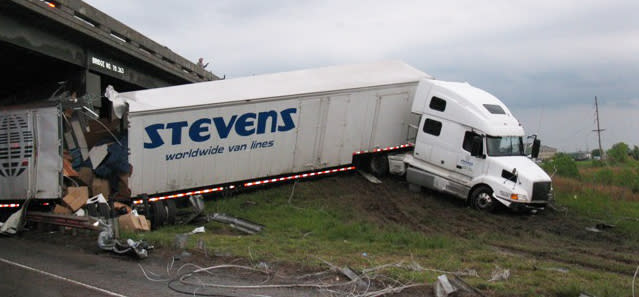
Police accident reports are not reliable enough to determine who’s at fault in truck crashes for the CSA safety enforcement system, according to an accident reconstruction specialist.
Jeffrey Kidd, president of Collision Specialists Inc., told a CSA advisory panel Tuesday that even when the reports are 100% accurate, they are not reliable as a stand-alone source.
Kidd, who was a Georgia state trooper before he started his accident investigation firm in 2005, said there are not enough officers to handle the commercial truck workload and their training is not adequate to the task.
He was speaking to the CSA Subcommittee of the Motor Carrier Safety Advisory Committee, whose meeting is continuing in Alexandria, Va., Wednesday.
The subcommittee is preparing recommendations on a host of CSA issues for consideration by the full MCSAC panel. That panel, in turn, will present a final report to FMCSA later this year.
The committee, composed of representatives from safety enforcement, industry, the safety advocacy community and others, analyzes issues and makes recommendations to the agency. The agency is not obliged to accept the recommendations but the group’s deliberations have become an important part of the agency’s process.
The Crash Accountability Question
Tuesday's discussion of police accident reports was significant because it goes to one of the toughest CSA problems. Right now, the data the agency uses in CSA does not say whether or not the carrier was at fault in a crash.
The CSA Safety Measurement System rates a carrier’s crash history in comparison to other carriers’ history, presuming a certain degree of fault throughout the data. This has led to the conclusion that past crashes are a predictor of future crashes no matter who is at fault.
Trucking interests and others contend that the agency needs to find a way to measure fault, and the agency is studying the issue.
The reliability of police accident reports is one of several areas the agency is examining. It also wants to determine if the benefits of determining accountability are worth the costs, and how to give the public a chance to participate in the evaluation process.
MCSAC’s recommendations will influence the agency’s report, which is due this summer.
On the Ground in Georgia
Kidd, who said he has done 3,500 accident reconstructions, told the panel that in Georgia there simply are not enough trained officers to keep up with the crashes.
There are 500,000 crashes in Georgia each year – an injury crash every five minutes and a fatal crash every seven hours, he said.
The state has 59,000 officers, but not enough are certified North American Standard inspectors, he said. "With the amount of commercial crashes we have each day, the qualified personnel are just not available."
Moreover, the initial training for commercial vehicle crashes covers just the paperwork. It does not touch on trucking basics such as vehicle configurations, licensing, conspicuity, braking or hours of service, Kidd said.
An investigator who’s not trained in electronic control module technology could erase vital data by moving the vehicle, he said.
Moreover, the state does not have enough money for investigation equipment such as cameras, measuring devices, specialized training or uniforms for the dirty job of inspecting the wrecked vehicle, he said.
Inspectors face additional pressures, as well, he added. A thorough examination of a truck wreck can take hours, but states have incentive programs to expedite clearing of the road.
There is no uniformity among the states in reporting or training, although there is a national standard for the information that needs to be gathered, he said.
Another Voice
Another accident reconstruction specialist, consulting engineer James Hrycay of Windsor, Ontario, said that in his experience police reports all cover the same basic information.
Hrycay’s take is that the states have begun a long-term process of improving their accident reporting.
“The emphasis needs to be on making sure officers on the scene are collecting good data,” he said. “Enforcement agencies need to keep up the effort on this issue.”
He would like to see a North American standard for accident reporting, such as exists for truck inspections.
Screening Panel?
One suggestion from the industry for accounting for fault in crashes is to have a panel of experts screen police accident reports to determine who’s to blame.
Subcommittee member Robert Petrancosta, vice president of safety for Con-way Freight, asked Kidd if he thought the idea would work.
Kidd said no, which was the answer Petrancosta later said he was looking for.
“I think it’s inconceivable you can take every DOT reportable accident and run it through a central body … and get clear, accurate, consistent determinations,” he said.
It would be possible to cull out the accidents where a carrier is obviously not at fault, he said. “You could make that determination fairly – but at what expense? There are others where you can’t make it as clearly, and then it becomes a game of chance.”
Con-way’s solution is to put cameras in its tractors, which will give it the data to challenge a police report through the DataQ’s correction process. But Petrancosta acknowledged that this is an expense not all carriers can bear.
“I wish there was this great entity that could be used as a governance body for all accidents, but just the sheer numbers say that isn’t going to happen,” he said.
By Oliver B. Patton, Washington Editor
More Safety & Compliance

FMCSA Pauses Biennial-Update Enforcement Amid Motus Transition
Carriers whose updates were due on or after June 1 have more time, while FMCSA works to stabilize its new registration system and warns of phishing sites impersonating its new carrier registration system, Motus.
Read More →
ZF Expands Commercial Vehicle Push in North America
ZF is expanding its North American commercial-vehicle presence with new transmission applications, electrification, trailer technology and autonomous-driving systems.
Read More →
Truck Drivers Need More Than Another Alert
Fleets have more visibility into truck health, safety events, and driver activity than ever. The next challenge is turning all that information into useful guidance for the person who has to decide what to do next.
Read More →
Tesla Wants a Self-Driving Semi. Are Cameras Enough?
Could Tesla’s camera-only autonomous driving technology work on an 80,000-pound Semi? In this commentary, HDT's Deborah Lockridge takes a look at Tesla, Cybercab, and how autonomous trucks see the road.
Read More →
What DOT’s Automated Vehicle Strategy Means for Trucking
The U.S. Department of Transportation issued a new automated-vehicle strategy that outlines plans for driverless-truck regulations, cross-state freight corridors, and federal safety standards.
Read More →
NYC Expands Speed, Pedestrian Safety Tech Across Fleet
New York City is expanding intelligent speed assistance and pedestrian-alert systems across its municipal fleet, moving the technologies from pilot programs into vehicle procurement and retrofit requirements.
Read More →
FMCSA Removes 110 Truck Driver Training Schools from Certified ELDT List
Federal regulators also are targeting more than 160 additional training providers and launching a nationwide audit of third-party CDL skills testers as part of a broader crackdown on trucking fraud.
Read More →
Beyond DOT Compliance: What Makes a Trucking Fleet Truly Safe?
A trucking fleet can follow every rule and still make unsafe decisions. The real test comes when safety conflicts with freight, productivity, or cost.
Read More →
Hours of Service Pilot Programs: FMCSA Readies for 2027 Rollout
Two pilot programs could eventually reshape hours-of-service rules, giving truck drivers options to pause their 14-hour clock or use longer split sleeper rest periods.
Read More →
New Guide Offers Pet Safety Tips for Truck Drivers
Hundreds of thousands of pets travel in truck cabs. A new safety guide from Volvo Trucks and the Center for Pet Safety offers practical advice for truck drivers who bring dogs and cats along for the ride.
Read More →