




5 Things Motor Carriers Need to Know about LTL Freight Classification Changes
Significant changes in the National Motor Freight Classification system will impact less-than-truckload fleet operations in 2025. Are you ready?

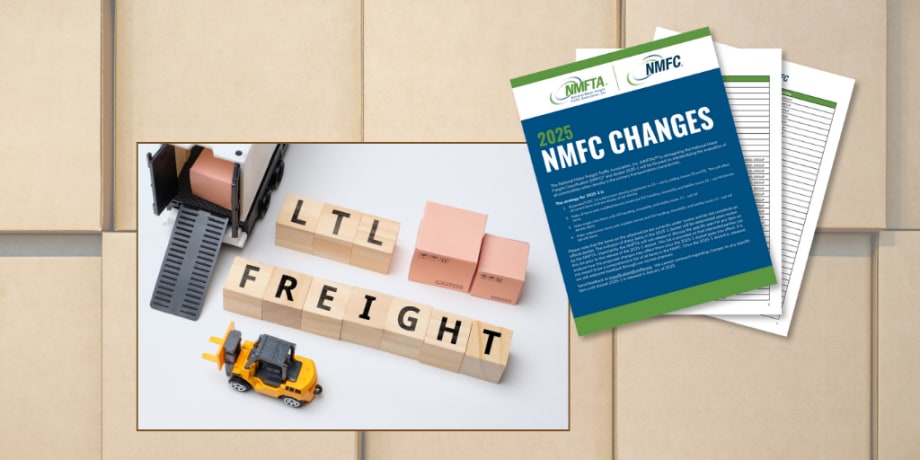
2025 will bring changes to how less-than-truckload freight is classified.
Image: HDT Graphic
It’s imperative that freight moves safely, efficiently, and is cost-effective. But this is slightly more complex for those who transport less-than-truckload freight, as there are other important factors: ensuring commodities are classed correctly and that the shipment size and/or weight is accurately determined to allot proper space in a trailer.
With all of the commodity types that are shipped every day, it is important to know how to determine the freight class of most items — if cargo is labeled as the wrong freight class, this can interfere with logistics when loading LTL shipments.
Since 1935, the National Motor Freight Traffic Association's National Motor Freight Classification (NMFC) has been the standardized system in North America that classifies freight for LTL shipping purposes. It simplifies how carriers and shippers determine shipping costs and procedures.
For those unfamiliar with the system, currently the NMFC assigns a freight class based on four criteria:
Density
Handling
Stowability
Liability
Based on a combination of these characteristics, a freight shipping class is assigned, ranging from 50 to 500.
There are 18 separate classes ranging within these values, with lower numbers indicating cargo that is more favorable to ship. Freight that is in a higher freight class will also have a higher shipping cost, owing to its difficulty to ship.
Changes Are Coming to LTL Freight Classification
But as of 2025, the freight classification system will undergo significant changes, and your trucking fleet operations must be prepared.
“We have re-evaluated the current freight classification system so it reflects the current state of LTL freight transport,” said Keith Peterson, director of operations for NMFTA. “Major changes are set to take place in 2025 and we need those who transport LTL freight to be aware.”
The new NMFC will be easier to use and understand, according to NMFTA. Classifying freight will be more accurate on the first try.
To ensure all users are in the know, the NMFTA and NMFC hosted hour-long LTL Listening Sessions for carriers, shippers, and third-party logistics providers (3PLs), respectively in early August.
Attendees gained in-depth insights on the changes, asked questions directly to NMFTA representatives, and shared experiences that can help shape the future of the NMFC and its online classification tool, ClassIT.
5 Things You Need to Know About the New LTL Classifications
1. The NMFC changes will directly impact carriers, shippers, and third-party logistics providers (3PLs) who ship LTL freight.
2. The overall goal of the NMFC changes is to ultimately reduce any friction between carriers, shippers, and 3PLs as they work alongside one another to effectively and efficiently transport products to the desired end destination.
3. The NMFC changes will take place in a phased approach, with the first set of changes coming in Docket 2025-1. Here's a summary:
Standardized density scale for LTL freight with no handling, stowability, and liability issues.
Unique identifiers for freight with special handling, stowability, or liability needs.
Condensed and modernized commodity listings.
Improved usability of the ClassIT, the NMFC’s online classification tool.
4. NMFTA has several resources to help motor carriers prepare for the change:
NMFTA's NFMC changes page, where you can download the list of changes and access frequently asked questions.
5. You'll need to spread the message to your shippers to ensure they’re informed of the changes.
More Fleet Management

Color Match Smarter: Tools That Restore & Perform
For fleet managers and collision repair professionals keeping heavy-duty trucks on the road, getting the color right the first time isn't just about appearance — it's about efficiency, turnaround time, and bottom-line results. Discover how today's digital color tools are transforming the repair process from guesswork to precision.
Read More →
FMCSA Pauses Biennial-Update Enforcement Amid Motus Transition
Carriers whose updates were due on or after June 1 have more time, while FMCSA works to stabilize its new registration system and warns of phishing sites impersonating its new carrier registration system, Motus.
Read More →
2026 Blueprint for Countering Smarter Supply Chain Theft
Cargo theft is no longer just the cost of doing business. It's a multi-billion-dollar criminal enterprise exploiting vulnerabilities across your fleet, drivers, and supply chain.
Read More →


How Telematics Improves Visibility, Control, and Performance in Refrigerated Fleets
Explore how telematics help refrigerated fleets improve visibility, uptime, efficiency, compliance, and cargo protection across connected cold chain operations.
Read More →
What the U.S.-Canada Trade War Means for Trucking
Escalating U.S.-Canada tariffs could disrupt cross-border freight, reduce truck volumes, raise costs, and create new uncertainty for carriers on both sides of the border.
Read More →
What Are Trucking’s Top Concerns for 2026?
The American Transportation Research Institute wants to know what's worrying trucking fleet managers, drivers, and other stakeholders in its annual Industry Issues survey.
Read More →
American Trucking Associations Looks for a New Leader
ATA President and CEO Chris Spear abruptly left his job at the association on August 21, at a pivotal time for the trucking industry.
Read More →
Public Wi-Fi Cybersecurity Risks: How Truck Drivers and Fleets Can Protect Their Data
Public Wi-Fi can expose truck drivers and fleets to credential theft, malware, and other cyber threats. Here’s how to reduce the risk on the road.
Read More →
For Nicky Cupp, Fleet Innovation Starts With Frustration
HDT Truck Fleet Innovator Nicky Cupp turns everyday pain points at Fraley & Schilling into opportunities for better technology and smarter processes.
Read More →
Adam Buttgenbach’s Approach to Electric Trucks: Start With Where They Fit
HDT Truck Fleet Innovator Adam Buttgenbach helped PepsiCo build one of North America’s largest EV fleets by focusing on where electric trucks make operational sense.
Read More →